コンテンツ
アッシェンブレナーがNVIDIAを「空売り」した本当の意味 ― 本命はBloom Energy・SanDisk・CoreWe...
アッシェンブレナーが「本当に」買っているもの
16億ドルのNVIDIAプット ― なぜ「ヘッジ」と読むのが妥当か
他の有力投資家4人 ― それぞれの「AI買い方」
NVIDIA一本足にせず、AI資産を組み立てる5つのチャネル
スマートマネーを「追う」のはOK、「コピー」はNG

市場が複雑すぎますか?Edgen Searchに聞いてみてください。

答えはすぐに表示され、情報は正確で、あなたが未来を決めるトレーディング判断を下せるようにします。

今すぐ Search を体験

アッシェンブレナーがNVIDIAを「空売り」した本当の意味 ― 本命はBloom Energy・SanDisk・CoreWeaveのAIインフラ3銘柄

Edgen
· May 21 2026
アッシェンブレナーがNVIDIAを「空売り」した本当の意味 ― 本命はBloom Energy・SanDisk・CoreWeaveのAIインフラ3銘柄

アッシェンブレナーがNVIDIAを「空売り」した本当の意味 ― 本命はBloom Energy・SanDisk・CoreWeaveのAIインフラ3銘柄

By Edgen Research | 2026-05-21 対象ティッカー: $BE, $SNDK, $CRWV, $GOOGL, $MSFT, $AVGO, $NVDA | 関連: $BRK.B, $AMD, $MU, $TSM

世界のトップ投資家は、いま実際に何を買っているのか? 5月15日に出そろった2026年第1四半期の13F報告書は、ここ数年で最も明確な答えを示した。主要ファンドは例外なくAI関連へのエクスポージャーを増やしている。違いは「どう買っているか」だけだ。

最も話題になったのが元OpenAI研究員 レオポルド・アッシェンブレナー ― 著名なエッセイ『Situational Awareness』で知られ、現在は Situational Awareness LP を運用する人物だ(2026年3月の SEC Form ADV ベースで規制AUMは92.8億ドル、うち米国株のロングポジション開示分が55.2億ドル)。一部メディアは「アッシェンブレナーが84.6億ドル相当のAIチップを空売り」と報じた。これは形式的には正しいが、実態を誤解させる見出しである。彼が実際に「キャッシュを投じて買った」のは、AIブームを下支えする電力・メモリ・データセンター容量といったインフラ層だ。NVIDIAなど半導体に対する84.6億ドルのプットは、AIロングを守るためのヘッジである可能性が極めて高く、AIそのものに賭ける弱気ポジションではない。

長期でAI関連の資産形成を考えるなら、彼の買いリストと、他4人の有力投資家が動かしているお金の方向こそ、はるかに役に立つ地図になる。

アッシェンブレナーが「本当に」買っているもの

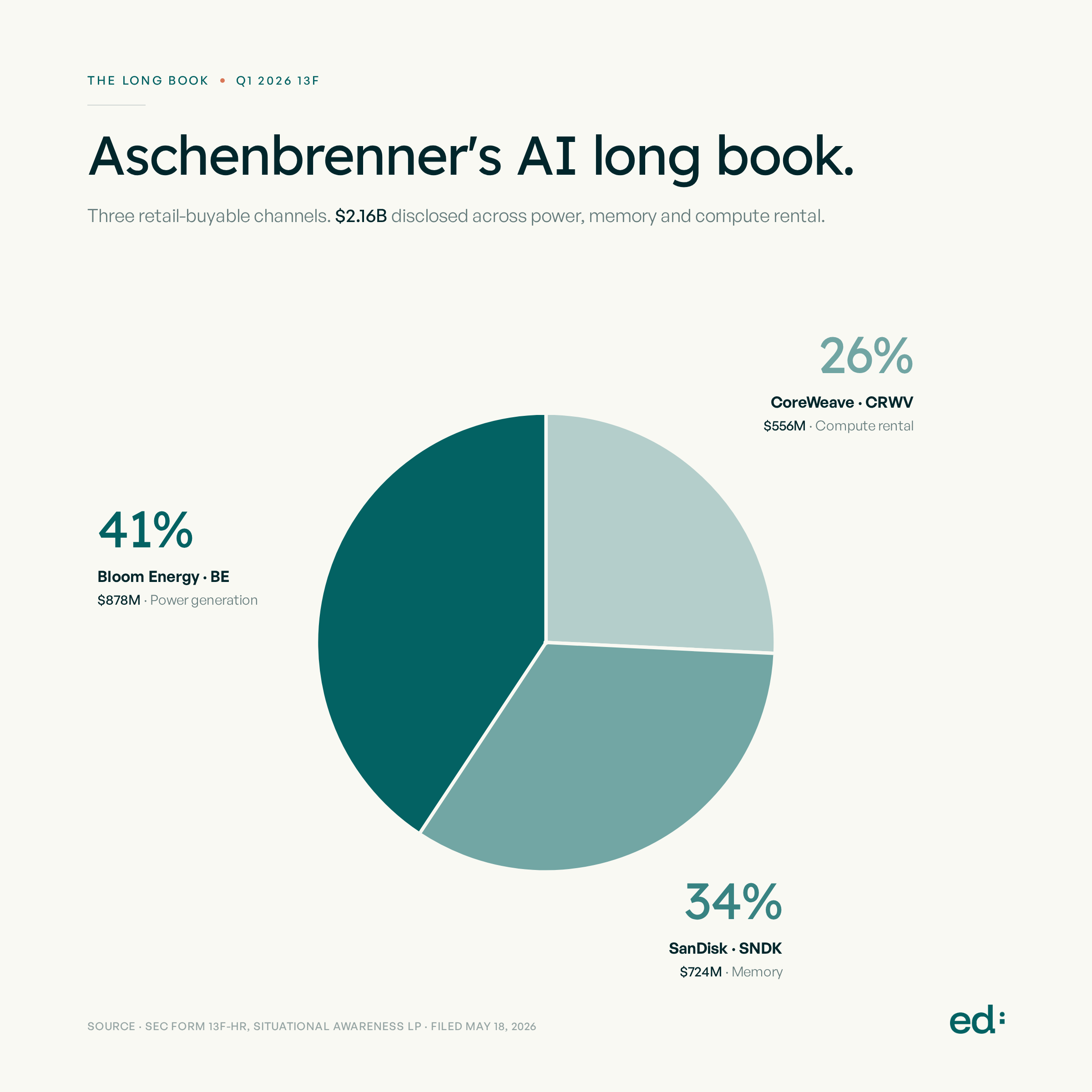
派手な空売り報道の裏側では、彼のポートフォリオは圧倒的にロングに傾いている。買っているのはAIインフラの中核だ。

ポジション 規模 エクスポージャーの中身
Bloom Energy (BE) 8.78億ドル オンサイト発電 ― 新規AIデータセンター建設の最大のボトルネック
SanDisk (SNDK) 7.24億ドル NANDフラッシュメモリ ― AIチップ装置の「もう半分」
CoreWeave (CRWV) 5.56億ドル AI向けGPUレンタル ― AI計算需要が直接売上に乗る事業
暗号資産マイナー(CLSK / RIOT / APLD / IREN) 買い増し 既存データセンターと電力契約をAIホスティング向けに転用
その他ロング(13Fで開示) 約34億ドル 米国株ロング合計は約55.2億ドル規模

共通項: NVIDIAの株価が「いまこの瞬間に妥当か」とは無関係に、AIの規模が拡大すれば確実に消費されるものを抱え込んでいる、という構造だ。彼自身、ファンド立ち上げのきっかけとなった2024年のエッセイでこう書いている。

「この1年で、会議室の議題は『100億ドル規模のクラスタ』から『1000億ドル規模』、そして『1兆ドル規模』へと跳ね上がった。半年ごとに桁が1つずつ増えていく。」 ― レオポルド・アッシェンブレナー『Situational Awareness: The Decade Ahead』(2024年6月)

計算リソースが本当にこの速度で膨張すると信じるなら(アッシェンブレナーはそう信じ、92.8億ドルのファンドはその前提で組まれている)、勝つのは「最も付加価値を取るチップメーカー」ではなく、インプットを売る側の企業になる。

Aschenbrenner's AI Long Book — 3 retail-buyable channels: Bloom Energy 41%, SanDisk 34%, CoreWeave 26%
Source: SEC Form 13F-HR, Situational Awareness LP, filed May 18, 2026 — Aschenbrenner's three disclosed AI infrastructure positions, equity values at market.

しかも、これら3銘柄はいずれも個人投資家が普通の証券口座で買える。 ヘッジファンドの16億ドル規模のオプション戦略を真似することはできなくても、ロング側はそのまま個人投資家にとっての3本柱として参考にできる。

16億ドルのNVIDIAプット ― なぜ「ヘッジ」と読むのが妥当か

ここがメディアの大半が読み違えたポイントだ。13F報告書のフォーマットは、オプションのポジションを実際のコストよりはるかに大きく見せてしまう。

13Fに載る数字 実際の意味
「NVIDIAに16億ドルのプット」 プット行使時に対象となる株式の額面であって、支払った金額ではない
「半導体プットバスケット計84.6億ドル」 同上 ― 原資産の株式評価額の合計
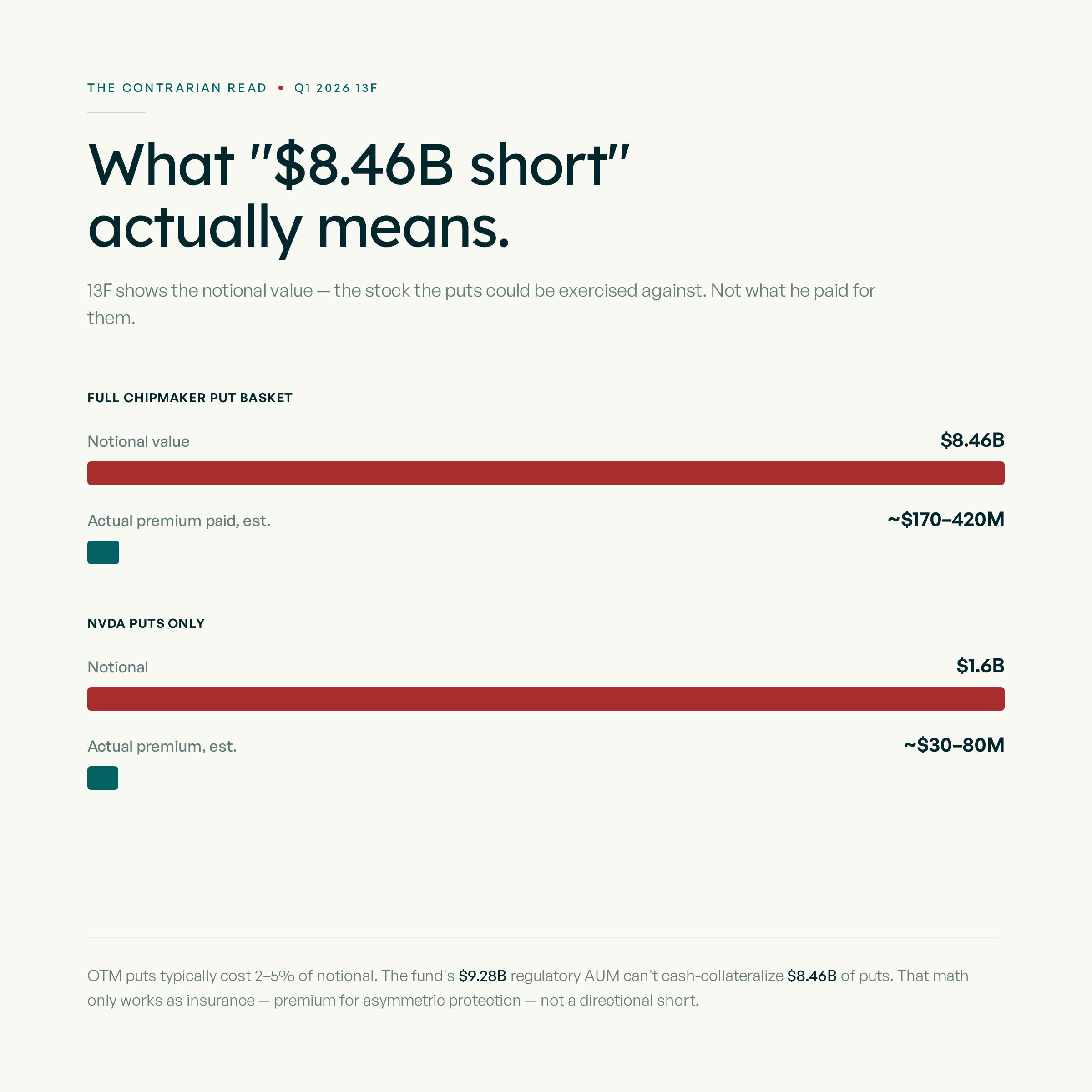
見えない情報: 実際に払ったプレミアム 業界の感覚値ではアウト・オブ・ザ・マネー(OTM)プットのプレミアムは想定元本の2〜5%程度。つまり84.6億ドルの想定元本に対し、実コストは1.7〜4.2億ドル程度と推測される

もうひとつ、構造面で動かぬ証拠がある。規制AUMが92.8億ドルしかないファンドが、84.6億ドルのプットを現金で担保することは数学的に不可能だ。この数字が成立するのは、プレミアムだけ払って非対称のリターンを取る、いわゆる保険として組まれている場合に限られる。NVIDIA単体に絞ると、16億ドルの想定元本に対する実際のプレミアムは約3,000万〜8,000万ドルにとどまるだろう。これは55.2億ドル規模のAIロングブックに対する標準的なヘッジサイズだ。プットはロングを守るために存在している。

Why '$8.46B short' is misleading — notional vs actual premium paid: full chipmaker put basket $8.46B notional vs ~$170-420M premium; NVDA puts $1.6B notional vs ~$30-80M premium
Aschenbrenner's chipmaker put basket as notional vs estimated actual premium. OTM puts typically cost 2-5% of notional. The fund's $9.28B regulatory AUM cannot cash-collateralize $8.46B of puts — supporting the hedge interpretation.

比較するとわかりやすい。

  • 本当に16億ドルをNVIDIAの下落に賭けたなら、現金16億ドルを使った株式ショートとして開示されるはずだ。実際はそうなっていない。
  • 彼がやったこと: 小さなプレミアムで、もし半導体が崩れたら大きく払い戻される、そうでなければほぼゼロで失効する ― 典型的な「AI強気派のヘッジ」構造である。

メディアの解釈は割れている。Hedge Fund Alpha は「AIチップに対する85億ドルの賭け」と書き、TrendSpider は「AIインフラのロングを保有したままかけている半導体プットの想定元本」と慎重に表現した。我々は後者の読み方を支持する。本当の確信は、現金を投下したロングブックの方に出ている。

他の有力投資家4人 ― それぞれの「AI買い方」

同じレンズで第1四半期13Fシーズン全体を見直すと、各ファンドが「長期的にどこへエクスポージャーを取りに行っているか」がはっきりする。

投資家 エクスポージャーを取っている対象 本人の言葉
グレッグ・アベル(バークシャー・ハサウェイ ― バフェットの後継者として初の13F提出) Google(Alphabet)を4倍に拡大(+204%で約230億ドル)、デルタ航空、NYタイムズも保有 バフェットとマンガーは長年、Googleを「最大の機会損失」と公言してきた。アベルの+204%はその穴埋め ― 半導体サイクルではなく広告キャッシュフロー経由でAI需要を取りに行く判断だ
ビル・アックマン(パーシング・スクエア) Microsoftを新規購入(20.9億ドル相当)、Amazon買い増し、Googleは95%売却 5月15日のX投稿: 「Microsoftの365とAzureは、企業向けITで最も価値あるフランチャイズの2つだ」 ― エントリー水準は予想PER 21倍、市場平均並みのバリュエーション
ナンシー・ペロシ(米下院議員開示) NVIDIAおよびBroadcomの深い ITM コール PTR(議員資産取引報告)に表れる定番パターン ― 行使価格が大きく下にあるコールで、株式と同等の上値を約3割の自己資本で取りにいくAI強気の高レバレッジ戦略
ドナルド・トランプ(大統領倫理局 OGE 開示) NVIDIA、Microsoft、Broadcom、Amazon、Appleを各100〜500万ドル保有。Amazon・Meta・Microsoftの大口売却も実行 トランプ・オーガニゼーション声明: 「資産は第三者機関による完全一任口座で運用されている」。一方、90日間で3,642件の個別売買が記録されている事実は別の物語を語る

全有力投資家の最新ポートフォリオを見る ― Edgen Whale Holdings →

NVIDIA一本足にせず、AI資産を組み立てる5つのチャネル

6人の動きを横断して読み取れる結論はひとつ。スマートマネーは「チップ1銘柄」ではなく、複数のチャネルを通じてAI関連エクスポージャーを組み上げている。 これから5〜10年スパンでAIに乗りたい個人投資家は、NVIDIAの次の決算に全資産を賭ける必要はない。

5 channels to build AI exposure: Software margins (MSFT, GOOGL); Power generation (BE); Memory & storage (SNDK, MU); Compute rental (CRWV + miners); Chip leaders (NVDA, AVGO — highest beta, valuation risk)
Five channels smart money is using to build AI exposure across Q1 2026 13F filings. Each channel maps to a retail-buyable ticker set.

1チャネルに絞る必要はない。先ほど紹介したスマートマネー筋の大半は、複数チャネルを組み合わせて保有している ― それが長期資産形成における「AI配分」の現実的な姿だ。メモリ周りをさらに深掘りしたい方はSK Hynix / Micron 特集記事でHBMサイクルがいかにメモリ銘柄を再評価しているかを掘り下げている。

スマートマネーを「追う」のはOK、「コピー」はNG

13F報告書は実際の売買から45日遅れて開示される。ペロシをコピーした時点で、彼女のタイミングはすでに6週間古い。13Fを見てから動いてもポジションがすでに反対に回っている可能性すらある。

賢い使い方は、スマートマネーが繰り返し現れる場所のパターンを観察することだ。Edgen Whale Holdings は SEC への提出書類を着信ベースで追跡しており、個人投資家が「本物のお金がどこへ流れているか」を最短で見られる手段に近い。

今四半期のパターンははっきりしている ― 電力、メモリ、ソフトウェアの利益率、データセンター容量。アッシェンブレナーはこの4つすべての内側にいる。NVIDIAプットは、その背中にかける保険にすぎない。

本記事は調査・教育目的であり、個別の投資助言ではありません。一次情報: 2026年5月15〜18日に提出された Berkshire Hathaway、Pershing Square Capital Management、ARK Investment Management、Situational Awareness LP の SEC Form 13F-HR、米下院書記局のナンシー・ペロシ議員 PTR、ドナルド・J・トランプ大統領の OGE Form 278-T(2026年5月8日認証、5月12日受理)。二次情報: Quiver Quantitative、TrendSpider、Hedge Fund Alpha、Seeking Alpha、WhaleWisdom、CNBC、Benzinga。投資判断の前に最新データを確認してください。Edgen および寄稿者は本記事で言及した有価証券のポジションを保有することがあります。

紹介
Redeem miles for gift cards and each is worth ~1 cent; redeem for long-haul business and they're worth 2.5-4+. With programs now dynamically priced, the one check that decides every redemption.

How to redeem airline miles without wasting them

The single biggest mistake with miles is redeeming them for the easy stuff: gift cards, merchandise, seat upgrades at the gate. Do that and each mile is worth about one cent. Redeem the *same* miles for flights, especially long-haul or premium-cabin flights, and they're often worth two to five cents each, sometimes more. So the real skill isn't earning miles; it's not throwing away their value at the finish line. Here's how to actually use them. A mile has no fixed price; its value depends entirely on what you redeem it for. The way to judge any redemption is simple math: (cash price of the flight) ÷ (miles it costs) = cents per mile. If a flight costs $400 or 20,000 miles, that's 2 cents a mile, a solid deal. If a $90 flight costs 18,000 miles, that's half a cent, which is terrible; pay cash and keep the miles. Run this check before every redemption. It instantly separates a great use from a waste, and it's the one habit that makes miles worth having. As a rule of thumb, most major ai
Edgen
·
Jun 30 2026
Short-term goals (under ~3 years) belong in safe cash; long-term goals (5+ years) can take market risk. The best HYSAs now pay ~4-5% APY. How to sort yours and run both.

Long-term vs short-term financial goals (and how to plan both)

The difference comes down to one thing: time. A short-term goal is money you'll need within roughly three years (an emergency fund, a trip, a wedding, next year's tax bill), so it has to be *safe and reachable*. A long-term goal is five-plus years out (retirement, a house down the road, a kid's education), so it can take market risk, because time smooths the bumps out. Get that match right and you've done most of the work. It's not the size, it's the deadline. A $2,000 goal you need in six months is short-term; a $2,000 goal you won't touch for fifteen years is long-term, and they belong in completely different places. This is the part that actually matters, and where people lose money without realizing it. Short-term money should not be in the stock market. If your emergency fund is in stocks and the market drops 20% the same month your car dies, you're selling at the worst possible time. Short-term goals go somewhere stable and accessible, and a high-yield savings account is the clas
Edgen
·
Jun 30 2026
Mortgages near 6.5%, home prices flat, and the Fed split on rate cuts vs hikes. With timing a coin flip, the 3 questions that actually decide whether to buy now or wait.

Should you buy a house now or wait? How to actually decide

The honest answer: buy when you'll stay put for at least five years and you'll still have an emergency fund left after the down payment. Otherwise, waiting (and renting) is often the smarter money move, not the weaker one. "Rent vs buy" isn't a math problem with one right answer, and it's almost never really about timing the market. It's about your *life*, in three questions. Before the three questions, here's the mid-2026 backdrop — because "now or wait" usually hides a bet on rates and prices, and the data says that bet is a coin flip. The picture: mortgages are still pricey, prices have gone flat (more than half of the 20 big metros saw year-over-year declines in March), and the cheap-money era hasn't returned. So "buy before it runs away" and "wait for the crash" are *both* weak arguments right now. The whole "wait for rates to drop" plan rests on the Fed, and the Fed is split down the middle. In its June 2026 projections, policymakers were divided: 8 expected no change this year,
Edgen
·
Jun 30 2026
Most financial goals fail because they're wishes, not systems. Here's the 3-part anatomy of a goal that sticks (a number, a date, one automatic move), plus why 37% of adults can't cover a $400 surprise.

How to set financial goals you'll actually hit

A financial goal you'll actually hit has three things a vague wish doesn't: a number, a date, and one automatic move that happens whether or not you remember it. "Save more" is a wish. "$6,000 in a separate account by next December, $500 auto-transferred on payday" is a goal. The gap between those two sentences is the reason most goals quietly die, and it has almost nothing to do with willpower. Key Takeaways A real financial goal answers three questions: how much, by when, and what for. Drop any one and it stops working. "Pay off debt" has no number and no date, so there's nothing to aim at or measure, while "$8,000 of card debt cleared in 18 months" tells you exactly whether you're on track and the day you're done. The "what for" matters more than people expect. A goal tied to something real (a buffer so a bad month isn't a crisis, a deposit on a first place) survives the months when motivation dips. In our experience reading how people actually use a money tool, the goals that get
Edgen
·
Jun 30 2026
A big RSU grant just vested — now what? Here's what a modern money tool actually surfaces first, using Ed as a worked example: a reality check, the 22% tax gap most high earners miss, and the concentration risk nobody flags.

Your RSUs Just Vested. Here's What a Money Tool Surfaces First.

You just had a big RSU grant vest. Congratulations — and now the awkward part: a six-figure pile of your own company's stock, a vague sense you should "do something," and no one actually telling you what. An advisor, a spreadsheet, and a piece of software each handle this moment differently. Here's what a modern money tool surfaces in a moment like this — using Ed as a worked example — so you can decide what kind of help actually fits. Key takeaways You connect your brokerage and bank through read-only aggregation, so the tool can read balances but can't move a dollar. Ed's framing is simple: precise about your money, blind to your identity. Instead of sorting your lattes into categories, Ed opens on a single Financial Reality Check — a read on whether your money could survive a bad month. For a lot of high earners, that one number lands harder than any budget, because it answers a question the other apps never ask. (If the Reality Check is the numbers side, your money type is the beha
Edgen
·
Jun 26 2026
A money personality test is more than a quiz if it measures behavior, not just vibes. Here's the science behind money types, how Ed's test works, and how to use your result.

What Is a Money Personality Test? The Science Behind Your Money Type

The short version: a good money personality test should feel like a roast and work like a mirror — fun on the surface, behavioral underneath. The useful ones don't tell you what you know; they show you how you act with money, and the one blind spot worth watching. Key takeaways Here's the uncomfortable backdrop. U.S. financial literacy has been stuck for a decade — adults answer only about 49% of the standard knowledge questions correctly, essentially flat since 2017 (TIAA Institute–GFLEC, 2025) — even as free financial information became infinite. If facts fixed money, they'd have fixed it by now. They don't, because the thing that actually drives your outcomes lives one level below the facts: how you're wired to behave when money is on the line. That's the whole premise of financial fitness — and it's what a money personality test is built to surface. Not what you know. What you do. The idea has real research behind it — money behavior is patterned and measurable, and a few tradition
Edgen
·
Jun 23 2026
A financial reality check scores where you actually stand across safety, control, progress, upside, and Mental Load. Here's why a money score matters, how Ed's checkup works, and what to do with your weakest area.

What Is a Financial Reality Check? Why Your Credit Score Isn't Enough

The short version: your credit score measures how safe you are to lend to. Almost nobody has ever seen the number that measures whether you are actually secure. A financial reality check is that second number. Key takeaways Ask people for their credit score and many can recite it. Ask whether they could survive three months without income, or where their money quietly leaks each month, and you get a shrug. That's the gap. A credit score answers a lender's question — how risky is it to extend this person debt? It can be high while your life is fragile, or low while you're genuinely fine, because it was never built to measure you. A financial reality check answers the question the credit score ignores: are you safe, clear, progressing, building, and at ease? Here's the simple version, with the research behind each axis.
Edgen
·
Jun 23 2026
SpaceX opens Thursday at a $1.77 trillion valuation — the largest IPO ever. Only 4.2% of stock actually trades. Musk is locked up for 366 days. The next 366 days run on an unusually clean calendar of supply releases. Here are the 13 dates worth watching.

SpaceX goes public Thursday with a possible $5 trillion hit. Here's the calendar that actually matters.

SpaceX prices Wednesday night and opens Thursday on Nasdaq at $135 per share — a $1.77 trillion valuation, the largest IPO ever. Most coverage will frame what comes next as a sentiment trade, an Elon story, or a race to Goldman's $5 trillion bull case. The reality is more grounded and more useful: the next 366 days are governed by an unusually clean calendar of supply releases — when 95.8% of the company can or cannot trade, when index funds add weight, when the lock-up cliff arrives, when Musk himself becomes a potential seller for the first time. Read the calendar and you've already understood the structure most market commentary will spend the next quarter trying to explain. Here are the 13 dates worth watching. Two things keep showing up in headlines that don't survive a careful read. The first is the idea that index funds are about to be forced into a massive single-event SpaceX buy. They aren't. Nasdaq did create a fast-track inclusion rule that lets SpaceX join the Nasdaq 100 wi
Edgen
·
Jun 10 2026

投資、もうひとりじゃない

Ed を無料で試そう。クレカ不要、縛りなし