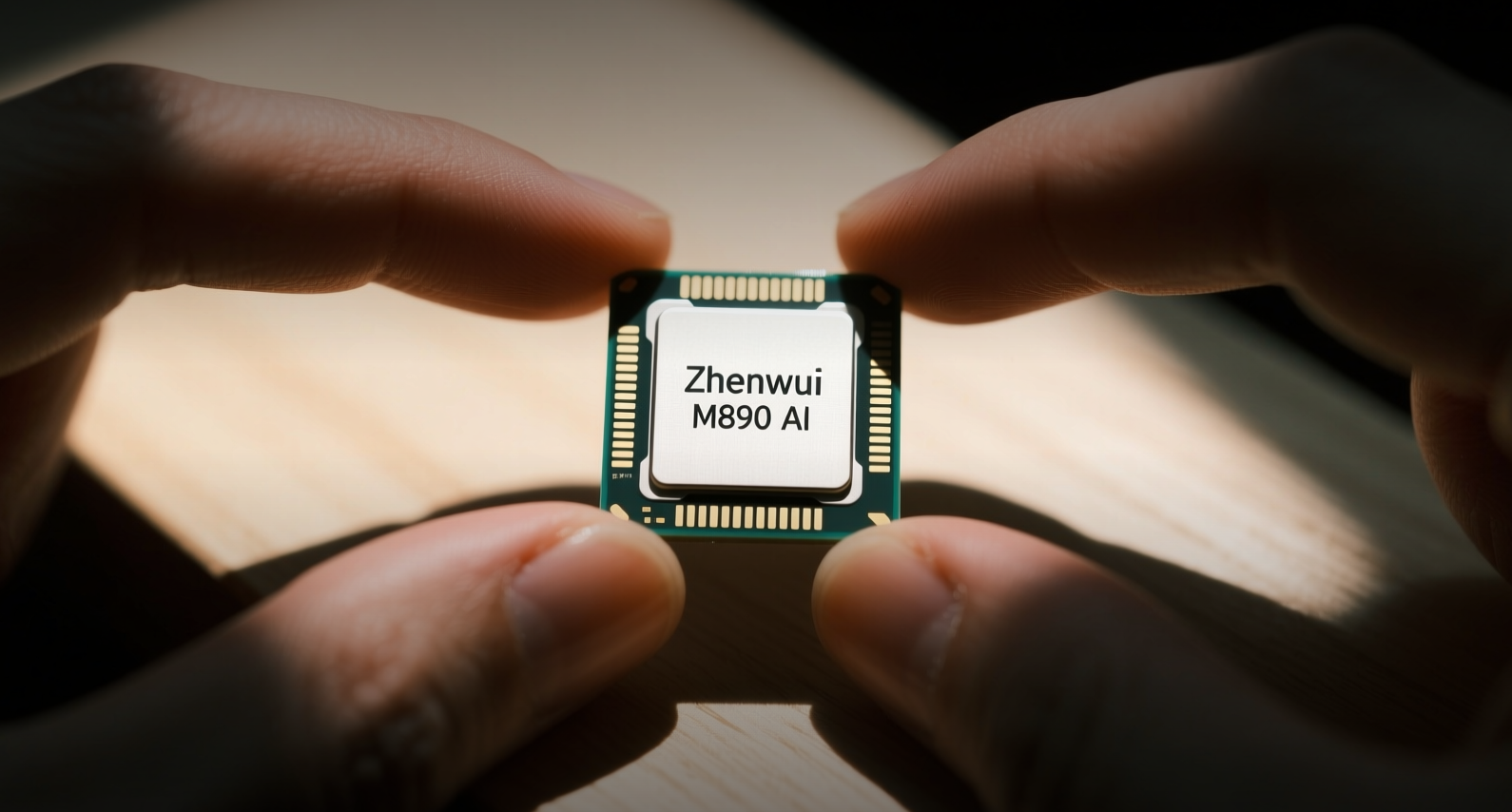
Alibaba's homegrown AI chip and server rack are now among the most recognized infrastructure products in China's AI buildout.
Alibaba Group Holding Ltd.'s self-developed Zhenwu M890 AI chip and Panjiu AL128 supernode server won a top "Treasure of the Hall" award at the 2026 World Artificial Intelligence Conference, the company said July 17.
"This recognition validates our approach of building vertically integrated AI infrastructure from chip to cluster," a T-Head spokesperson said.
The Zhenwu M890 packs 144 gigabytes of HBM memory with 800 gigabytes-per-second chip-to-chip interconnect bandwidth, supporting data precision from FP32 down to FP4. The Panjiu AL128 server crams 128 chips into a single rack using an orthogonal cable-less architecture and Alibaba's proprietary ALink System interconnect, delivering petabyte-per-second bandwidth with sub-100 nanosecond latency — a 50% inference performance improvement over traditional eight-GPU server architectures, according to Alibaba.
The win comes as Alibaba has deployed more than 56,000 Zhenwu chips across 400-plus customers in 20 industries including autonomous driving, finance and energy, making it the most widely deployed domestic AI chip in China by application scope. The company is betting its in-house silicon can reduce reliance on Nvidia Corp. GPUs, which remain constrained by US export controls.
Zhenwu M890 closes the gap with Nvidia's mainstream lineup
The Zhenwu M890's 144 GB HBM memory capacity matches Nvidia's H100 (80 GB HBM3) and approaches the H200's 141 GB, though Nvidia's upcoming Blackwell B200 is expected to double that. Alibaba's chip supports FP4 precision for low-power inference — a feature Nvidia introduced with the Blackwell architecture — suggesting T-Head has closed the feature gap by at least one generation.
The Panjiu AL128's 128-GPU single-rack density far exceeds the standard eight-GPU server configuration used in most data centers today. By eliminating cables through orthogonal backplane design, Alibaba claims interconnect costs drop 80% compared with traditional architectures. The server uses liquid cooling to manage the thermal load of 128 densely packed chips.
Alibaba's chip strategy mirrors those of Amazon.com Inc. (Trainium, Inferentia), Google LLC (TPU) and Microsoft Corp. (Maia), all of which have developed custom silicon to reduce dependence on Nvidia, which commands an estimated 80% of the AI accelerator market. Unlike US hyperscalers, however, Alibaba faces the additional constraint of US export controls that block shipments of Nvidia's H100 and Blackwell chips to China, forcing domestic alternatives.
56,000 chips deployed, but the real test lies ahead
The 56,000 Zhenwu chips deployed to date represent a fraction of the hundreds of thousands of accelerators that Chinese tech giants are racing to install. Huawei Technologies Co.'s Ascend 910B has emerged as the leading domestic alternative, while startups like Enflame and Cambricon are also competing for cloud and enterprise contracts.
Alibaba's chip has an advantage in software ecosystem: the Zhenwu runs on the same programming framework as Alibaba Cloud's PAI platform, which already serves millions of developers. Nvidia's CUDA remains the industry standard, but Alibaba's ability to offer an integrated hardware-software stack — chip, server, cloud platform and model training service — gives it a moat that pure-play chip startups lack.
The WAIC award, selected from more than 3,000 products exhibited at the conference, signals that China's AI infrastructure ecosystem is maturing beyond reliance on imported silicon. For Alibaba, whose cloud computing unit competes with Huawei Cloud and Tencent Cloud for enterprise AI workloads, the Zhenwu-Panjiu combination represents a potential differentiator in a market where hardware availability is increasingly a competitive bottleneck.
Alibaba shares trade at about 10 times forward earnings. The company does not disclose Zhenwu chip revenue separately, but analysts at Jefferies estimated in June that Alibaba's in-house chip program could save the company $1.5 billion to $2 billion annually in GPU procurement costs by 2028 if deployment scales as planned.
This article is for informational purposes only and does not constitute investment advice.