Goldman Sachs raised its humanoid robot market forecast fourfold, projecting 6.5 million units shipped by 2035 and a $138 billion opportunity, with warehouse logistics and auto assembly lines first to deploy.
Goldman Sachs raised its global humanoid robot shipment forecast fourfold to 6.5 million units by 2035, a $138 billion market, with warehouse logistics and automotive assembly identified as the earliest deployment verticals.
"We are upgrading our humanoid robot market forecasts," Eric Sheridan, managing director and internet and e-commerce equity analyst at Goldman Sachs, wrote in an 80-page report on physical AI. "Global market size is expected to reach approximately 890,000 units by 2030 and approximately 6.5 million units by 2035."
The bank raised its 2026 base case from 51,000 to 75,000 units, its 2030 forecast from 256,000 to 890,000, and its 2035 projection from 1.4 million to 6.5 million. Each robot carries $3,000 to $6,000-plus of semiconductor content, spanning high-performance computing modules at $1,500 to $4,000-plus, analog and mixed-signal chips at $750 to $1,050, and edge storage at $600 to $800.
The revision reflects institutional conviction in physical AI, with direct implications for semiconductor suppliers, industrial automation incumbents, and the robotics supply chain. Goldman estimates warehouse automation could save Amazon about $72 billion in service costs by 2030.
Warehouse logistics leads early adoption
Amazon has deployed more than 1 million robots across 300-plus sites, while Walmart has automated freight operations across all 3,100 U.S. stores, with more than half of e-commerce orders processed through automated facilities. Goldman estimates automation could deliver about 240 basis points of EBIT margin improvement for Amazon by 2030, equivalent to roughly 5.6 percent leverage on total service costs.
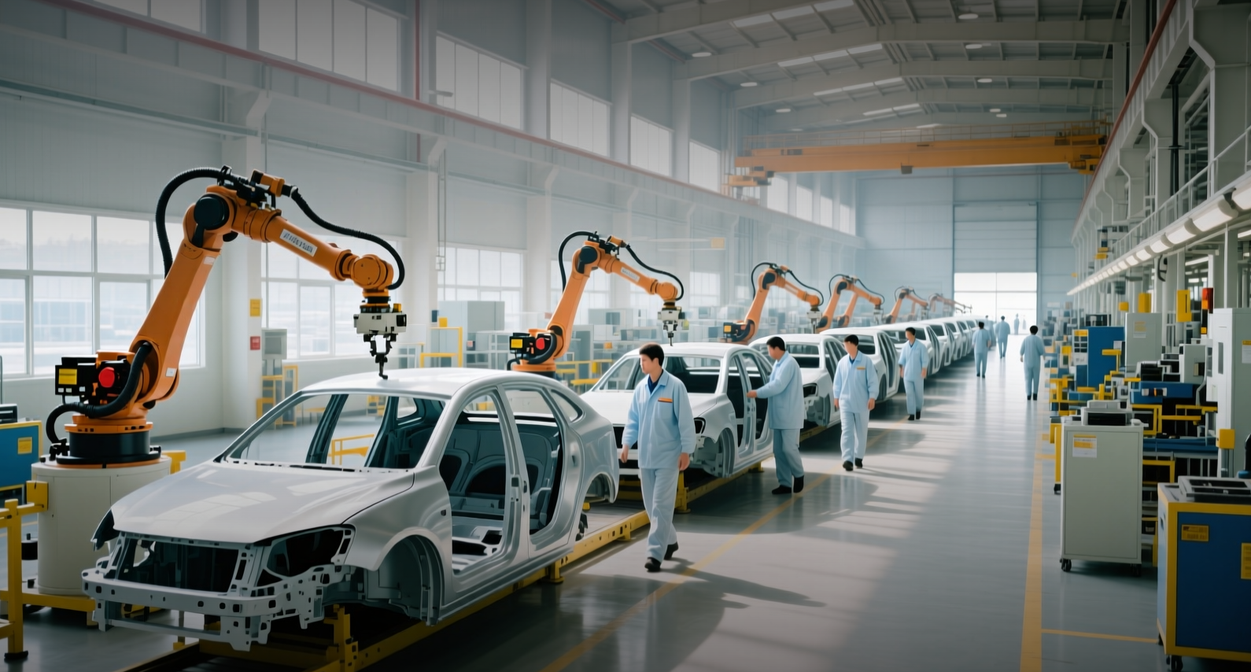
Automotive is the second wave. Body welding is already highly automated, but final assembly and parts sorting still rely heavily on manual labor. Goldman's scenario analysis shows automakers procuring humanoids at $20,000 to $60,000 per unit at adoption rates of 10 percent to 50 percent could expand gross margins by 1 percent to 6 percent, though consumer price pass-through could reduce the net effect.
The shift is also pressuring traditional industrial automation vendors. Goldman expects the market for software-defined virtual programmable logic controllers (vPLCs) to grow 20 percent to 30 percent annually, challenging the hardware-bundled model of Siemens, Rockwell Automation, and Schneider Electric.
Supply chain intersects with autos and consumer electronics
The humanoid buildout draws on existing automotive and consumer electronics suppliers. Chinese EV maker Xpeng last week valued its robotics business at more than $6 billion, roughly the size of its electric car business. Analysts at Deutsche Bank, Bernstein, and UBS have rated Shenzhen-listed Shuanghuan, a gearbox supplier co-developing reducers with Tesla, a buy or outperform, with price targets ranging from 45 to 60 yuan.
China dominates production. The industry shipped about 20,000 humanoid units globally last year, with Chinese manufacturers accounting for 95 percent, according to BofA Global Research. China's industry ministry expects more than 100,000 units built this year, and BofA forecasts 1.2 million annual shipments globally by 2030.
JPMorgan analyst Rajat Gupta visited Tesla's Fremont factory last week and reported that the automaker is converting its discontinued Model S and Model X production lines to Optimus humanoid production.
Goldman's "Executive Perspectives" survey found about 40 percent of executives expect at least 10 percent of workflows to be automated by general-purpose robots within three to five years.
For investors, the fourfold forecast revision reframes the robotics trade from speculative to supply-chain-driven. Semiconductor names including Nvidia, Texas Instruments, and Analog Devices stand to capture $3,000 to $6,000 of content per unit. The Solactive China Humanoid Robot Index, tracking 20 listed Chinese humanoid and component companies, peaked in September 2025 and has since given back gains from mid-2024, suggesting the market is still pricing uncertainty about commercialization timelines.
This article is for informational purposes only and does not constitute investment advice.