

Key Takeaways:
- Qualcomm fell more than 5% on June 10, leading a broad semiconductor selloff
- Bank of America clients sold a record $10.8 billion in tech stocks last week
- The Nasdaq slid 0.97% as profit-taking and macro risks weighed on the sector
Key Takeaways:
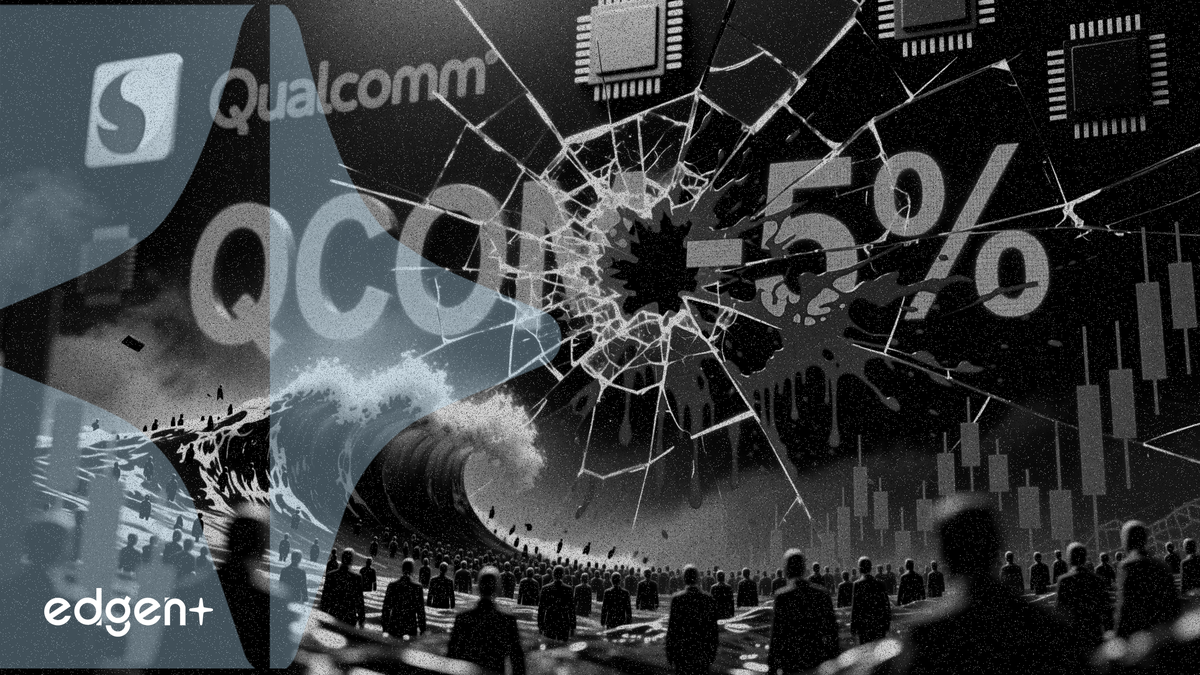
US-listed semiconductor stocks suffered their worst single-day selloff in months on June 10, with Qualcomm plunging more than 5% and dragging the broader sector lower.
The selloff erased more than $200 billion in market value from Philadelphia Semiconductor Index components as investors rotated out of chip stocks ahead of key inflation data and the SpaceX IPO.
"The selling is broad-based and institutional in nature, which suggests this isn't simple profit-taking," Jonathan Krinsky, chief technical strategist at BTIG, said in a note Tuesday. "We see further momentum unwind with risk to the 50-day moving average, or about 14% downside."
Qualcomm fell more than 5%, Broadcom dropped over 4%, while Advanced Micro Devices, Taiwan Semiconductor Manufacturing Co. and Nvidia each declined at least 2%. The iShares Semiconductor ETF (SOXX) had already plunged 10.4% on Friday in its biggest single-day drop since 2020, and the weakness extended into Tuesday's session. The Nasdaq Composite slid 0.97% to 25,678.82, while the S&P 500 fell 0.26% to 7,386.65.
The selloff comes as Bank of America data showed clients sold a record $10.8 billion in tech stocks last week — the largest amount since the firm began tracking the data in 2008 — and $14.2 billion in single stocks overall. Outflows as a percentage of the S&P 500 tech sector's market capitalization were the most since 2014. The magnitude suggests the pullback could extend beyond what many investors currently expect, particularly with the SpaceX IPO set to debut Friday and the consumer price index expected to top 4% for the first time since May 2023.
Several factors converged to drive the selling. Traders cited profit-taking after a strong run in chip stocks, de-risking ahead of the CPI release, and repositioning for the SpaceX IPO — which is set to price at $135 a share and raise roughly $75 billion, a record sum. There was also speculation that a pause in construction at a data center in Wyoming could signal softening demand for AI capacity, though Crusoe CEO Chase Lochmiller told CNBC the halt was "a customer-driven pause for some site-related issues."
The institutional nature of the selling is a key concern. Bank of America's data showed the outflows were driven by big institutional money rather than retail traders, and corporate stock buybacks as a share of market cap hit their lowest level since late 2023, with the slowdown most pronounced in technology. That combination removes two pillars that had underpinned the sector's rally.
For investors, the question is whether this marks a correction within a bull market or the beginning of a deeper rotation. Nvidia shares, which have more than doubled over the past 12 months, now face headwinds from both valuation concerns and the potential for AI spending to moderate. Micron and SanDisk have outperformed Nvidia as the top AI stocks in 2026, signaling that the market is already rewarding different parts of the semiconductor value chain. Apple extended its losses, falling almost 4% as investors questioned its artificial intelligence capabilities, while quantum computing stocks such as Rigetti Computing also tumbled as risk appetite contracted. The weakness spread to Asia on Wednesday, with SoftBank losing 9% in Tokyo and Samsung dragging South Korea's Kospi lower.
This article is for informational purposes only and does not constitute investment advice.
