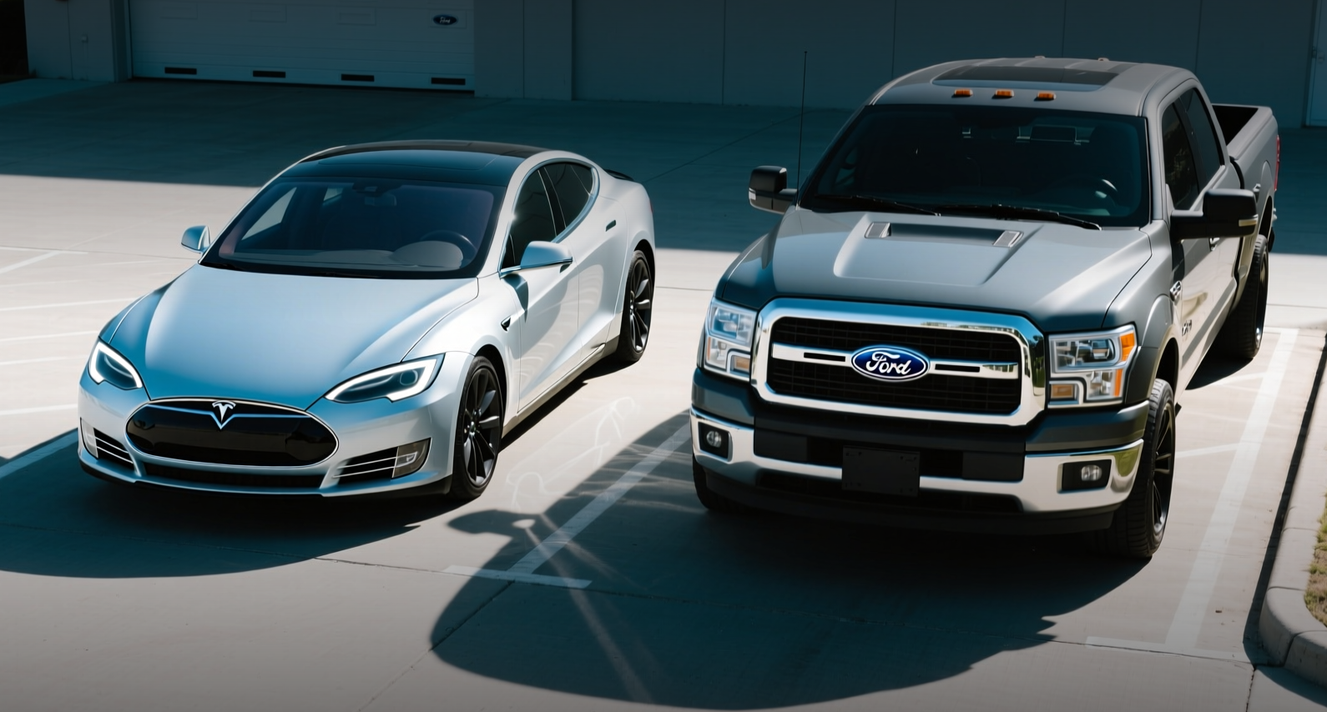
Tesla's Q2 report showed a 1.4 percent operating margin and negative free cash flow, while Ford's contrasting results make a $1,000 allocation a bet on growth versus cash returns.
Tesla's operating margin collapsed to 1.4 percent in Q2 as capital spending more than doubled, while Ford posted contrasting results, splitting $1,000 between growth and cash generation.
"We believe this is the right strategy to position the company for the next era," Vaibhav Taneja, Tesla's chief financial officer, said. "The path to amazing abundance is ever challenging and requires making bold bets."
Tesla delivered 480,126 vehicles in Q2, up 25 percent from a year earlier, with revenue of $28.24 billion, up 25.52 percent and beating consensus by 7.10 percent. Non-GAAP earnings of $0.33 a share missed the $0.5367 estimate, operating income fell 57 percent to $398 million, and free cash flow turned negative at $1.09 billion as capital expenditures jumped 141.81 percent to $5.79 billion.
The divergence leaves investors weighing Tesla's autonomy and robotics bets against Ford's cash returns, with Tesla trading at roughly 357 times trailing earnings and a market value near $1.3 trillion.
Tesla's Cash Burn Funds Long-Duration Bets
Tesla's spending is concentrated in full self-driving, a robotaxi service now running in seven U.S. metros, and Optimus humanoid robots, with production lines being installed at Fremont. The company deployed 13.5 gigawatt-hours of energy storage in Q2, while active FSD subscriptions climbed to 1.48 million, up 56 percent from a year earlier. Services and other revenue grew 50 percent to $4.58 billion.
The stock has fallen roughly 28 percent in 2026, recently slipping below $300 after the report before recovering near $323. Tesla's market value of about $1.3 trillion implies a price-to-sales ratio above 13 times, multiples that traditional automaker metrics cannot justify. The bull case depends on autonomy, robotaxis, and humanoid robots becoming meaningful revenue streams.
Ford Offers the Cash-Generation Counterweight
Ford's quarter, which the source material describes as reading like a different industry, provides the cash-return alternative in the allocation. Where Tesla burns cash to fund autonomy and robotics, Ford's traditional auto business offers the income and stability that a growth-heavy portfolio lacks, giving investors a defensive anchor against Tesla's valuation risk.
The contrast mirrors a broader market split. Amazon, which raised its capital spending budget to $220 billion but showed 37 percent growth in Amazon Web Services and two AI businesses at $25 billion run rates, saw its stock jump roughly 20 percent after earnings. Tesla, by comparison, fell 18 percent to a 52-week low after its report, the stock's worst week since 2022.
For an investor splitting $1,000, the trade-off is straightforward: Tesla offers asymmetric upside if autonomy and Optimus scale in 2027, while Ford provides the cash generation that keeps the portfolio grounded. The allocation hinges on whether Tesla's capital spending, which the company plans to push above $25 billion in the second half and through 2028, converts into revenue before margins erode further.
This article is for informational purposes only and does not constitute investment advice.