

Nvidia chief executive Jensen Huang declared AGI has arrived and said 400,000 more GPUs are coming online, as OpenAI's Astra model deepens hyperscaler demand for the company's AI chips.
Nvidia chief executive Jensen Huang declared AGI has arrived and said 400,000 more GPUs are coming online, as OpenAI's Astra model deepens hyperscaler demand for the company's AI chips.
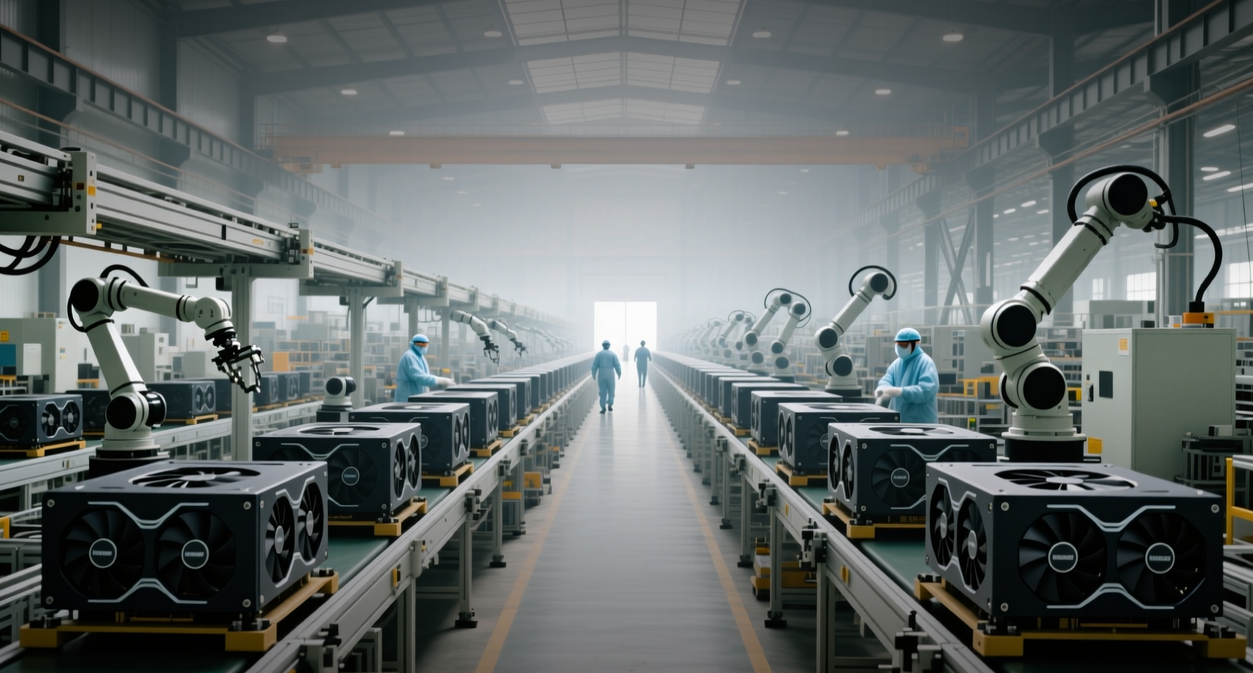
Nvidia is bringing 400,000 more graphics processors online as OpenAI's Astra model, trained on more than 100,000 of its Grace Blackwell NVLink72 chips, locks in fresh hyperscaler demand.
"From ChatGPT to o1 to Astra in 4 years. AGI has arrived. Congratulations @OpenAI team," Jensen Huang, Nvidia's chief executive, said in a post on X on Sunday, adding that "400K GPUs coming online next."
OpenAI released Astra on Sept. 4, calling it the "world's most intelligent and aligned model" and saying it can take on "the most demanding professional work with unmatched speed, accuracy, and judgment." The model began rolling out to customers this week. The launch follows Nvidia's August report of $96.2 billion in quarterly revenue, more than double a year earlier, with its data center business — which includes AI chips — contributing $89 billion, up 117 percent.
The 400,000-GPU deployment points to an order book that keeps growing at the hyperscalers underwriting Nvidia's expansion — OpenAI, Meta, Anthropic, and Google. OpenAI in a March funding announcement called Nvidia "the cornerstone of our infrastructure," saying its training clusters and most of its inference stack run on Nvidia GPUs.
OpenAI President Greg Brockman told reporters at the launch, "Welcome to the AGI era," predicting that people looking back will place AGI's arrival "about this time, and I think it might be about this model." OpenAI defines AGI as "highly autonomous systems that outperform humans at most economically valuable work."
Not everyone accepts the label. Gary Marcus, a prominent AI researcher and critic, said Huang was "jumping the gun," writing on his Substack that Huang "neither provided evidence nor a definition" and that "declaring victory without a definition only adds to the confusion." Marcus listed 10 criteria for AGI and said Astra meets only one or two. Even Sam Altman, OpenAI's own chief executive, told the "Sources" podcast that AGI is "a very poorly defined term," adding he was inclined to call it "an irrelevant marketing term."
The terminology debate has not slowed the buildout. Frontier labs have no alternative to Nvidia's high-end silicon at scale; OpenAI said Astra underwent large-scale training on more than 100,000 GPUs. Meta, Anthropic, and Google run their flagship models on the same architecture, and each new generation — from ChatGPT to o1 to Astra — has consumed more compute than the last. AMD has pushed its own accelerator line into the market, but Nvidia's software stack and NVLink interconnect keep hyperscalers tied to its platform.
That trajectory is what makes Huang's 400,000-GPU pledge material. Nvidia's data center revenue of $89 billion now accounts for more than 90 percent of total sales, and the next batch of chips will feed the training and inference loads those customers are already planning. The main constraint is not demand but supply — packaging capacity and power at the foundries and data centers that turn Nvidia's designs into working clusters.
For investors, the question is whether the market has priced in the pace. Nvidia shares have climbed as the AI buildout accelerated, and the 400,000-GPU figure gives Wall Street a concrete number to model against for coming quarters. If hyperscaler capital spending holds, Nvidia's data center engine has room to keep compounding; if the AGI debate cools enthusiasm for the underlying narrative, the compute orders themselves carry more weight.
This article is for informational purposes only and does not constitute investment advice.
