

Tesla is updating its Full Self-Driving software to better detect and navigate potholes, a mundane but technically demanding challenge for its camera-based neural network as the company pushes toward unsupervised robotaxi operations.
Tesla is updating its Full Self-Driving software to better detect and navigate potholes, a mundane but technically demanding challenge for its camera-based neural network as the company pushes toward unsupervised robotaxi operations.
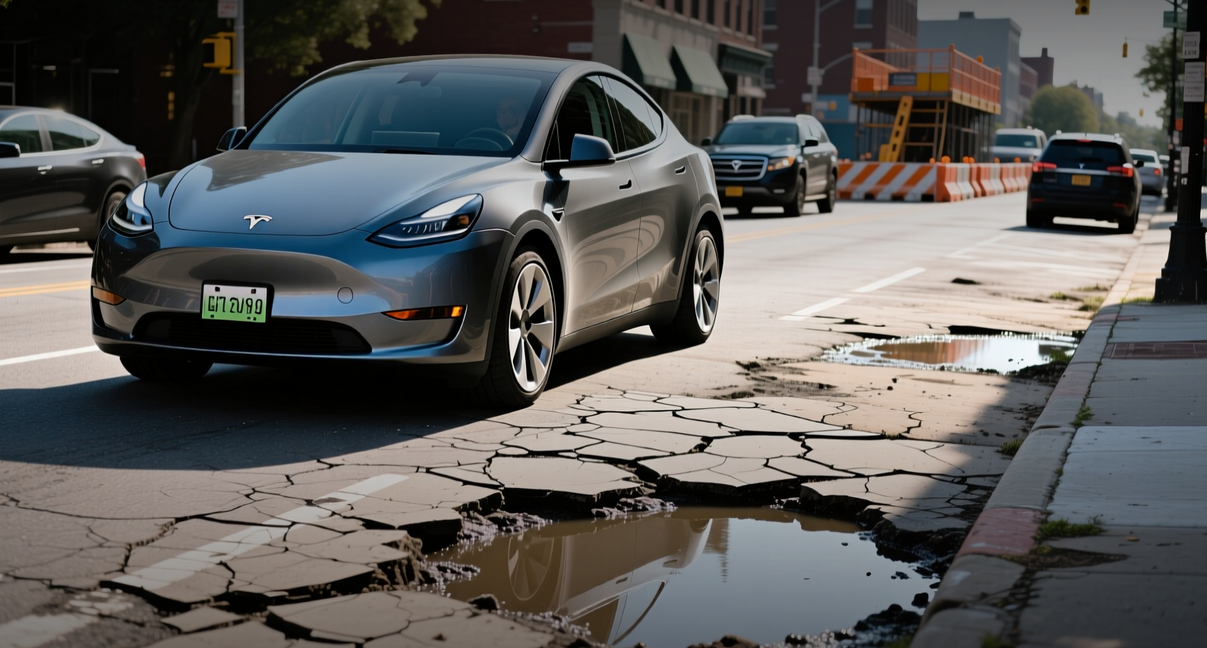
Tesla's full self-driving software is confronting one of the least glamorous obstacles in autonomy: potholes. The company has been quietly rolling out fixes to help its neural network detect and navigate road surface damage, a mundane but critical hurdle separating supervised autonomy from the robotaxi future Tesla has promised for years.
"Potholes are the kind of edge case that doesn't show up in training data until you deploy at scale," said Sam Korus, director of research at ARK Invest, which has published extensive analysis of Tesla's autonomous driving progress. "The real world is full of these prosaic challenges that are actually quite hard for vision-based systems."
Tesla's FSD software, currently at version 14.3.8 on the 2026 Summer Update, has been updated to better identify and respond to potholes and other road surface defects, according to Teslarati's reporting on Aug. 31. The update follows years of owner complaints about FSD vehicles striking potholes that a human driver would easily avoid, particularly on poorly maintained city streets.
The technical challenge is significant. Tesla's FSD relies primarily on a camera-based neural network that must classify road conditions in real time. Unlike lane markings or traffic signals, potholes vary infinitely in shape, depth, and color, and they appear suddenly at highway speeds. The system must decide within milliseconds whether to brake, swerve, or accept the impact — a decision that requires understanding not just the obstacle but the surrounding traffic and road geometry.
Tesla's approach to pothole handling has evolved through its neural network training pipeline. The company collects video from its fleet of millions of vehicles and uses that data to train the FSD model on edge cases. But potholes present a data labeling problem: they are transient, location-specific, and often obscured by shadows, water, or other vehicles. A pothole that exists on Monday may be patched by Wednesday, making it difficult to build a consistent training set.
The stakes extend beyond driver comfort. Tesla's robotaxi ambitions, including the Cybercab platform that launched self-driving rides in select markets this year, depend on the software handling every road condition a human driver would encounter. A federal probe into Tesla's Cybercab launch, reported by Forbes on Sept. 4, underscores the regulatory scrutiny surrounding the company's autonomous driving rollout.
Tesla faces competition from Waymo, which operates autonomous ride-hailing in several U.S. cities using a combination of lidar, radar, and cameras. Waymo's vehicles have logged millions of miles in urban environments, giving the Alphabet subsidiary a data advantage in handling complex road conditions. However, Waymo operates in geofenced areas with detailed mapping, while Tesla's FSD is designed to work anywhere a driver can take a Tesla.
The pothole problem also intersects with safety concerns. A fatal crash in Batavia, Illinois, in March 2026, in which a Tesla Model Y running FSD attempted a left turn and struck a pickup truck, has drawn attention to the limits of the system. Tesla's report to the National Highway Traffic Safety Administration confirmed the driver-assist system was engaged, though the company redacted key details about the software version and operating conditions.
Tesla CEO Elon Musk has been vocal about FSD's safety benefits, recently amplifying owner stories about the system avoiding collisions that human drivers could not. In an Aug. 30 post on X, Musk wrote that FSD "will improve your quality of life and may save your life." But the gap between highway performance and the messy reality of city streets — where potholes, construction zones, and unpredictable pedestrian behavior converge — remains the defining engineering challenge.
Tesla shares have priced in the autonomous driving narrative for years, with the company's valuation depending heavily on the eventual deployment of a robotaxi network. The Cybercab launch has begun in limited markets, but the pothole problem illustrates how far the technology still has to go before it can operate without human supervision on every road.
For investors, the question is whether Tesla can close the gap between its supervised FSD system and true unsupervised autonomy. Each software iteration that handles a new edge case — whether a pothole, an unprotected left turn, or a construction zone — brings the company closer to that threshold. But the timeline remains uncertain, and competitors like Waymo continue to expand their own autonomous operations.
This article is for informational purposes only and does not constitute investment advice.
