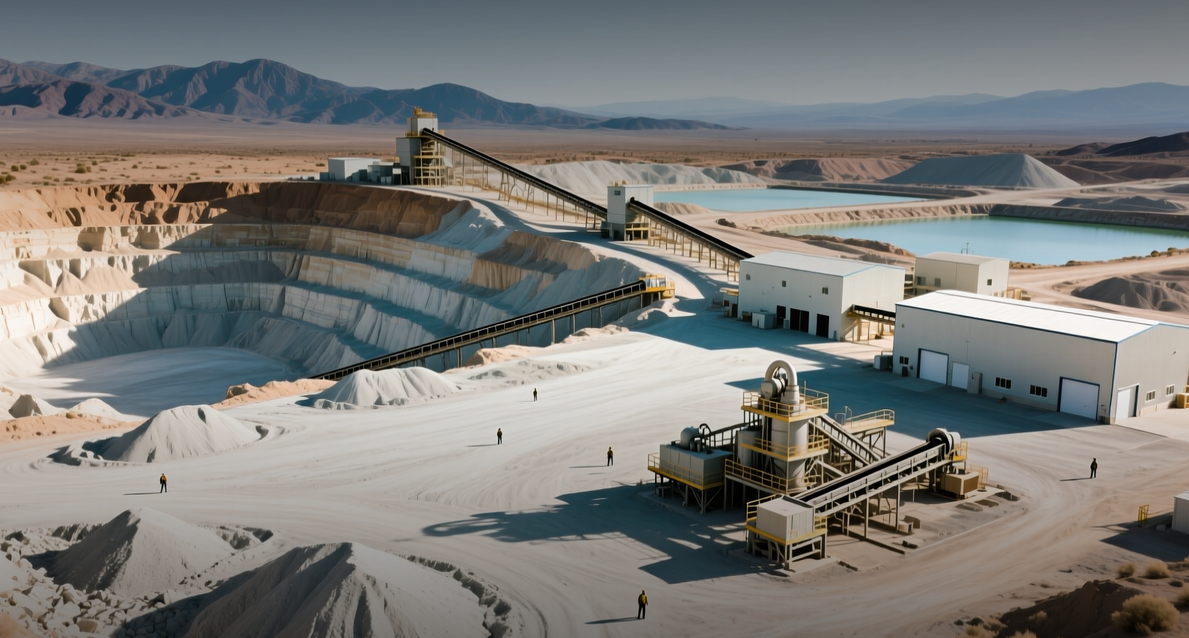
MP Materials signed a nine-figure, multi-year contract to supply gadolinium oxide to a U.S. aerospace and defense manufacturer, expanding its domestic rare earth supply chain beyond magnets.
The unnamed customer's commitment follows a $400 million Pentagon investment and a $500 million Apple purchase agreement for American-made rare earth magnets, according to company disclosures. MP Materials operates the Mountain Pass mine and processing facility in California and is building a larger magnet manufacturing campus in Northlake, Texas.
MP produced 840 metric tons of neodymium-praseodymium oxide in Q2, up 41 percent year over year, and sold 1,006 metric tons, a 127 percent increase. Quarterly revenue rose 89 percent to $108.5 million, while adjusted EBITDA improved by $41 million to $28.5 million. The magnetics segment generated $16.5 million in revenue with $7.5 million in adjusted EBITDA. Shares closed down 4.38 percent on the announcement day.
China processes nearly 90 percent of the world's rare earth supply, and DFARS 252.225-7052 bars U.S. defense contractors from using Chinese-sourced rare earth magnets starting Jan. 1, 2027. IDTechEx projects global rare earth magnet demand to grow roughly 70 percent by 2036, driven by electric vehicles, wind turbines, and robotics.
Q2 Production Rises 41% as NdPr Sales Jump 127%
The gadolinium oxide contract requires MP to develop additional separation capacity at Mountain Pass, with management expecting the deal to be worth nine figures over multiple years. Gadolinium is used in nuclear reactor shielding on submarines, infrared sensors, and electronics.
MP's magnetics business, which produces sintered neodymium-iron-boron magnets for defense and aerospace applications, generated $16.5 million in Q2 revenue. The company's Texas operations in Fort Worth currently produce rare earth metals and magnets, with the larger Northlake campus under construction.
Defense Rule Forces Domestic Supply Shift by 2027
The DFARS regulation effective Jan. 1, 2027, prohibits U.S. defense contractors from using magnets containing rare earth material mined, refined, or produced in China, Russia, North Korea, or Iran. China accounted for roughly 69 percent of global rare earth mine production in 2025, according to Mining Technology.
IDTechEx projects electric vehicles will remain the largest source of magnet demand, with wind energy accounting for roughly a fifth of global demand by 2036. Robotics is emerging as a fast-growing category: more than 95 percent of motors used in humanoid robots contain rare earth permanent magnets, and a single humanoid robot can use roughly 40 of them.
Peer Evolution Metals & Technologies (NASDAQ: EMAT) is pursuing a similar strategy, having placed binding purchase orders for 13 ULVAC sintered-magnet production machines expected to support roughly 10,000 metric tons of annual rare earth magnet capacity by November 2026.
The more companies decide that dependence on China represents an unacceptable supply chain risk, the more valuable MP's domestic production becomes. The aerospace agreement is unlikely to be the last such deal as the Jan. 1, 2027, DFARS deadline approaches.
This article is for informational purposes only and does not constitute investment advice.