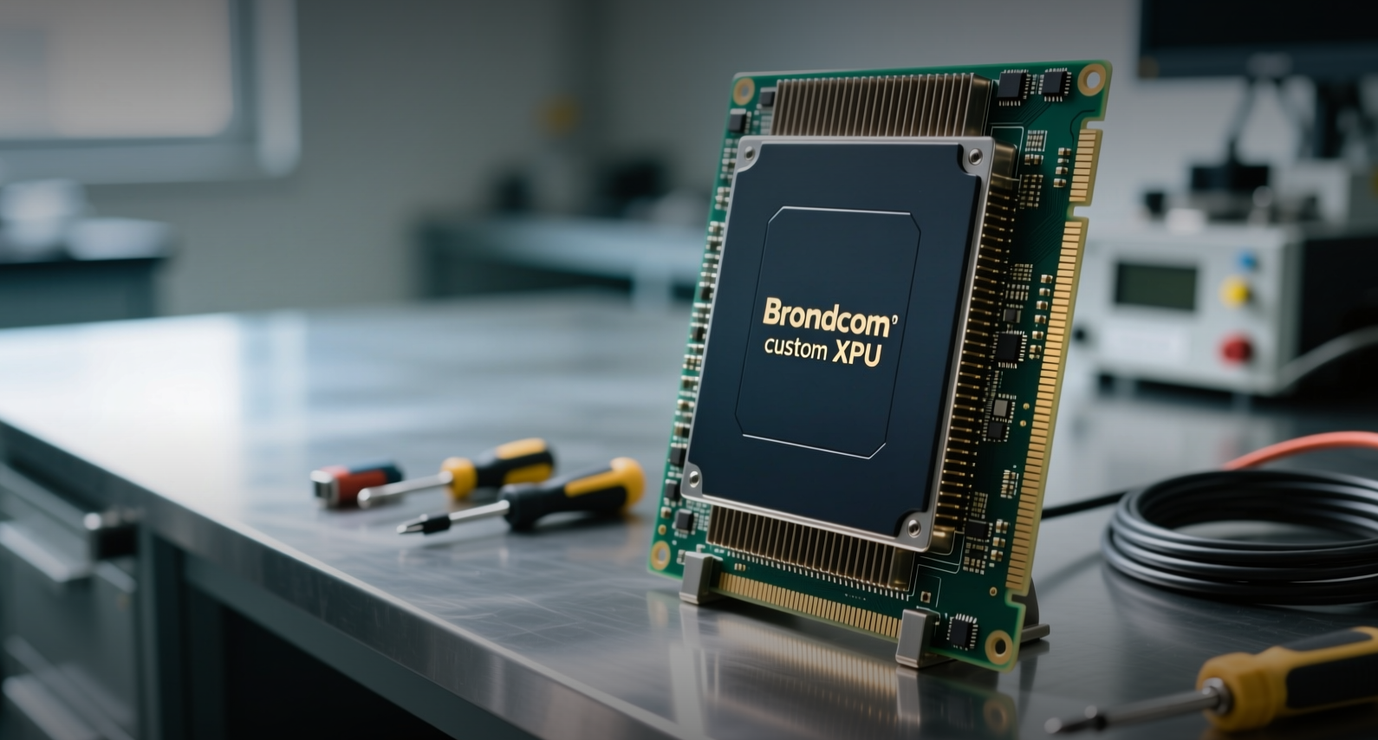
Broadcom booked $30 billion in AI semiconductor orders in a single quarter, more than double what it shipped — and the gap keeps widening.
Broadcom's AI semiconductor revenue surged 143 percent year over year to $10.8 billion in fiscal Q2, as hyperscalers and frontier AI labs locked in multi-generation custom XPU deals that extend through 2028.
"Demand for XPUs and networking is simply insatiable," Hock Tan, chief executive officer at Broadcom, said on the earnings call.
Semiconductor Solutions revenue hit a record $15 billion, up 79 percent, while AI bookings exceeded $30 billion against $10.8 billion shipped. Management guided Q3 AI semiconductor revenue to $16 billion, implying more than 200 percent year-over-year growth, and total Q3 revenue to approximately $29.4 billion, up 84 percent.
Broadcom now expects fiscal 2026 AI revenue of $56 billion and more than $100 billion in fiscal 2027, with visibility extending into 2028. The company is developing a 20-gigawatt AI compute platform with Apollo and Blackstone, a $35 billion first tranche already committed.
Six Customers, One Order Book
Broadcom's custom XPU business rests on six core AI customers. Google signed a multi-generation TPU and networking agreement. Anthropic is expected to access an additional 5 gigawatts of next-generation TPU-based compute beginning in 2027. OpenAI production starts in late 2026, and Meta has committed to multiple generations of MTIA XPUs.
Networking is the second pillar. It accounted for almost 40 percent of AI semiconductor revenue in Q2, driven by 200G and 400G SerDes, Ethernet and PCI Express switches, Tomahawk 6 100-terabit Ethernet switches, co-packaged optics, DSPs, lasers, and Jericho fabric solutions. These products handle both scale-up connectivity inside racks and scale-out connectivity across large AI data centers.
NVIDIA and AMD Close In
NVIDIA is expanding beyond GPUs into a complete AI-infrastructure platform spanning CPUs, scale-up and scale-out networking, systems, and software. Its Vera Rubin platform combines Vera CPUs, Rubin GPUs, NVLink, InfiniBand or Ethernet, and other accelerators, increasing revenue opportunity per gigawatt from about $18 billion with Hopper to $40 billion with Vera Rubin.
AMD's Helios platform integrates EPYC Venice CPUs, MI450-Series GPUs, Pensando networking, and ROCm software, creating a rack-scale AI system competing for the same hyperscaler and frontier-model infrastructure spending that Broadcom targets. Marvell Technology, Broadcom's closest rival in custom AI silicon, posted Q1 FY2027 revenue of $2.42 billion, up 27.6 percent — well below Broadcom's 47.9 percent growth rate.
Broadcom shares trade at roughly 60 times trailing earnings and 20 times forward earnings, versus NVIDIA at 44 times trailing. Analyst consensus on AVGO sits at $527.88, with seven Strong Buy and 37 Buy ratings. The stock slid about 13 percent in the week after earnings as investors digested the valuation, though shares remain up 23.8 percent over the past year.
The competitive question is whether Broadcom's custom silicon model can hold share as NVIDIA and AMD push into rack-scale platforms. Broadcom's $30 billion quarterly bookings against $10.8 billion shipped suggests demand visibility that extends well beyond the current cycle. If the company delivers on the $100 billion fiscal 2027 AI revenue target, the forward multiple compresses sharply from current levels.
This article is for informational purposes only and does not constitute investment advice.