

Key Takeaways: XPeng's second-generation VLA model now understands time, not just space — moving its autonomous driving stack from 3D to 4D spacetime.
Key Takeaways: XPeng's second-generation VLA model now understands time, not just space — moving its autonomous driving stack from 3D to 4D spacetime.
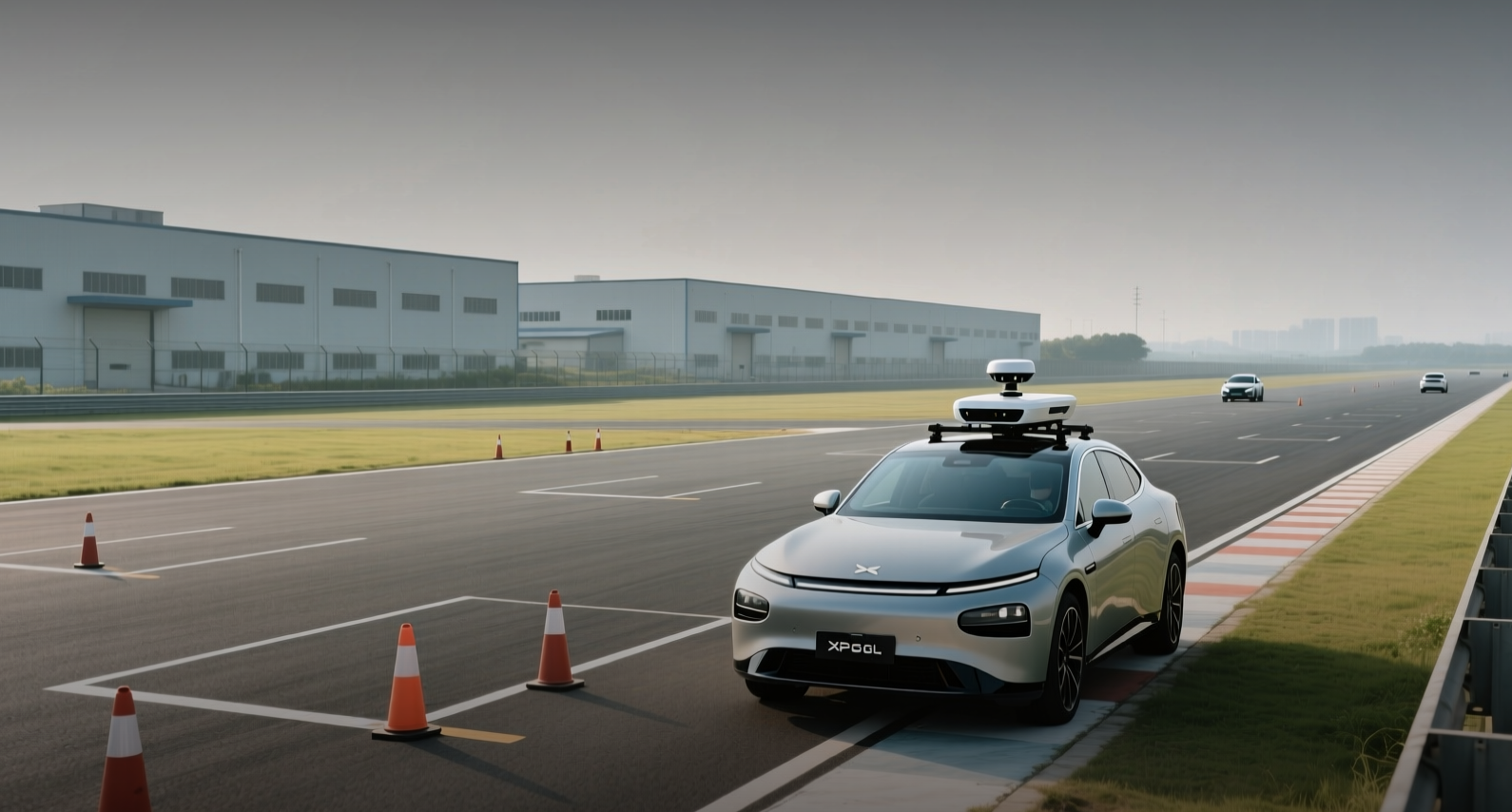
XPeng's second-generation VLA model now understands time, not just space — moving its autonomous driving stack from 3D perception to 4D spacetime prediction.
XPeng's second-generation VLA model now predicts traffic behavior six seconds ahead, a 20-fold safety improvement that could reshape China's autonomous driving market as the system rolls out in September. The upgrade, announced Aug. 27, begins deployment across all Ultra and Ultra SE models, with the XPeng G9L debuting as the first vehicle to carry the system.
CMSI analysts said XPeng's physical AI positioning could unlock valuation upside, maintaining a HKD92 price target on the stock while cutting it from a prior level. The firm's bullish stance reflects the technology moat created by the VLA upgrade rather than near-term vehicle sales.
The new version introduces MasterAgent, a centralized "vehicle brain" that integrates VLA and VLM (Vision-Language Model) functions within the cockpit, bringing select L4-level Robotaxi experiences to mass-produced vehicles. The on-device model's parameter count has increased 3.5x, supporting effective temporal sequences of up to 30 seconds and enabling scene prediction up to 6 seconds into the future. XPeng's X-Foresight predictive world model, deployed in vehicles for the first time, simulates possible future behaviors of surrounding traffic participants.
XPeng shares fell 3.34 percent on the announcement day, with short selling at 45.8 percent of turnover ($244.2 million), suggesting the market has yet to fully price in the technology upgrade. The company's Robotaxi fleet, equipped with the second-generation VLA, has obtained Guangzhou's Intelligent Connected Vehicle remote testing certification, allowing fully driverless road tests on designated Level 1, 2, and 3 testing roads in the city.
The leap from 3D space to 4D spacetime represents a fundamental shift in how the AI model processes the driving environment. Traditional autonomous driving systems perceive objects in space — a pedestrian, a vehicle, a traffic light — but lack the temporal context to predict how those objects will behave. XPeng's updated foundation model now incorporates time as a core dimension, allowing the system to reason about what will happen next, not just what is happening now.
This capability is particularly significant for L4 autonomy. The system can now predict what may happen in the next six seconds and simulate possible future behaviors of surrounding traffic participants, giving the vehicle a planning horizon that extends beyond simple reactive braking. The 20-fold improvement in multidimensional safety capabilities stems from this predictive layer, which allows the vehicle to anticipate dangerous scenarios before they fully develop.
XPeng's approach differs from Tesla's FSD, which was recently removed from China's supported list, and Huawei's ADS, which has been expanding across domestic EV brands. XPeng's unified technical foundation enables smooth capability progression from L2 to L4, meaning the same underlying architecture powers everything from highway assistance to fully autonomous Robotaxi operations.
The distilled Lite version of the second-generation VLA, deployed on lower-compute platforms through learning-based token compression and distillation training, will first appear on the XPeng G9L Max. All Max variants will receive corresponding capability upgrades, extending the technology beyond flagship models to the broader lineup.
XPeng's Robotaxi program has already secured regulatory momentum. The Guangzhou certification for remote testing — without a safety operator in the driver's seat — marks one of the first instances of a Chinese automaker receiving such authorization for fully unmanned road testing. The company's ability to bridge the gap between consumer vehicles and Robotaxi operations on a single technical foundation could prove decisive as China's autonomous driving regulatory framework matures.
XPeng trades at a significant discount to its physical AI potential, according to CMSI, which sees the HKD92 target as reflecting the company's technology moat rather than near-term vehicle sales. The September rollout of the second-generation VLA across Ultra, Ultra SE, and Max variants will test whether the market begins to re-rate the stock on its AI capabilities rather than its EV delivery numbers.
This article is for informational purposes only and does not constitute investment advice.
