WTI October crude futures settled at $85.01 per barrel, down $2.05 or more than 2.35%, as traders locked in gains from a two-week rally ahead of the U.S. Treasury's Iran sanctions announcement.
"The sell-off reflects profit-taking rather than a reassessment of geopolitical risk," said Michał Jóźwiak, financial markets analyst at XTB. "Both benchmarks had already logged a second consecutive weekly gain of more than 5%."
Brent crude fell $1.90, or 2%, to $92.60 a barrel, while Abu Dhabi Murban futures dropped 2.23% to $101.18. NYMEX September natural gas settled at $2.7820 per million British thermal units, with September gasoline at $3.2708 per gallon and heating oil at $4.2677 per gallon.
The decline comes as Treasury Secretary Scott Bessent prepares what he called "the largest financial offensive in history" against Iran, with secondary sanctions targeting third-country buyers. JPMorgan models Brent at roughly $114 per barrel under a three-month Strait of Hormuz disruption scenario, while Goldman Sachs' base case projects $80 in Q4 and $75 next year — a gap that shows how much hinges on enforcement credibility.
Buy-the-Rumour, Sell-the-News Dynamics
The August 24 price action follows a classic pattern in geopolitical commodity markets. Prices had already incorporated a substantial risk premium during the prior two weeks, rising more than 5% on both major benchmarks. When the announcement arrived, the enforcement specifics failed to materially exceed what traders had already priced, triggering a reversal.
This pattern is particularly pronounced in crude oil because the market attracts both physical participants, who care about actual supply, and macro funds, whose positions are driven by scenario probabilities. When these two groups have different conviction levels, price action can diverge sharply from apparent fundamental logic.
Strait of Hormuz Remains the Structural Risk
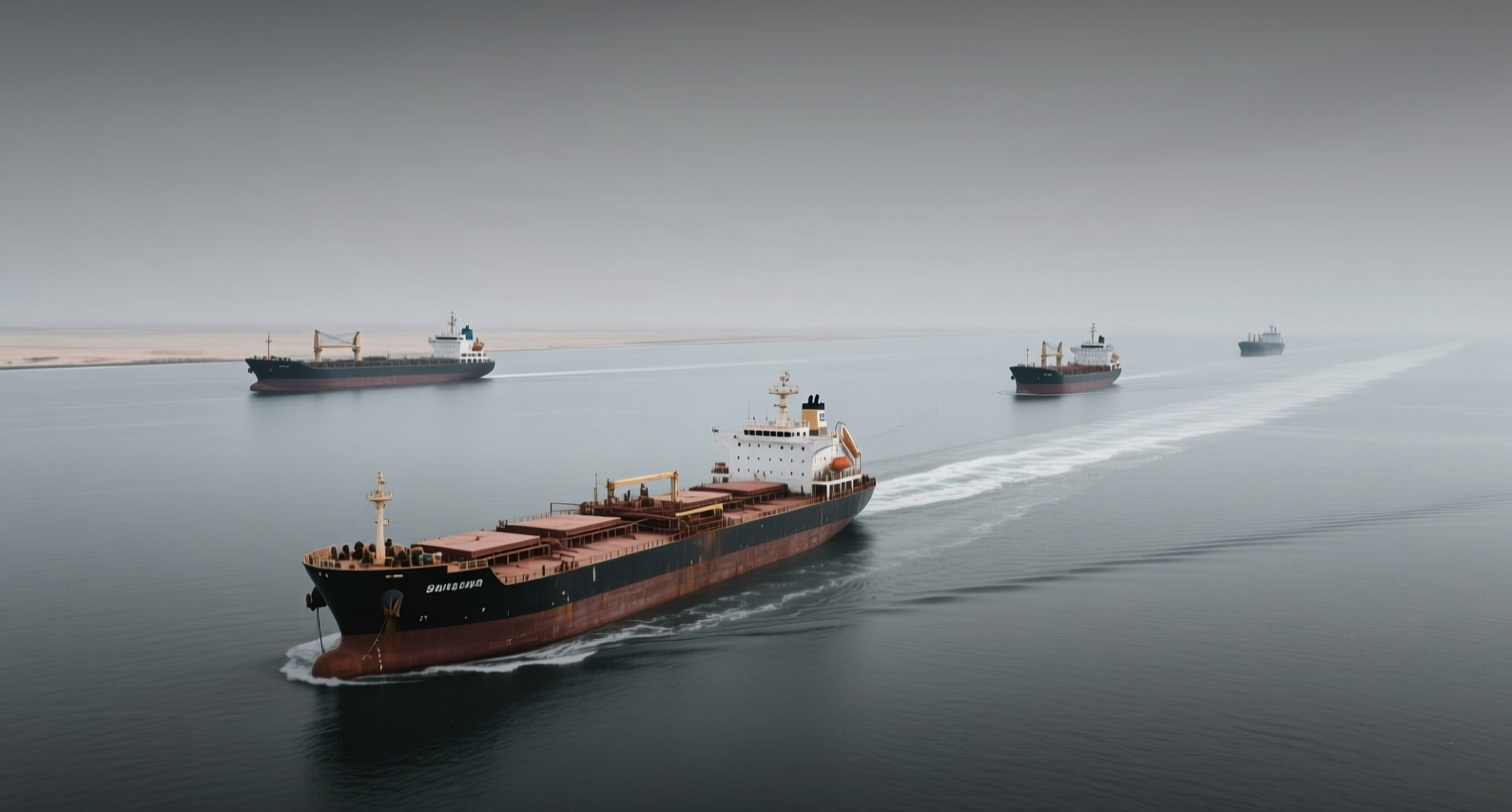
Roughly one-fifth of global oil supply transits the Strait of Hormuz, a navigable channel that narrows to approximately 33 kilometers at its tightest point. No pipeline infrastructure exists at sufficient scale to bypass this route for Gulf producers. Friday night saw increased activity in the strait, with approximately 16 million barrels transported — nearly 80% of the standard volume before the war — and an estimated 40 tankers transiting in both directions off the coast of Oman.
The price impact of Hormuz disruption is not proportional to the volume of Iranian exports at risk. It scales with the probability that the entire transit corridor becomes operationally unreliable. Even a temporary closure would force rerouting around the Cape of Good Hope, adding weeks of transit time and dramatically increasing freight costs across the full range of Gulf exporters.
Sanctions Enforcement Is the Key Variable
The August 2026 U.S. posture extends beyond direct Iran-facing restrictions. Presidential-level threats against countries trading with Iran represent a qualitative escalation in sanctions architecture. When secondary sanctions are credibly threatened, compliance decisions shift from Iranian entities to the legal and risk departments of third-country importers, banks, and shipping firms.
Iran's response posture is not monolithic. Pragmatic elements within the leadership have shown preference for de-escalation, while hardline factions appear willing to absorb economic pressure rather than make concessions. Commonwealth Bank of Australia's commodities research highlighted that if maximum-pressure measures prove effective in economically isolating Iran, the country's incentive to respond through destabilizing action in regional energy corridors could increase rather than decrease.
The last time crude markets faced a comparable sanctions-plus-chokepoint dynamic was in 2019, when attacks on Saudi Aramco's Abqaiq facility briefly knocked out 5.7 million barrels per day of production. Brent spiked nearly 15% in a single session before retracing as spare capacity was deployed. The current setup carries similar tail risk, though the duration of any disruption remains the central variable.
For consumers, the immediate relief at the pump is modest — WTI remains up 7.11% since the start of 2026, with a 52-week range stretching from $54.97 to $119.47 per barrel. The path forward depends on whether enforcement actually reduces Iranian export volumes, whether Chinese buyers pull back from discounted barrels, and whether Tehran retaliates in ways that destabilize the strait for the broader global supply chain.
This article is for informational purposes only and does not constitute investment advice.