

An unexpected surge in demand from users running local AI agents has turned Apple's niche Mac Mini into a surprise hardware hit, revealing a new front in the AI infrastructure race.
An unexpected surge in demand from users running local AI agents has turned Apple's niche Mac Mini into a surprise hardware hit, revealing a new front in the AI infrastructure race.
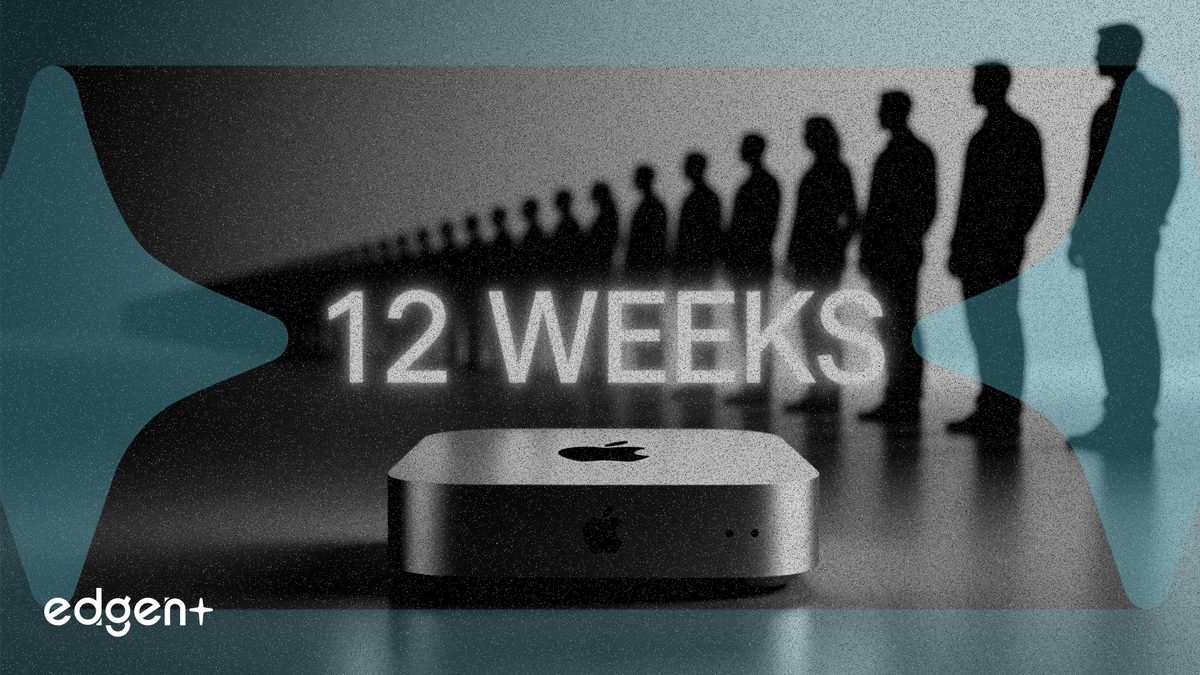
A surge in demand from developers building private artificial intelligence agents has caused shipping times for Apple’s high-RAM Mac Mini and Mac Studio computers to balloon to as long as 12 weeks, signaling a new consumer-level hardware bottleneck in the broader AI buildout. The supply crunch for what was considered a niche product highlights a new, unanticipated demand vector for high-memory personal computers, catching the world's largest tech company by surprise.
"Apple was caught up by the number of people buying Minis for Clawdbot [aka OpenClaw], which would have been impossible to predict a few months ago," Francisco Jeronimo, vice president at research firm IDC, said.
On Apple’s website, Mac Minis configured with 32GB or 64GB of RAM—costing $999 and $1,999, respectively—are listed as "currently unavailable." Other, less powerful models show wait times of a month, while the high-memory Mac Studio, which starts at $3,499, is delayed by up to 12 weeks. The shortage is notable for a product line that, according to Consumer Intelligence Research Partners, accounted for only about 3 percent of Apple’s U.S. Mac sales last year.
The supply issue is a microcosm of the global scramble for AI infrastructure, moving beyond massive data centers to the desktops of individual users. It suggests a new growth segment for hardware makers focused on "prosumer" devices with powerful local processing capabilities, but also exposes their supply chains to the volatile and fast-moving demands of the AI development community.
The demand spike is directly linked to the rise of local AI agents, particularly open-source platforms like OpenClaw. Unlike cloud-based AI, these agents run directly on a user's machine, offering more privacy and avoiding the usage quotas and costs of services from providers like Google or OpenAI. The Mac Mini, with its compact form factor and powerful M-series chips, has become a preferred hardware host for this "always-on" software.
This trend first gained mass traction in China, where intense price competition among cloud providers like Alibaba and Tencent has made the underlying API calls for these agents economically viable for small businesses and individuals. A cottage industry has appeared on platforms like Taobao, offering paid installation and configuration services for OpenClaw. The Chinese government has further fueled the fire, with districts like Shenzhen’s Longgang offering grants of up to RMB 10 million (approximately $1.4 million) for "one-person companies" that use AI agents to automate business functions.
While Apple’s supply chain is among the world’s most sophisticated, the Mac Mini shortage is a symptom of a much larger strain on technology components. Analysts speculate the scarcity is a mix of Apple undercalculating demand, managing inventory ahead of a potential M5 chip refresh, and a global shortage of the high-bandwidth memory chips coveted by AI data center operators.
The AI buildout is causing bottlenecks across the entire supply chain. According to the IEA, backlogs for essential grid components like transformers are up by at least 30 percent, with prices increasing 1.5 times since 2020. Data centers themselves face grid connection queues of up to seven years in Northern Virginia and ten years in the Netherlands. The consumer-facing shortage of a niche Apple product is one of the first tangible signs of this massive industrial-level strain.
The trend validates a new premium market for consumer and professional hardware with 32GB of RAM or more. While Apple (AAPL) is positioned to benefit, the current supply disruption and the potential for an overdue product update create an opening for competitors. Investors will be watching to see if rivals like Dell (DELL) or HP (HPQ) can capitalize on the shortage by marketing their own high-RAM workstations to the emerging AI developer demographic.
This article is for informational purposes only and does not constitute investment advice.