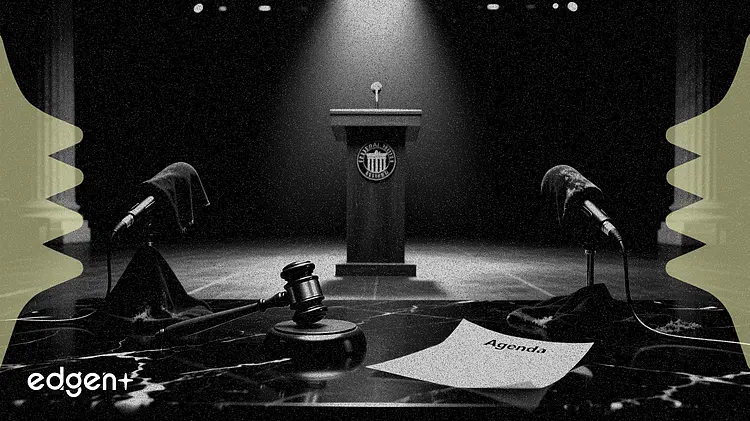
Kevin Warsh is preparing to overhaul how the Federal Reserve communicates with markets, starting with fewer press conferences and less forward guidance — a shift that could amplify volatility around every policy decision.
The new Fed chair, sworn in May 22, has not committed to holding press briefings after every Federal Open Market Committee meeting, breaking with predecessor Jerome Powell's practice of regular post-decision commentary. Warsh has long argued that central banks telegraph too much, distorting market signals and locking policymakers into forecasts they later regret.
"The Fed tells the whole world what their dots are going to be, what their forecasts are going to be," Warsh said at his April Senate confirmation hearing. "Well, the Fed is human, then they hold on to those forecasts longer than they should."
The fed funds rate currently stands at 3.50 percent to 3.75 percent, unchanged since the April FOMC meeting where the committee voted to hold steady. Markets assign a 98 percent probability of no change at next week's June 16-17 meeting, though a 25-basis-point hike is now priced in by December after firmer-than-expected data — May CPI accelerated to 4.2 percent year over year and nonfarm payrolls rose 172,000 versus expectations of about 85,000.
"If you ask me my true personal opinion right now, Fed chairs and other central bankers around the FOMC, they speak quite frequently," Warsh said at his confirmation hearing. "I think truth-seeking is more important than repetition. If one has a press conference, one wants to deliver some important news."
The shift matters because markets have spent four years under Powell's model of maximum transparency — press conferences after every meeting, detailed dot-plot projections, and frequent public speeches by Fed officials. Warsh wants to reverse that. In a 2014 review of the Bank of England's communications strategy, he called its monthly meeting schedule "sub-optimal" and recommended reducing annual meetings from 12 to eight. "Outside of crisis periods, the economic landscape tends to change rather slowly," he wrote.
The Dot Plot and the 'Hall of Mirrors'
Warsh's critique extends to the Summary of Economic Projections, the quarterly "dot plot" where 19 Fed officials anonymously forecast the path of interest rates. He has said this tool hobbled the Fed during the post-pandemic inflation surge, because officials clung to outdated projections rather than adjusting policy quickly.
Several ideas for reforming the dot plot have circulated inside the Fed, according to former St. Louis Fed President James Bullard. They include releasing the forecasts after a delay to keep market attention on the statement, or publishing only the staff forecast — an idea the staff itself has resisted over concerns about political scrutiny.
"The transition to a new communication regime may be bumpy," former Fed Vice Chair Richard Clarida warned shortly after Warsh's nomination in January.
The immediate question for next week's meeting is whether the FOMC statement will remove its "easing bias" — language signaling the central bank hopes to keep cutting rates. Three FOMC members dissented at the April meeting, indicating they wanted the Fed to stop leaning toward cuts. JP Morgan Chief Economist Michael Feroli said he does not expect Warsh to say he is "open" to rate hikes, "but I could see him saying he can't rule it out."
What Fewer Briefings Mean for Markets
The practical risk of less Fed communication is greater uncertainty around policy turning points. Former Cleveland Fed President Loretta Mester said surprising markets is "not really a good idea," though she acknowledged communication "can be improved."
Warsh's view is that less guidance produces better signals. In 2004, then-Governor Ben Bernanke coined the "hall of mirrors problem" — where the policymaker simultaneously sends signals to markets and tries to read signals from them. Warsh believes Fed communication pollutes that feedback loop by oversteering markets toward expectations the Fed then feels obligated to fulfill.
The Fed has already announced Warsh will hold a press conference after next week's meeting, suggesting at least initial adherence to Powell's framework. But his Senate testimony made clear he views that as a starting point, not a commitment. If he reverts to four press conferences per year — the pre-Powell standard — every scheduled briefing will carry outsized weight, and every unscheduled silence will be parsed for meaning.
This article is for informational purposes only and does not constitute investment advice.