

Key Takeaways: Consumer confidence in the US remained stuck in contraction territory for a second month as the University of Michigan's sentiment index missed expectations.
Key Takeaways: Consumer confidence in the US remained stuck in contraction territory for a second month as the University of Michigan's sentiment index missed expectations.
Consumer confidence in the US remained stuck in contraction territory for a second month as the University of Michigan's sentiment index missed expectations.
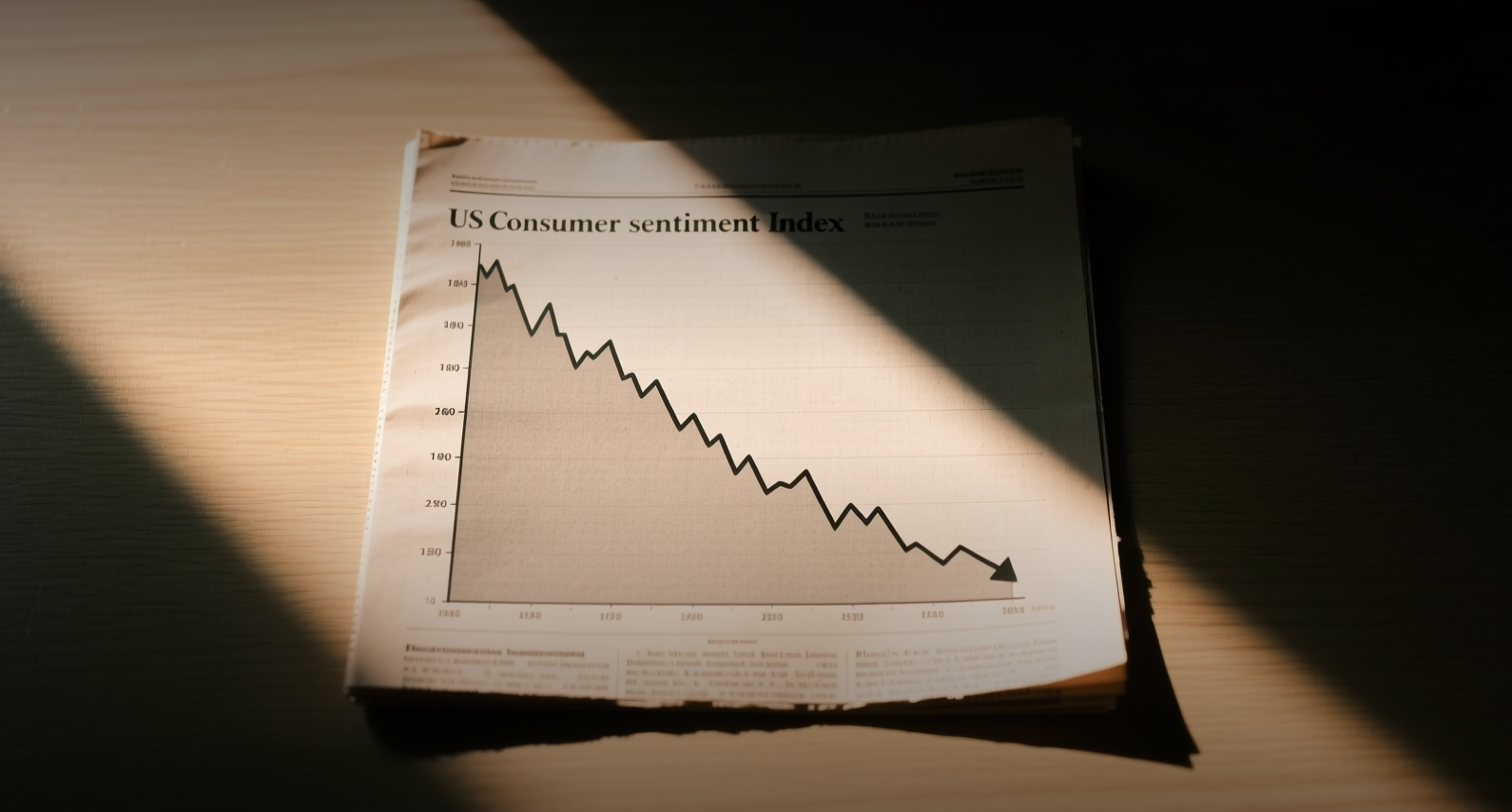
The University of Michigan's consumer sentiment index held below the 50 threshold for a second straight month in June, final data showed Friday, as Americans' views of their finances and the economy stayed mired in pessimism despite a resilient labor market and record stock prices.
"The survey is capturing tribal loyalty, not the economy," said Lance Roberts, chief strategist at RIA Advisors, pointing to a partisan gap in sentiment that now exceeds divisions by income, age or education combined.
The headline index came in at 49.5, below the 50 consensus estimate but above the preliminary reading of 48.9. The current conditions sub-index fell to 47.7 from 48.4 in the preliminary survey, missing expectations for 49, while the expectations gauge rose to 50.7 from 49.3, topping the 49.3 forecast. The May reading of 44.8 marked the lowest in the survey's history dating to 1952 — worse than during the Covid-19 pandemic, the post-2008 recession or the inflationary surge of 2022.
The persistent gap between consumer sentiment and hard economic data — the S&P 500 sits near record levels, retail sales rose 0.9 percent in May and GDP continues to expand — raises questions about the reliability of the Michigan survey as a policy signal. If consumers' gloom translates into reduced spending, the personal savings rate, already at 2.6 percent — the lowest since 2008 — could face further pressure, potentially slowing an economy that has defied recession forecasts for two years.
The Conference Board's rival confidence measure painted a far brighter picture, coming in at 93.1 in May, near its historical average. That survey cited "moderately less positive" views on business conditions but "modest improvements" in six-month expectations.
Some analysts attribute the divergence to the Michigan survey's shift from phone to online polling this year, a change that research suggests tends to produce less optimistic responses. Phone interviews, by nature, can prompt overly agreeable answers, according to Gallup research, meaning the online results may be more truthful — but also more negative.
Hard Data Tells a Different Story
Beyond sentiment surveys, the hard economic data tells "a third story entirely," Roberts said. Corporate earnings, GDP growth and S&P 500 performance are all on the rise, partly fueled by the artificial-intelligence investment boom. Consumers also hold more liquid assets than before the pandemic — about 84 percent of disposable income, according to Federal Reserve data — suggesting the capacity to spend remains intact even as confidence wanes.
The personal savings rate falling to 2.6 percent in May, however, signals that households are drawing down buffers. Individual debt is elevated and private-credit default rates are rising, according to Bloomberg and Federal Reserve Bank of New York data, creating a tension between present spending power and future financial health.
What the Data Means for the Fed
For the Federal Reserve, the persistent consumer pessimism adds a complicating factor to the policy outlook. While the central bank has held its benchmark rate at 5.25 percent to 5.5 percent since July 2023, markets are pricing in a growing probability of rate cuts as economic data softens. The last time consumer sentiment was this low for a sustained period — during the 2008 financial crisis — the Fed had already slashed rates to near zero.
If sentiment remains depressed while spending holds up, the Fed may interpret the divergence as noise rather than a signal of impending recession. But if the savings rate continues to fall and credit stress spreads, the consumer-led growth engine that has powered the expansion could stall, forcing the central bank to act sooner than its current projections suggest.
This article is for informational purposes only and does not constitute investment advice.
