
The UK economy posted its strongest growth in two years, yet the pound faltered as troubling signs emerged from across the channel.
The UK economy posted its strongest growth in two years, yet the pound faltered as troubling signs emerged from across the channel.
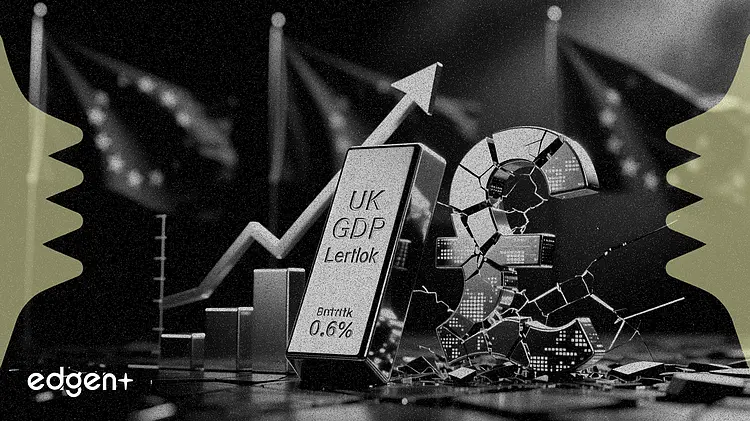
The United Kingdom’s economy expanded by 0.6% in the first quarter of 2026, more than doubling the prior period's growth and beating forecasts, yet the strong data failed to lift the pound as broader European business investment sank to an 11-year low.
"Business investment is a major determinant of GDP growth," Antonio Fatas, a professor of economics at INSEAD, told Europe in Motion, highlighting that Europe has been "falling behind the US when it comes to productivity growth in recent years."
The UK's growth accelerated from a revised 0.2% in the fourth quarter of 2025, driven primarily by a robust 0.8% expansion in the services sector, according to data released Wednesday. Despite this, the sterling came under pressure against the dollar. The muted reaction contrasted with a grim outlook from the continent, where the EU's business investment rate fell to 21.8% in the final quarter of 2025, its lowest since 2010, according to Eurostat.
The divergence between the UK's surprisingly strong GDP print and the pound's weakness suggests markets are weighing the domestic recovery against a deteriorating European investment climate. This complicates the Bank of England's next move, as the strong growth could argue for delaying interest rate cuts, while the external weakness and hesitant currency reaction may call for caution.
While the UK's services sector showed resilience, businesses across the European Union are pulling back sharply. The EU's business investment rate, which measures corporate spending on assets like machinery and buildings relative to value created, hit its lowest point in over a decade. Some of the bloc's main business hubs, including Ireland and the Netherlands, reported rates below 17 percent.
A European Central Bank survey of 64 leading firms identified weak demand as the primary constraint, cited by 90 percent of respondents. Firms also expressed significant concern over low profitability, regulatory burdens, and rising labor costs. The unpredictable nature of climate regulations and geopolitical tensions, particularly tariffs and war-related disruptions, were also noted as major deterrents to long-term capital spending.
This backdrop of caution on the continent provides a crucial context for the pound's lackluster performance. Traders appear to be looking past the UK's positive headline figure, focusing instead on the risk of contagion from a broader European slowdown.
The complex global picture is further illustrated by recent corporate earnings from outside the UK. In Brazil, Greenlane Renewables Inc. is partnering with Panasonic to localize production, a strategic move to capture growth in a market with a new government mandate for biomethane. The company is deliberately shifting away from low-margin contracts to focus on high-margin products and royalties, according to its first-quarter report.
Meanwhile, digital banking giant Nu Holdings Ltd. reported adding nearly four million customers in the first quarter to reach over 135 million globally, with revenues surpassing $5 billion for the first time. The company's success, particularly in Latin American markets like Brazil and Mexico, is being driven by what it calls an "AI transformation," rebuilding its banking services around artificial intelligence.
These examples highlight a global economy where growth is not uniform. While European businesses hesitate, companies in other regions are finding pockets of strong growth by tapping into specific government policies or technological shifts. For the UK, even with a strong domestic report, its fortunes remain tied to a European neighbor struggling with investment confidence. The Bank of England now faces the difficult task of setting monetary policy for an economy that is outperforming its region but remains vulnerable to external headwinds.
This article is for informational purposes only and does not constitute investment advice.
