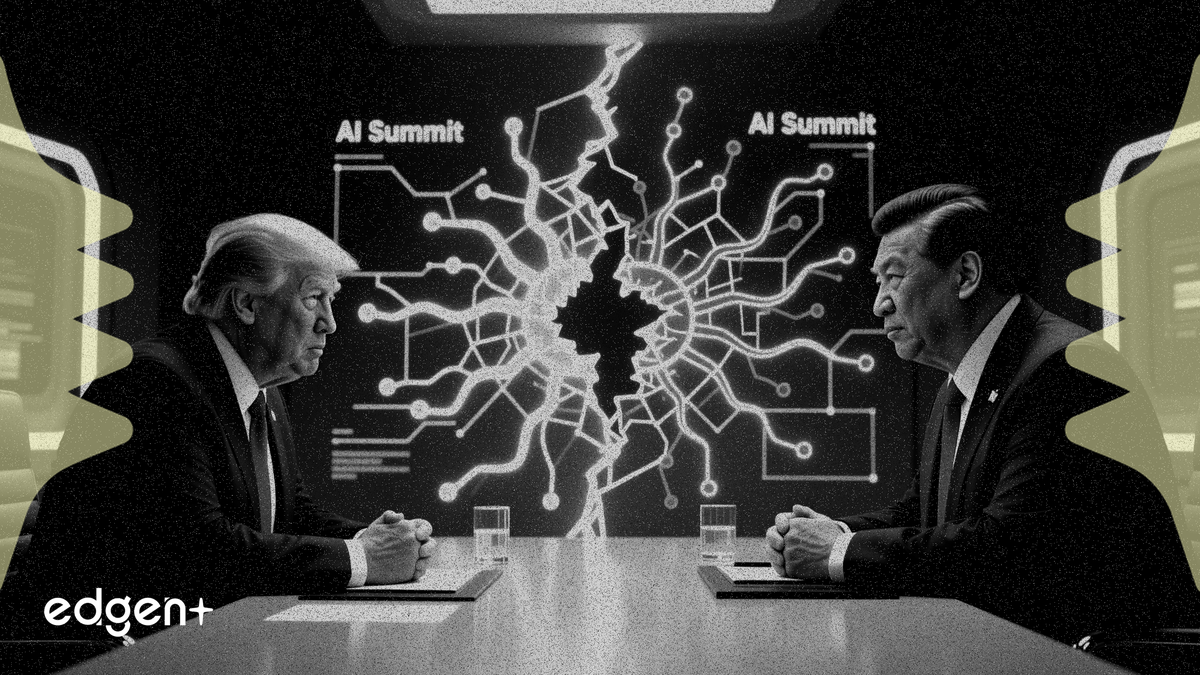
U.S. President Donald Trump and Chinese President Xi Jinping will meet in Beijing for a high-stakes summit focused on the escalating conflict over artificial intelligence, a technology race that could redefine global economic and military power. The meeting, scheduled for May 13-15, comes as Washington accuses Beijing of industrial-scale theft of AI know-how while China pushes back against U.S. restrictions on advanced semiconductor exports it sees as suppressing its growth.
"The US government has information indicating that foreign entities, principally based in China, are engaged in deliberate, industrial-scale campaigns to distill US frontier AI systems," according to a leaked memo from the White House Office of Science and Technology Policy. This process involves using fraudulent accounts to illicitly train Chinese models on the output of more advanced U.S. systems, like those from the AI company Anthropic, which detected over 16 million such attempts.
The core of the dispute centers on access to technology and resources. The U.S. has implemented a policy of selective restriction on high-performance AI chips, such as those made by Nvidia, to slow China's military and technological advancement. In response, U.S. prosecutors have uncovered smuggling rings moving "billions of dollars" of restricted chips to China. Beijing, meanwhile, holds significant leverage with its control over approximately 70% of global rare-earth mineral mining and an even greater share of refining, which are vital for American manufacturing sectors.
For investors, the summit's outcome presents a landscape of uncertainty, with the potential for either de-escalation or a new wave of restrictions impacting the global tech sector. The negotiations are highly transactional, with the U.S. seeking concessions on trade and support for its war in Iran, while China aims to secure its tech supply chain. A potential multi-billion dollar deal for Boeing aircraft and large-scale purchases of U.S. agricultural products are also on the table, creating a complex web of interconnected interests.
The Chip War and IP Theft
Washington's primary concern is the rapid, and allegedly illicit, advancement of China's AI capabilities. The practice of "distillation" allows Chinese labs to develop powerful AI models "in a fraction of the time, and at a fraction of the cost," according to U.S. AI firm Anthropic. This not only erodes the competitive advantage of U.S. companies like Nvidia and Google but also, as the company warned, creates "significant national security risks" by potentially removing safeguards against the use of AI for malicious purposes.
Beijing has shown it is also willing to play hardball to protect its own nascent AI industry. The government recently blocked a $2 billion takeover of Chinese AI startup Manus by Meta, and prevented its founders from leaving the country. This move was seen as a clear signal that "Chinese AI talent and technology are not for sale to American companies," Han Shen Lin, China country director at the Asia Group, told Reuters.
A Transactional Summit
The upcoming meeting is unlikely to resolve the deep structural competition between the two powers. Instead, analysts expect a focus on crisis management and tactical agreements. The U.S. controls the world's most advanced AI chips, but China's dominance over rare-earth minerals—critical for everything from EVs to F-35 jets—gives it a powerful counter-lever. Chinese export restrictions on these minerals, first imposed in April 2025, have already disrupted U.S. aerospace and automotive supply chains.
The summit agenda extends beyond tech, touching on the war in Iran and the sensitive issue of Taiwan. The U.S. is pressing China to help secure oil shipping routes, while Beijing is wary of aligning with Washington's foreign policy. On Taiwan, which Chinese Foreign Minister Wang Yi described as "the biggest point of risk," any shift in the U.S. policy of "strategic ambiguity" could have profound regional consequences. Ultimately, the summit's success will be measured not in grand bargains, but in its ability to establish guardrails to prevent the spiraling rivalry from entering a more dangerous phase.
This article is for informational purposes only and does not constitute investment advice.