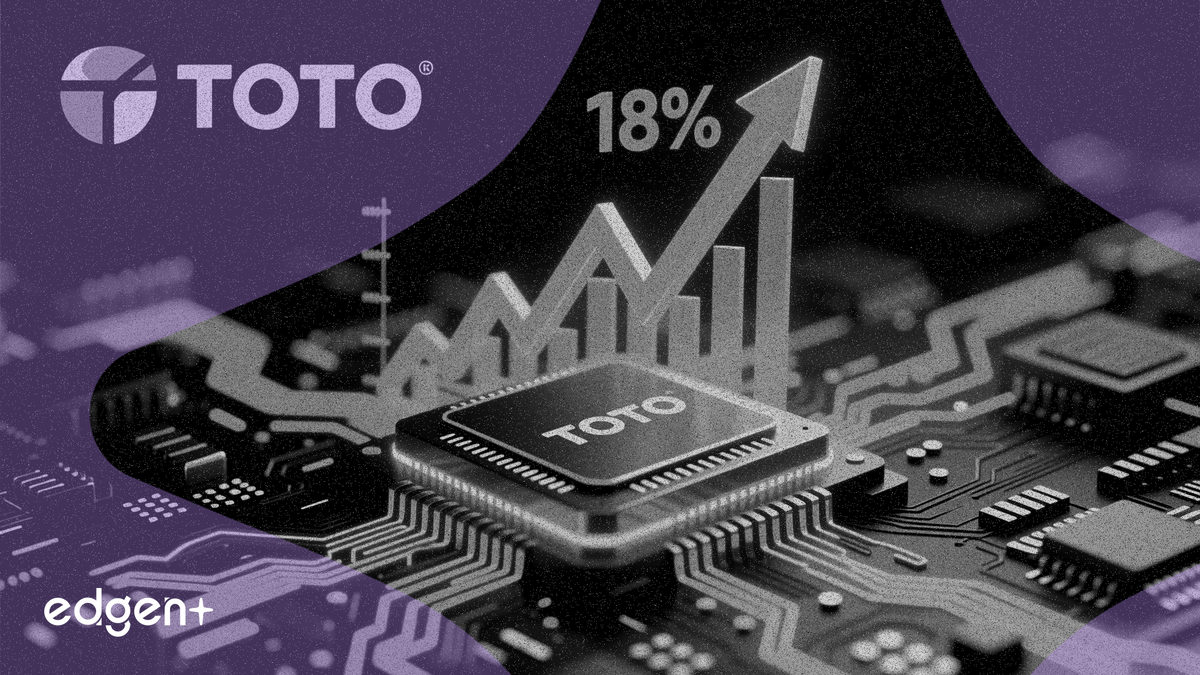
The world’s second-largest maker of electrostatic chucks isn’t a chip gear company — it’s Japanese toilet giant Toto.

Japanese toilet maker Toto is pivoting to the AI supply chain, leveraging a little-known advanced ceramics unit that supplies critical components for NAND memory manufacturing and now accounts for over half its profit. The move, which sent shares up 18 percent, turns the washlet brand into one of the market's most unusual AI infrastructure plays.
"This rally was driven by Toto’s advanced ceramics division," Citigroup analyst Masashi Miki said, but cautioned that the company's overall profit guidance was "barely passing" due to headwinds in its core international housing business and "downside risk" in assumptions related to the Middle East.
For the fiscal year ended March 31, Toto’s ceramics unit saw operating profit rise 34 percent to ¥28.9 billion ($184 million), making up 55 percent of the company's total ¥53.8 billion operating profit. The company plans to invest another ¥30 billion ($192 million) to expand capacity, forecasting 27 percent sales growth for the division next year.
Toto’s success highlights a broader trend of investors rewarding Japanese industrial firms with exposure to the AI buildout. The re-rating offers a new avenue for AI exposure beyond names like Nvidia, but also raises questions about whether the market is creating a bubble by chasing AI connections in unexpected places.
Toto, best known for its bidet-style “Washlet” toilets, is the world's second-largest producer of electrostatic chucks (E-chucks). These components are critical for holding silicon wafers in place during the fabrication of NAND memory, a key part of the data center expansion fueled by AI. The advanced ceramics division, established in 1984, has become the company’s primary profit engine, overshadowing weaker performance in its traditional housing equipment business.
The market reaction shows how hot the AI trade remains, rewarding companies with exposure to chips, memory, and data center infrastructure, even when their core business is seemingly unrelated. This isn't an isolated case in Japan. Cosmetics manufacturer Kao has a business making cleaning agents for semiconductors, while MSG inventor Ajinomoto is investing ¥25 billion ($159.5 million) to produce insulating film for motherboards.
Toto’s pivot stands in contrast to more speculative moves in the market. Struggling shoe company Allbirds recently announced it would rebrand as NewBird AI and purchase GPUs, causing its stock to surge more than fivefold despite having no operational history in cloud infrastructure. Market professionals compared the move to past bubble-era rebrands.
Toto’s case is more grounded. Its ceramics business is an established, profitable entity selling real components into the semiconductor supply chain. The company's planned ¥30 billion investment is aimed at boosting mass production and R&D to meet sustained demand from data centers and AI applications, with management forecasting another year of record profit in fiscal 2027. This existing foundation makes its stock surge a story of a successful industrial pivot rather than pure market speculation.
This article is for informational purposes only and does not constitute investment advice.