

Tesla's Full Self-Driving system recorded 3.5 times fewer collisions on Dutch roads, giving the company its strongest safety data point yet for European regulatory approval.
Tesla's Full Self-Driving system recorded 3.5 times fewer collisions on Dutch roads, giving the company its strongest safety data point yet for European regulatory approval.
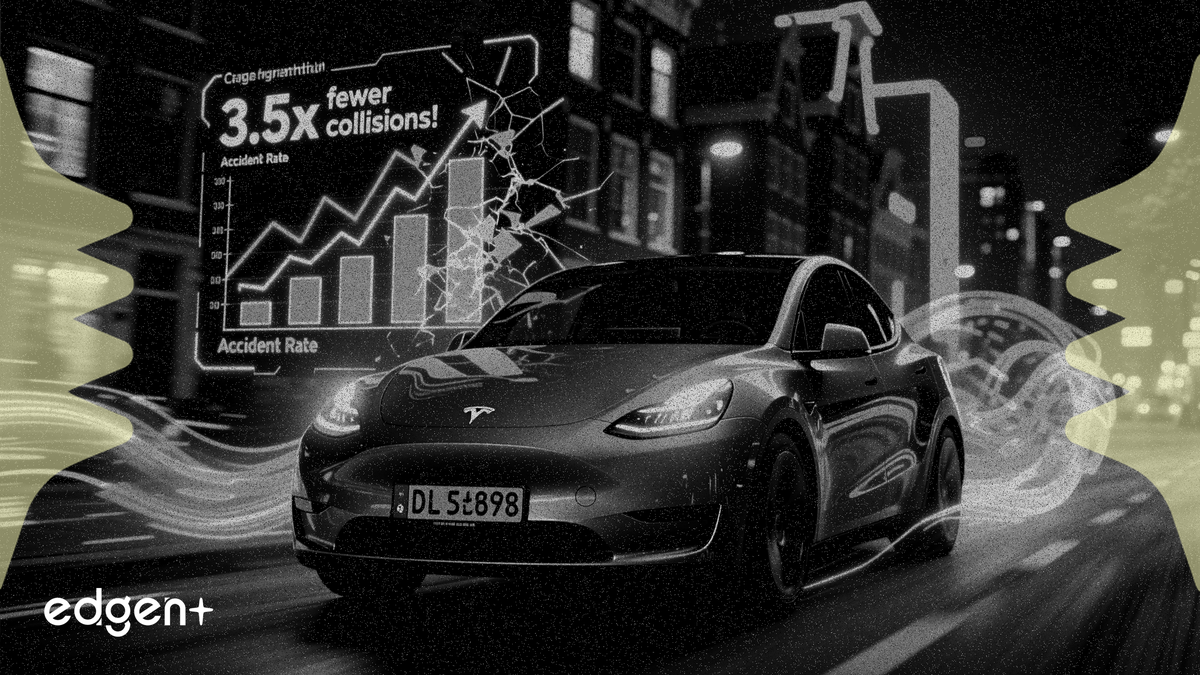
Tesla's Full Self-Driving system recorded 3.5 times fewer collisions than human drivers across 16.6 million kilometers on Dutch roads, giving the company its strongest safety argument yet for expanding the technology across Europe.
"As with many new innovations...they come slowly, then all at once," Cathie Wood, chief executive of ARK Invest, said after sharing video of her Tesla robo-taxi ride in Austin, Texas. Wood noted the car had accumulated a $75 parking ticket — "something we hadn't thought of before" for the financial model.
On highways, FSD-equipped Teslas recorded a 3.4 times reduction in collision rates with zero reported collisions across 16.6 million kilometers driven between April 10 and June 5, 2026. On non-highway roads, where most serious traffic injuries in the Netherlands occur, the improvement was a more modest 1.6 times. The data covers approximately 20 million to 23.6 million cumulative kilometers across the Netherlands and Lithuania, the two European markets where FSD Supervised is active.
The Netherlands' vehicle authority, the RDW, has been engaging with the European Commission on the initiative, which could accelerate acceptance across other EU member states. For Tesla, European approval would unlock a subscriber base that could meaningfully offset slowing EV sales growth — the company ended the first quarter with about 1.3 million FSD subscribers paying $99 monthly in the US.
The Data Behind the Claim
All of the safety data comes from Tesla's own telemetry, with no independent verification reported. Tesla is both the manufacturer of the system and the sole auditor of its safety performance, a fact that European regulators are likely to scrutinize. Mercedes beat Tesla to Level 3 conditional automation approval in certain European markets, but Tesla's approach — relying on fleet-scale data collection from millions of vehicles and continuous over-the-air updates — gives it a structural advantage in iteration speed that competitors cannot easily replicate.
The FSD Supervised label is important context: this is not fully autonomous driving. A human driver must remain attentive and ready to take over at all times. The system is classified as a driver-assistance tool under SAE Level 2, not a self-driving one. This distinction matters for regulatory classification and liability frameworks across EU member states.
What This Means for Investors
Tesla shares traded as high as $418.50 on Tuesday before closing at $396.68, down 3% in a session where the Nasdaq Composite fell 1% and the S&P 500 dropped 0.3%. The early gains reflected optimism around the Dutch data and Wood's endorsement, but the broader tech selloff erased the advance. The Dow Jones Industrial Average added 0.2%, highlighting the tech-heavy nature of the day's weakness.
The financial stakes are clear. Tesla earned $3.12 per share in 2023 on about 1.8 million vehicle deliveries. By 2025, that figure declined to $1.66 per share despite 1.6 million EVs sold. The robo-taxi operation, launched about a year ago in Austin, and FSD subscription services represent the anticipated recovery pathway. JPMorgan recently upgraded Tesla from underweight to neutral, raising its price target from $145 to $475. Goldman Sachs and Deutsche Bank both initiated coverage with buy ratings. Among 43 analysts tracked by MarketBeat, 22 recommend buying TSLA, 16 suggest holding, and five advise selling, with a consensus price target of $404.37.
Institutional investors control 66.2% of outstanding shares, with Vanguard increasing its stake by 2.6% to more than 258 million shares and Norges Bank establishing a fresh position worth approximately $17.1 billion.
Investors should watch two developments closely: whether the RDW's engagement with the European Commission produces concrete timelines for broader EU approval, and whether Tesla opens the door to independent verification of its safety claims, which would substantially increase the credibility of these metrics and likely accelerate regulatory acceptance across skeptical European markets.
This article is for informational purposes only and does not constitute investment advice.
