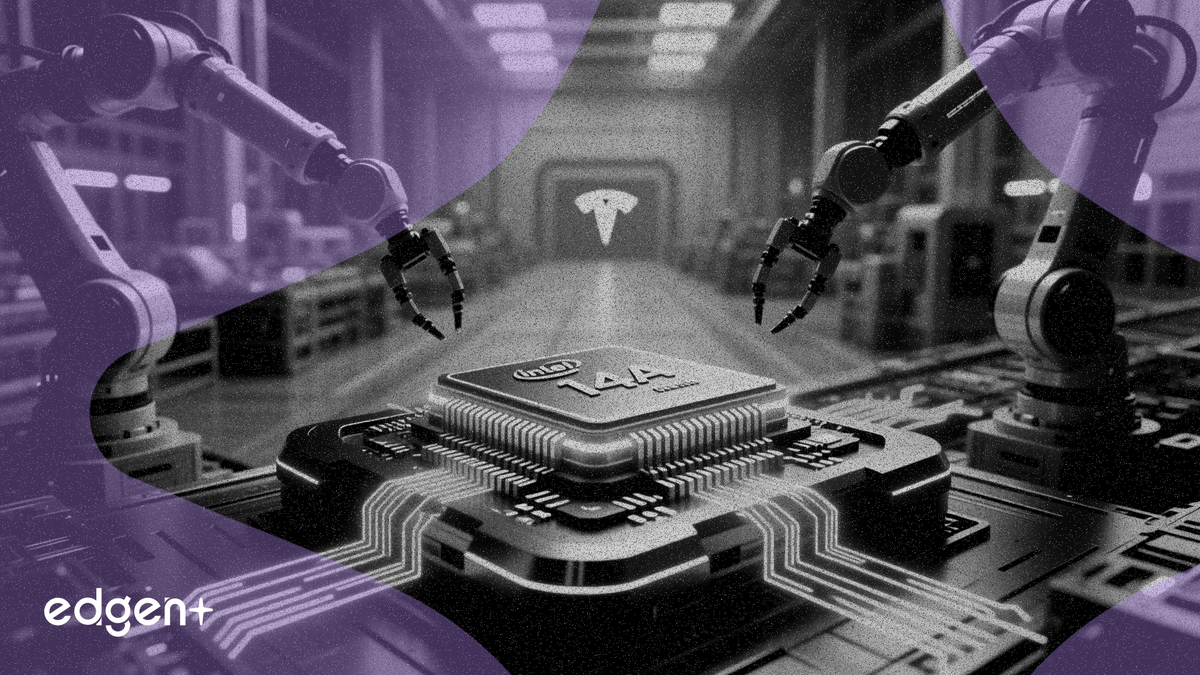
Tesla Inc. is making a significant move into semiconductor manufacturing, announcing plans to use Intel Corp.’s 14A process for a new chip-making venture with an initial research cost of around $3 billion. The initiative, dubbed “Terafab,” aims to vertically integrate Tesla’s hardware supply chain to support its ambitious expansion into artificial intelligence and robotics.
"We are still working out the details," Tesla CEO Elon Musk said during the company's Q1 2026 earnings call, regarding the responsibilities between the parties involved. Musk confirmed Tesla will work on the research fab, while his SpaceX company will handle the "initial part of the large-scale Terafab."
The plan involves a $3 billion research initiative at Tesla's Gigafactory in Texas to validate the production process using Intel's 14A process technology. This represents a major design win for Intel's foundry services, securing a high-profile and high-volume customer. For Tesla, it marks a critical step in controlling the hardware stack for its future products, from robotaxis to the Optimus humanoid robot.
This strategic pivot is about securing the massive computing power needed for Tesla's future. The company is not just building cars anymore; it's building autonomous machines that require immense data processing. By designing its own chips with Intel's advanced manufacturing, Tesla aims to create a closed-loop system that could lower costs and improve performance, reducing its dependency on current market leader Nvidia Corp.
From EVs to Robotics
The push into custom silicon is directly tied to Tesla's shift toward a "robotics-first future." The company announced it will begin production of its Optimus humanoid robot at its Fremont, California facility in the second quarter. This transition involves phasing out the legacy Model S and Model X production lines to create a first-generation robotics plant with a capacity of one million units annually.
While Fremont ramps up, Tesla is already breaking ground on a second-generation facility at Giga Texas, targeting a long-term production capacity of 10 million robots per year. To support this scale, Tesla is developing its own AI5 inference processor, designed to handle the intense computational demands of both the robotaxi fleet and the Optimus program. This follows the company's development of the D1 chip for its Dojo training supercomputer.
The "Terafab" and Digital Optimus
The Terafab is the physical manifestation of this strategy. While details remain murky, Musk's comments suggest a multi-company effort to build a massive new chip-making operation. Alongside the hardware, Tesla is also developing "Digital Optimus," an intelligence layer designed to automate digital workloads, complementing the real-world AI that will power the physical robots.
The move is a direct challenge to established semiconductor giants. By bringing chip design and manufacturing in-house—or at least into a closely controlled partnership—Tesla can tailor silicon to its exact needs. This could provide a significant competitive advantage in the burgeoning fields of autonomous vehicles and humanoid robotics, markets that are expected to be worth trillions ofdollars. For Intel, it's a powerful validation of its turnaround strategy and a chance to capture a significant share of the automotive and AI chip market.
This article is for informational purposes only and does not constitute investment advice.