

SpaceX will launch its first Nvidia-powered Starmind AI1 satellites in Q4 2027, a year ahead of the timeline in its IPO prospectus.
SpaceX will launch its first Nvidia-powered Starmind AI1 satellites in Q4 2027, a year ahead of the timeline in its IPO prospectus.
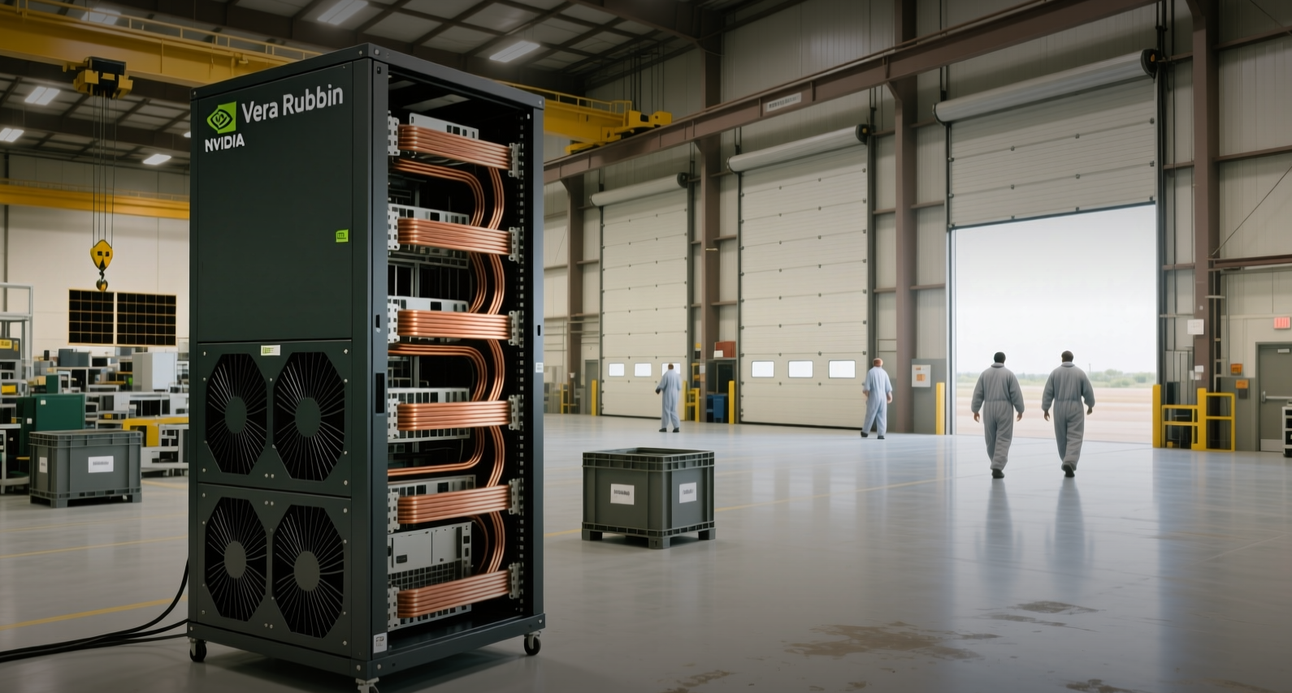
SpaceX will launch its first Nvidia-powered Starmind AI1 satellites into orbit in Q4 2027, pulling forward a space data center buildout that deepens an exclusive chip partnership with Nvidia.
"Agentic AI requires a new kind of computing system — one built not only to generate answers, but to take action," Ian Buck, Nvidia's vice president of hyperscale and high-performance computing, said.
The space-optimized Vera Rubin NVL72 system, designed jointly by the two companies, will be produced in Bastrop, Texas, where SpaceX's AI satellite manufacturing base is located. Musk described the design as "simpler, lower cost, higher density, lighter weight than traditional racks." SpaceXAI president Mike Nicolls said Vera's CPU performance and memory bandwidth let the company run "enormous amounts of orchestration, code and data processing while keeping GPUs doing what they do best."
The accelerated timeline — a year ahead of the 2028 deployment in SpaceX's IPO prospectus — lands as Nvidia prepares to report fiscal second-quarter results Wednesday after the close, with analysts expecting roughly $92 billion in revenue, nearly double a year earlier. Morgan Stanley's Adam Jonas projects SpaceX AI capital spending of about $53 billion in 2026, rising to $130 billion in 2027.
The partnership, formalized last month, makes Nvidia the sole chip supplier for SpaceX's AI infrastructure. SpaceX plans to use the Vera Rubin platform to expand compute for its Grok chatbot and related services, and Musk told investors earlier this month that SpaceX will receive a "considerable proportion" of Nvidia's GPU supply in 2027. The first-generation Starmind AI satellite will be based on an optimized Vera Rubin NVL72 system, extending the pairing already outlined for AI1 satellites.
Vera Rubin, Nvidia's next-generation platform now ramping into full production with shipments scheduled to begin this fall, pairs the Vera CPU with the Rubin GPU. The orbital deployment marks the first public flight date attached to a space-tuned NVL72 rack, extending the architecture from terrestrial AI factories to orbit.
The economics of orbital data centers remain steep. Wood Mackenzie estimates a 1-gigawatt orbital data center would cost about $170 billion — more than three times a comparable ground facility. Supporters argue falling launch costs, driven by SpaceX's Starship program, will gradually improve the economics, while critics note ground data centers retain a clear operating-cost advantage for years.
SpaceX's compute expansion is not limited to space. Musk said the company plans to accumulate more than 2 gigawatts of AI compute by the end of 2026 and push "closer to 10 gigawatts than 5 gigawatts" by the end of 2027. SpaceX already operates data centers in Tennessee and Mississippi and is reportedly planning at least one more in Texas. Musk said Aug. 4: "The whole industry is sprinting toward larger compute demands. We are rapidly expanding compute to meet our own needs from Grok's expansion, as well as external demand from leading companies like Google and Anthropic."
On the ground, SpaceX and Tesla are jointly pursuing a chip manufacturing project in Grimes County, Texas, with an initial investment of at least $16.8 billion in the Terafab project.
Nvidia shares fell 2.9 percent Monday and SpaceX slipped 1.4 percent as investors focused on the earnings report rather than the orbital announcement. Nvidia, trading at about 24 times this fiscal year's earnings and 16 times next year's target, has fallen in the days following each of its last four earnings reports despite beating profit estimates. Cantor Fitzgerald's C.J. Muse told clients it is time to "close your eyes" and bet heavily on Nvidia, while BMO Capital initiated coverage with an Outperform rating and a $340 price target.
This article is for informational purposes only and does not constitute investment advice.
