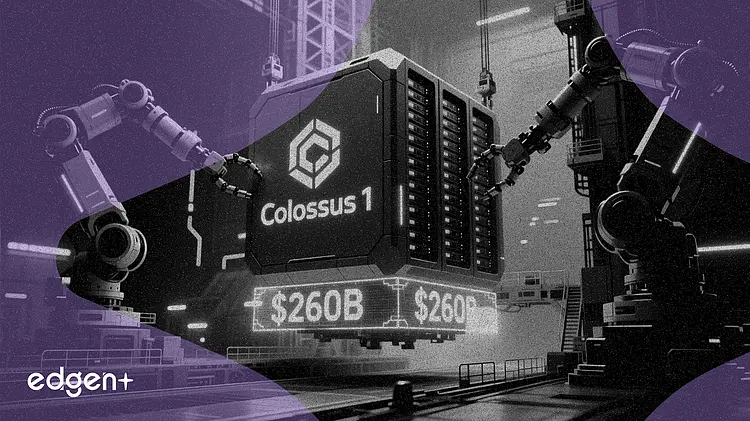
SpaceX couldn't make its own Colossus 1 data center work for training Grok, so it leased the entire facility to Anthropic for $1.25 billion a month.
SpaceX's Colossus 1 data center in Memphis was supposed to train the company's most advanced Grok models. Instead, it became a $1.25 billion-a-month revenue stream for Anthropic after SpaceX's own engineers couldn't overcome latency and hardware mismatch issues, according to people familiar with the matter who spoke to Bloomberg.
"SpaceX determined the facility would be more valuable generating revenue than sitting underutilized," Bret Johnsen, SpaceX's chief financial officer, said in a statement. The company has not abandoned internal AI work, he added, and retains the right to reclaim the capacity with 90 days' notice.
The 300-plus-megawatt facility houses more than 220,000 Nvidia GPUs spanning multiple chip generations — Hopper and Blackwell systems alongside older accelerators. That hardware heterogeneity created bottlenecks in distributed training, where slower chips force faster ones to wait. Colossus 2 and 3, built more uniformly around Blackwell chips, avoided the problem. The network links between Colossus 1 and the other two campuses, located more than 10 miles away, introduced latency that made cross-site training impractical.
The leasing arrangement transforms SpaceX from an AI builder into an AI landlord. Combined with a $920 million monthly deal with Google starting in October, SpaceX is collecting approximately $2.17 billion per month — or $26 billion annualized — from compute infrastructure it originally built for itself. The contracts, totaling more than $700 billion in aggregate value, became a centerpiece of SpaceX's IPO roadshow, which targets a roughly $750 billion valuation.
Why Colossus 1 couldn't train Grok
SpaceX built Colossus 1 in 122 days — a speed it touted during its IPO roadshow as exceeding industry averages. But speed came at a cost. The facility's mixed hardware inventory, combining older Nvidia accelerators with newer Hopper and Blackwell chips, created performance mismatches that degraded training efficiency. In distributed AI clusters, the entire system runs at the speed of its slowest component.
The network infrastructure connecting Colossus 1 to the other two campuses compounded the problem. Training frontier models requires ultra-fast, low-latency links between nodes. With Colossus 1 sitting more than 10 miles from the other sites, the older networking gear couldn't sustain the synchronization speed needed for large-scale training runs.
The result: SpaceX's most ambitious AI training cluster was effectively stranded. Rather than invest in costly network upgrades and hardware standardization, the company chose to monetize the capacity externally.
The $26 billion accidental business
Anthropic is paying $1.25 billion per month through May 2029 for access to Colossus 1 and Colossus II facilities — roughly $45 billion over three years. The deal gives Anthropic a temporary lifeline as it struggles with unpredictable demand for Claude, Claude Code, and the Opus model family. Users have reported rate limits and degraded performance during peak hours as the company has been capacity-constrained for months.
The arrangement is temporary: a 180-day lease with a 90-day mutual cancellation clause. Musk has said SpaceX could reclaim the capacity "if compute gets super tight." But Grok's declining traction — downloads fell from 20 million in January to 8.3 million in April, with paid conversion at a fifth of ChatGPT's — makes that reclamation less urgent.
For investors, the pivot raises questions about SpaceX's AI infrastructure narrative. The company presented its data center buildout as a strategic advantage during IPO roadshows, emphasizing construction speed and scale. The revelation that Colossus 1's technical limitations forced an external lease — to a competitor, no less — complicates that story. Critics have also questioned whether the lease pricing exceeds market rates and whether the deal structure involves circular financing between Musk-linked entities.
SpaceX shares opened at around $150 on their Nasdaq debut, an 11% premium to the IPO price, and surged as much as 30% in early trading before closing up 19%. The stock briefly pushed SpaceX's market value above $2.2 trillion.
The broader lesson for the AI industry: owning the hardware isn't the same as being able to use it. Geography, networking, and integration complexity can turn a data center into stranded capacity. As frontier labs compete for 100,000-plus-GPU clusters, the physical constraints of compute — not just model architecture — are becoming the binding bottleneck.
This article is for informational purposes only and does not constitute investment advice.