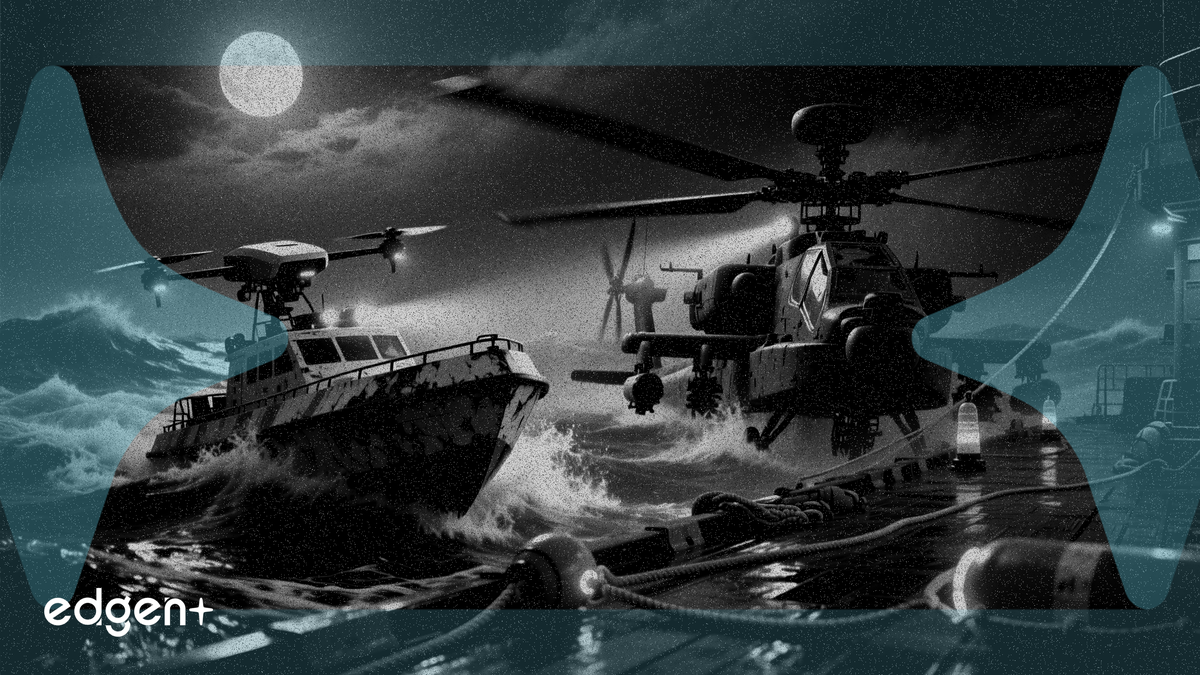
A Saronic Corsair drone boat rescued two US Army helicopter crew members near the Strait of Hormuz on Monday, the first known combat rescue by an unmanned surface vessel, validating a defense tech startup now valued at $9.25 billion.
"The soldiers were safely rescued within approximately two hours and are in stable condition," US Central Command said in a statement Tuesday. The Corsair, a 24-foot autonomous vessel built by Austin-based Saronic Technologies, ferried the downed Apache crew to a staging point where a helicopter hoisted them to safety.
The Corsair can travel at more than 35 knots with a range exceeding 1,000 nautical miles and a payload capacity of 1,000 pounds. Task Force 59, the Navy's AI and drone unit established in 2021, began operating the vessels in March under a $392 million contract awarded to Saronic in December 2024. The company has built more than 300 Corsair platforms, which have logged over 100,000 nautical miles across multi-day missions.
The rescue comes as the US war with Iran stretches past 100 days and the Strait of Hormuz remains largely closed to commercial shipping. President Donald Trump said on Truth Social that Iran shot down the Apache, adding that the US "must, of necessity, respond to this attack." The cause remains under investigation, though CNN reported, citing US officials, that the helicopter was struck by an Iranian Shahed drone.
From an $800 raft to a $9.25 billion defense contractor
Saronic was founded in 2022 by former Navy SEAL Dino Mavrookas, who spent more than a decade in the elite commando unit, along with Rob Lehman, Vibhav Altekar and Doug Lambert. The company built its first prototype in under six months by modifying an $800 Amazon raft with $30,000 worth of cameras, sensors and batteries, Mavrookas said in a podcast interview last year.
The company now employs 1,600 people across facilities in the US, UK and Australia. Its 500,000-square-foot Texas plant can produce thousands of Corsair and Mirage boats annually. A $300 million investment in a Louisiana shipyard will produce the Marauder, a 180-foot vessel designed and launched in under a year. Saronic is also seeking a site for "Port Alpha," a next-generation shipyard for larger vessels.
Saronic's product line spans three diesel-powered autonomous vessels: the 24-foot Corsair, the 52-foot Mirage and the 180-foot Marauder. All are fully modular, allowing operators to equip them with any payload, and a single operator can control up to 100 boats simultaneously, according to Mavrookas.
The company has raised $1.75 billion in a Series D round from blue-chip defense investors including Joe Lonsdale's 8VC, Caffeinated Capital and Andreessen Horowitz. Venture capital funding for defense technology reached $29 billion in 2025, triple the 2020 total, according to S&P Global Market Intelligence data.
The Pentagon is accelerating its push into unmanned surface vessels. In July, the Navy issued a solicitation for the Modular Attack Surface Craft program, seeking high-endurance USVs capable of carrying large payloads, including missiles, thousands of miles at sea. The Navy plans to deploy potentially thousands of Corsairs, Reuters reported.
"No longer should we send people if we have the opportunity to send a robot," Mavrookas said. "We have a responsibility to keep people safe."
This article is for informational purposes only and does not constitute investment advice.