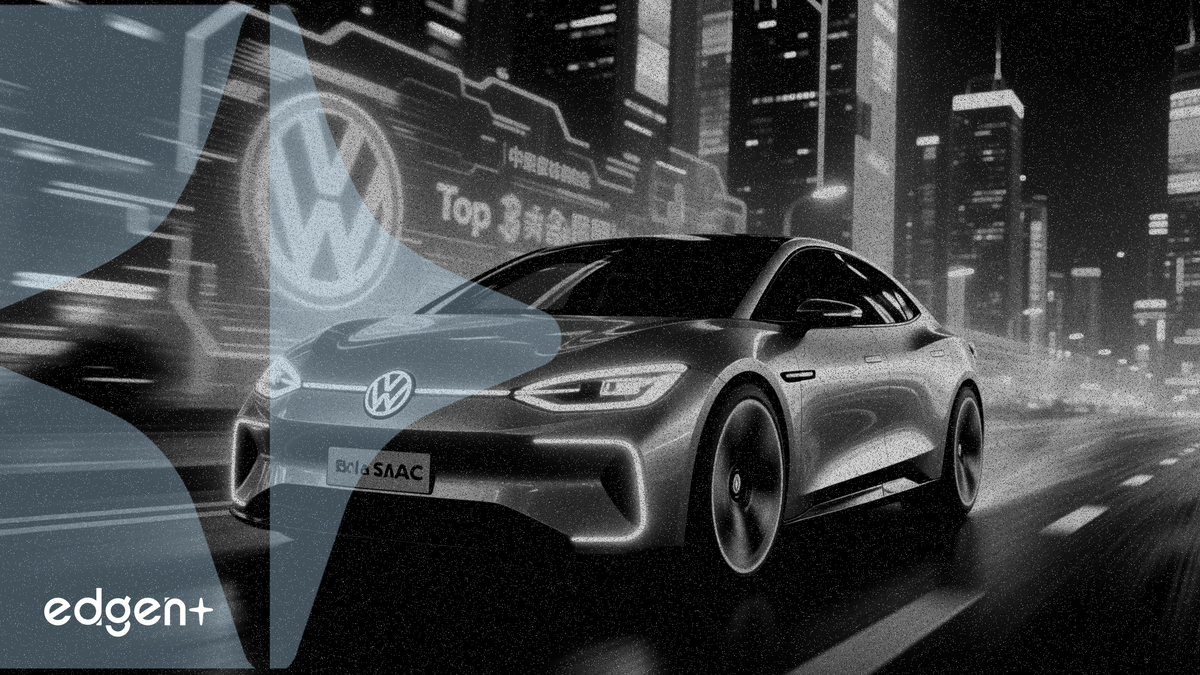
SAIC Volkswagen is charging into China’s competitive large SUV market with its ID.ERA9X, a flagship model developed under a new strategy that gives its Chinese team the lead in defining a vehicle designed for global export. The move is a direct challenge to local leaders like Li Auto and AITO, as the German automaker seeks to reclaim ground in the world’s largest EV market.
“We know the pain points and we know time is short, so we must lead with a flagship,” SAIC Volkswagen General Manager Tao Hailong said. The company aims for the ID.ERA9X to secure a top-three position in its segment. This launch marks a significant strategic shift for Volkswagen, which previously struggled to adapt to the speed of China’s EV market.
The ID.ERA9X is a large extended-range SUV over 5.2 meters long with a wheelbase exceeding 3 meters. It integrates German chassis tuning with Chinese technology, including a smart driving system from Momenta. The vehicle is the first of 7 new energy models SAIC Volkswagen plans to launch by 2026, a product offensive intended to push NEV sales above 20 percent of its total volume. Deliveries for the ID.ERA9X are set to begin on April 25.
This “Joint Venture 2.0” model represents a crucial pivot for Volkswagen. After missing the initial boom in China’s NEV market due to slow decision-making and software development delays, the company is now empowering its Chinese operations to drive product development. “In the past, joint ventures did not grasp the fastest-growing period of the new energy market because the right to define products was not in China,” said Deputy General Manager Fu Qiang. The ID.ERA9X, and the six models that will follow, are Volkswagen’s high-stakes bid to prove it can compete on both technology and speed.
A New Approach to Win Back Buyers
The strategy reversal comes as domestic Chinese brands have reshaped consumer expectations with rapid innovation in smart features and user experience. While Volkswagen dominated the internal combustion era with a reputation for reliability, it lost ground to rivals like Li Auto, which popularized the "dad car" concept, and Huawei-backed AITO, which raised the bar for in-car technology.
To counter this, the ID.ERA9X combines Volkswagen’s engineering strengths—such as its EA211 engine used as a range extender and its chassis expertise—with a supply chain of Chinese tech partners. This hybrid approach is designed to win back brand loyalists who switched to domestic EVs and attract new buyers. The company is also overhauling its sales and service channels, moving to a more direct-to-consumer model and expanding its retail footprint beyond traditional 4S dealerships.
Global Ambitions, Chinese Roots
A key part of the new strategy involves exporting vehicles developed in China to the rest of the world. The ID.ERA9X was designed from the start with global markets in mind, including right-hand drive versions for markets like Australia. Fu Qiang stated the car will be driven to Volkswagen's German headquarters to show the global team what the Chinese-led product definition can achieve.
This plan to turn China into an export hub for its most advanced vehicles is a first for Volkswagen. The success of the ID.ERA9X and the subsequent 6 models—which will include pure electric SUVs developed with XPeng and new plug-in hybrid sedans—will be a critical test for this new model. It could determine whether legacy joint ventures can stage a comeback and carve out a significant share of China's electric future.
This article is for informational purposes only and does not constitute investment advice.