

Nvidia's Jensen Huang says AI compute is now revenue, underpinning a $500 billion infrastructure financing push.
Nvidia's Jensen Huang says AI compute is now revenue, underpinning a $500 billion infrastructure financing push.
AI computing has crossed from capital expense into recurring revenue, Nvidia's Jensen Huang said, framing the chipmaker's $96.2 billion quarter as the start of a cycle backed by $500 billion in outside capital.
"AI has reached its inflection point. It's doing useful work. Its tokens are productive and profitable. Now, compute is revenue," Huang, founder and chief executive of Nvidia, said in the company's fiscal second-quarter release.
Nvidia reported revenue of $96.2 billion for the quarter ended July 26, up 106 percent from a year earlier and 18 percent from the prior quarter, with data center sales of $89.0 billion climbing 117 percent. Non-GAAP earnings per share came in at $2.22. The company guided third-quarter revenue to $108.0 billion, plus or minus 2 percent, and said it is not assuming any data center compute revenue from China in that outlook.
The statement lands as Nvidia and six of the world's largest asset managers — Apollo, BlackRock, Blackstone, Brookfield, Goldman Sachs and KKR — announced plans to mobilize more than $500 billion in third-party capital for AI infrastructure. Huang's framing recasts a GPU cluster as a toll road: installed, powered and connected, it generates usage-based income for years rather than depreciating from the moment of purchase.
The shift in framing is more than rhetoric. Apollo president Jim Zelter called modern compute "a scarce, mission-critical asset class with compelling investment characteristics," while Goldman Sachs chief executive David Solomon described the partnership as a turning point in a historic AI investment cycle. The two firms are among six asset managers backing standalone compute-financing vehicles that would let pension funds and insurers own AI capacity the way they own toll bridges and power plants.
The economics support the thesis. Nvidia projects its Blackwell and upcoming Vera Rubin architectures will generate a cumulative $1 trillion in revenue between 2025 and the end of 2027. Vera Rubin, now in full production, is ramping at partners including CoreWeave, Google Cloud, Microsoft Azure, Oracle Cloud Infrastructure and Nebius. International Data Corp. expects worldwide AI infrastructure spending to reach roughly $487 billion in 2026 and pass $1 trillion by 2029.
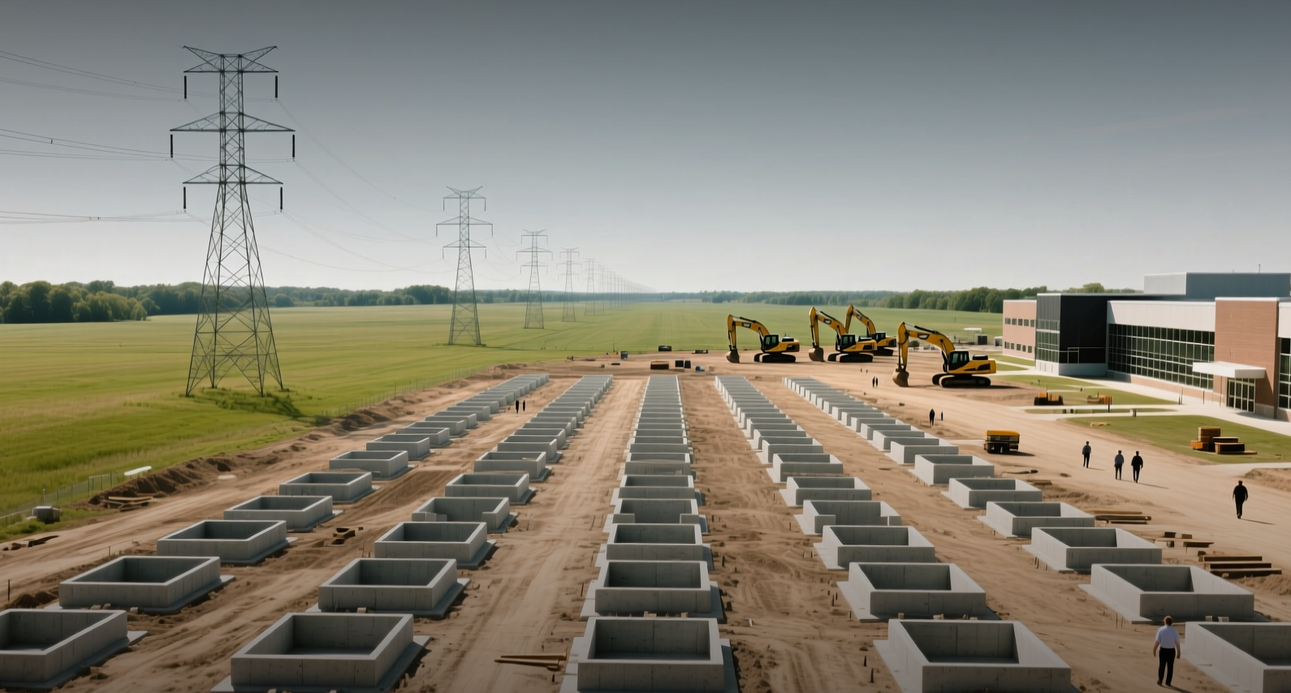
The constraint on that buildout is no longer silicon but electricity. The International Energy Agency projects data center power use will roughly double by 2030 to near 945 terawatt-hours, with accelerated-server demand growing about 30 percent a year — four times faster than all other sectors combined. Nvidia has responded by securing land, power and shell capacity through a partnership with SB Energy at a technology campus in Ohio, and by teaming with SK Telecom, NAVER and Brookfield to build gigawatt-scale AI factories in Korea.
For investors, the question is whether the market has priced in the shift. Nvidia returned about $26 billion to shareholders in the quarter and has $99 billion remaining under its buyback authorization, while shares have pulled back from May 2026 highs to the $210-$215 range. Options markets are pricing a 5-6 percent post-earnings move in either direction, above recent averages, as traders weigh whether the $500 billion financing push converts into the sustained demand Huang's "compute is revenue" thesis requires. Rival AMD, which has trailed Nvidia in data center GPUs, stands to gain if the financing wave broadens procurement beyond a single supplier.
This article is for informational purposes only and does not constitute investment advice.
