

Nvidia and Hyundai Motor Group are in final-stage negotiations to build an artificial intelligence research and development hub in South Korea, deepening ties between the world's largest AI chipmaker and a global automotive powerhouse.
Nvidia and Hyundai Motor Group are in final-stage negotiations to build an artificial intelligence research and development hub in South Korea, deepening ties between the world's largest AI chipmaker and a global automotive powerhouse.
Nvidia and Hyundai Motor Group are in final-stage negotiations to build an artificial intelligence research and development hub in South Korea, deepening ties between the world's largest AI chipmaker and a global automotive powerhouse.
Nvidia Corp. and Hyundai Motor Group are in final talks to build an AI research and development hub in South Korea, a partnership that would embed the chipmaker deeper into the country's automotive and robotics supply chains.
"The collaboration would give Nvidia a dedicated R&D base in one of the world's fastest-growing AI markets," a person with knowledge of the matter said. Nvidia Chief Executive Jensen Huang is expected to meet Hyundai Motor Group Executive Chair Euisun Chung on Friday in Seoul to finalize the agreement, according to the Korea Economic Daily.
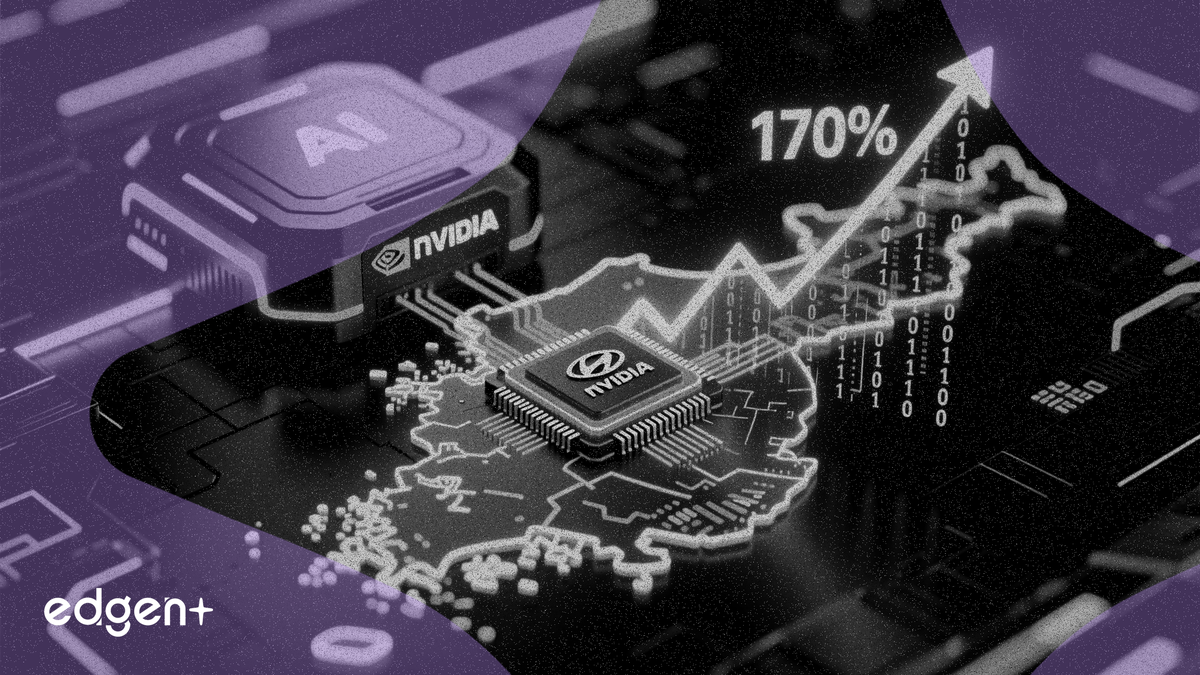
The talks come as South Korea's semiconductor exports surged nearly 170% in May to a record high, helping the country's total exports post their biggest gain in more than four decades. The Kospi index has more than doubled over the past year, with Samsung Electronics shares rising 10.1% to a record close on Monday and LG Electronics gaining 29.9% for a second straight session.
For Nvidia, the hub would provide proximity to its two largest memory-chip suppliers — Samsung Electronics and SK Hynix — and to Hyundai, one of the world's top automakers investing heavily in autonomous driving and robotics. For South Korea, the facility would cement its role as a critical node in Nvidia's global AI infrastructure, following last year's agreement to supply more than 260,000 of Nvidia's most advanced AI chips to the country's government and largest businesses.
Huang's visit to Seoul on Friday caps a two-week Asia trip that included the Computex trade show in Taipei, where he hosted the first-ever "Korean Partner Night" dinner with executives from Samsung, SK Hynix, LG Electronics and Naver. At the dinner, Huang described South Korea as "a critical part of our ecosystem" and said he hoped to "contribute to robotics in Korea."
The Hyundai partnership would extend Nvidia's reach beyond chips into physical AI — the application of artificial intelligence to robots, autonomous vehicles and industrial automation. Hyundai has been expanding its robotics ambitions through its Boston Dynamics subsidiary, maker of the Atlas humanoid robot, while Nvidia's Isaac platform provides the simulation environment and pre-trained models for training such machines.
LG Electronics is pursuing a parallel path. LG and Nvidia have been working to integrate LG's CLOi humanoid robot with Nvidia's Isaac robotics platform, according to people familiar with the matter. A meeting between LG Electronics President Ryu Jae-cheol and Nvidia's senior director for Omniverse and Robotics laid groundwork for combining LG's home robot with Isaac's physics-based training pipeline. LG Group Chairman Koo Kwang-mo is expected to meet Huang on Friday to formalize that arrangement.
The deepening ties with Korean conglomerates come as Nvidia ramps production of its Vera Rubin AI platform, which entered full production this month. Samsung and SK Hynix are among three suppliers of the sixth-generation HBM4 memory powering the system, with SK Hynix holding the largest allocation at an estimated 60% to 70% of volume and Samsung supplying roughly 25% to 30%, according to industry analysts. Samsung began mass-producing HBM4 in February and has shipped early samples of the next-generation HBM4E memory to customers including Nvidia.
Nvidia shares have more than tripled over the past year as the AI boom drives demand for its data center chips. The Korea R&D hub, if finalized, would give Nvidia a beachhead in a country that is both a critical supplier of memory chips and a growing consumer of AI infrastructure. For Hyundai, the partnership could accelerate its autonomous driving timeline and robotics ambitions, areas where the automaker has trailed Tesla Inc. and other competitors. Hyundai Motor Group shares have gained 45% this year, lagging the Kospi's 100% surge.
This article is for informational purposes only and does not constitute investment advice.
