

Japan's top robotics and manufacturing companies are building on Nvidia's Cosmos platform to bring physical AI into factories, farms and hospitals.
Japan's top robotics and manufacturing companies are building on Nvidia's Cosmos platform to bring physical AI into factories, farms and hospitals.
Nvidia enlisted 10 of Japan's largest industrial companies to join its Cosmos Coalition, betting the nation's manufacturing heritage can accelerate physical AI deployment across factories, farms and hospitals.
"The next frontier of AI is in the physical world, and this is a once-in-a-generation opportunity for Japan," Jensen Huang, founder and chief executive officer of Nvidia, said. "Japan invented modern manufacturing. Now, it has the opportunity to reinvent it for the age of intelligent industries."
The coalition includes FANUC, Yaskawa Electric, Kawasaki Heavy Industries, Hitachi, Sony Group, SoftBank Corp., NEC, Kubota, Fujitsu and AIRoA. Nvidia also introduced Cosmos 3 Edge, a 4-billion-parameter model for on-device vision reasoning and robot policy deployment on its Jetson Thor platforms. The lightweight model, built on Nvidia's Nemotron architecture, can be adapted for specific robots, vehicles and environments in about a day, the company said.
The partnerships position Nvidia's physical AI stack — spanning Cosmos world models, Isaac robotics development tools, Metropolis vision AI libraries and Jetson edge hardware — as the foundational platform for Japan's next industrial wave. Japanese manufacturers spent an estimated $35 billion on industrial automation in 2025, according to the Japan Robot Association, a figure that could grow as AI-powered machines replace traditional programmable logic controllers.
Cosmos 3 Edge Brings Frontier AI to the Factory Floor
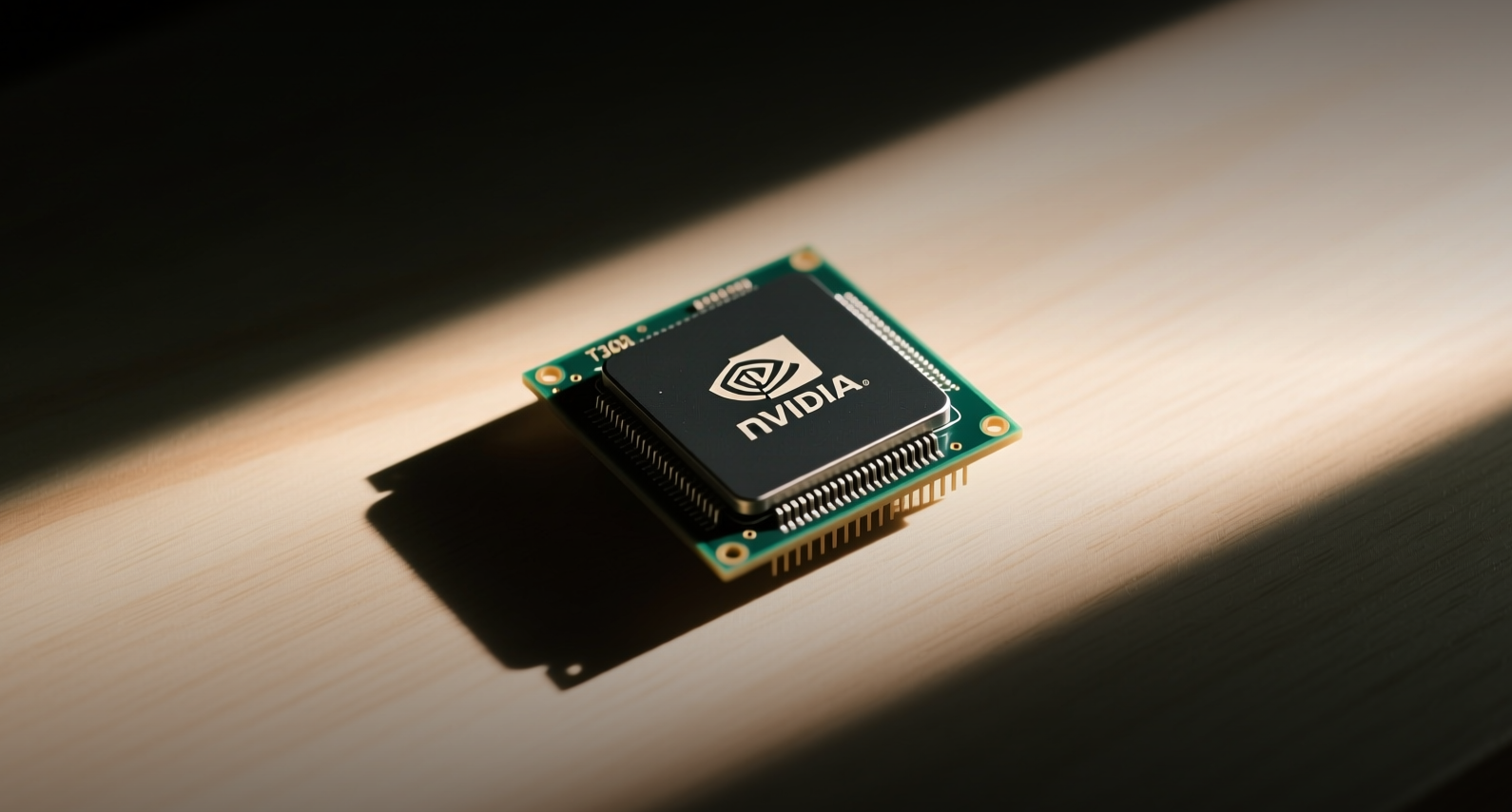
Cosmos 3 Edge runs on Nvidia's newly announced Jetson Thor modules, including the T3000 and T2000. The T3000 delivers 865 FP4 teraflops of AI compute with a Blackwell GPU, an eight-core Neoverse Arm CPU and 32 gigabytes of LPDDR5X memory in a form factor roughly half the size of the T5000. The T2000 offers 400 FP4 teraflops and 16 gigabytes of memory as a lower-cost entry point for autonomous mobile robots and industrial manipulators. Both modules are scheduled for availability in the first quarter of 2027.
The model helps robots understand their surroundings, reason in real time and generate actions locally without cloud connectivity — a requirement for factory environments where latency and data privacy matter. Nvidia's Metropolis libraries, also announced alongside Cosmos 3 Edge, help developers build video intelligence systems at least six times faster using coding agents, the company said.
Fujitsu is exploring a collaborative control platform with FANUC, Yaskawa Electric and Kawasaki Heavy Industries that integrates Nvidia's full physical AI stack, including Cosmos world foundation models, the Isaac robotics platform, Omniverse NuRec libraries and the Newton physics engine. The platform would support digital twins, robot learning, simulation-to-real workflows and pre-deployment validation across industrial sectors.
SoftBank Corp. is developing its own physical AI platform built on Cosmos, Omniverse and Isaac Sim, while also advancing AI-RAN initiatives using Nvidia's AI Aerial technology to deliver connectivity for billions of physical AI devices. NEC, Hitachi, OMRON and Preferred Networks are using Cosmos for world models and industrial AI research.
Japan's Industrial Giants Spread Physical AI Across Sectors
The applications span Japan's industrial base. Kawasaki Heavy Industries is applying Nvidia's physical AI technologies across healthcare, shipbuilding, transportation, aerospace and energy. Kubota is exploring Cosmos-based physical AI for autonomous agriculture and smart farming. Enactic is fine-tuning Nvidia's Isaac GR00T open model for elder-care semi-humanoid robots, while GROOVE X builds Jetson-powered companion robots called LOVOT.
In manufacturing, TRON K.K. is developing data workflows for task-specific physical AI models in assembly, picking, inspection and material handling, alongside factory 3D digitization workflows. Mujin is exploring Cosmos for autonomous robotics powered by its MujinOS operating system. Hitachi, OMRON and Shimizu Corp. are using Metropolis to bring Cosmos-powered vision AI agents into smart-building operations, automated inspection and construction safety, respectively.
The coalition expansion gives Nvidia a beachhead in Japan's industrial automation market, where incumbents like Mitsubishi Electric and Keyence have long dominated. Nvidia shares, trading at about 35 times forward earnings, have gained 140 percent over the past 12 months as investors priced in the physical AI opportunity. The company's data center revenue reached $35.6 billion in its most recent fiscal year, driven largely by AI training and inference workloads that Cosmos aims to extend into robotics and edge computing.
This article is for informational purposes only and does not constitute investment advice.
