

Moore Threads' latest GPU integration with a state-owned enterprise's large language model marks a critical step in China's pursuit of a self-reliant AI technology stack.
Moore Threads' latest GPU integration with a state-owned enterprise's large language model marks a critical step in China's pursuit of a self-reliant AI technology stack.
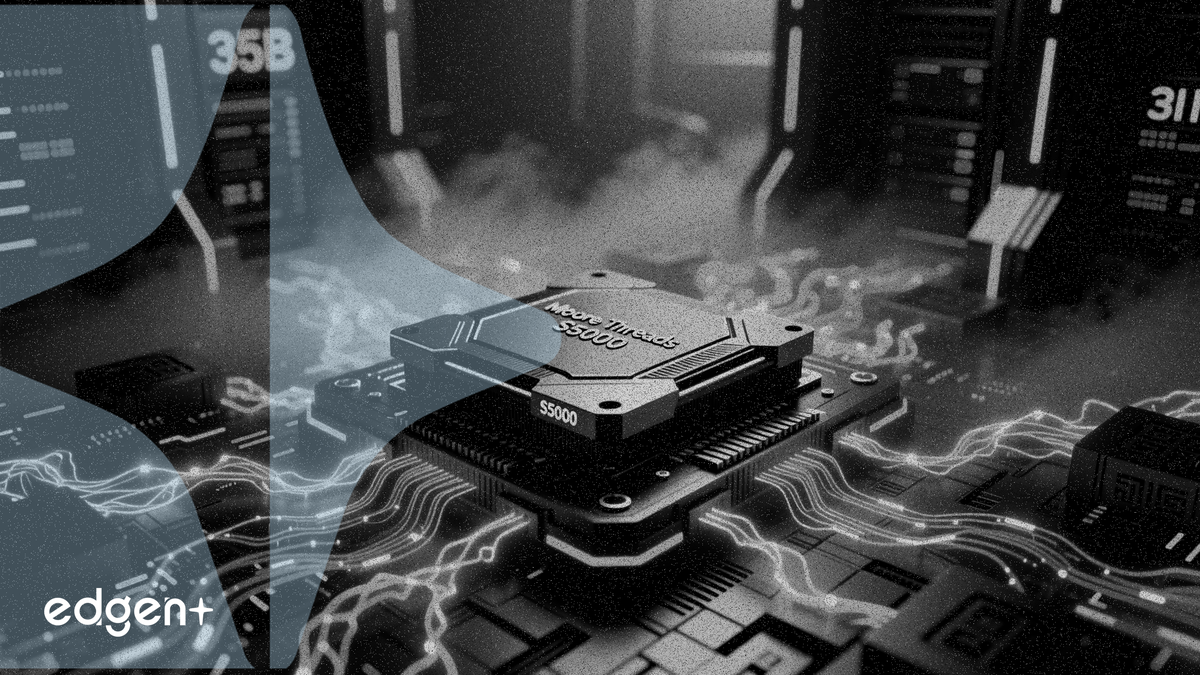
A new partnership between Chinese chipmaker Moore Threads and state-owned telecommunications giant China Mobile signals a major step in the country’s push for a domestic artificial intelligence supply chain. Moore Threads’ flagship MTT S5000 GPU has successfully been adapted to run China Mobile’s upcoming Jiutian 35B large language model, a move that directly challenges the dominance of foreign AI hardware providers like Nvidia in the world’s second-largest economy.
"This collaboration represents a deep synergy between a domestic GPU and a state-owned enterprise's large model, signifying that domestic AI computing power now has the core capability to support the large-scale implementation of industry-level large models," Moore Threads said in a company statement.
The MTT S5000, built on the fourth-generation MUSA "Pinghu" architecture, delivers a reported 1000 TFLOPS of dense AI computing power and supports a full range of precision from FP8 to FP64. This performance is enabled by Moore Threads’ proprietary MUSA software stack and a high-performance inference engine, SGLang-MUSA, which were optimized for the Jiutian model’s requirements for long-text processing and high-concurrency responses. While direct, independently verified comparisons are not yet available, the stated goal is to displace reliance on foreign chips that currently power the majority of AI training and inference workloads in China.
The partnership is a concrete example of "AI Nationalism," a global trend where governments are actively shaping their digital infrastructure to ensure technological sovereignty. For China, this means creating a "fully domestic solution" — from the underlying silicon to the AI application layer — insulating its strategic AI initiatives from foreign technology controls and supply chain disruptions.
This development does not exist in a vacuum. It is a direct result of Beijing’s national strategy, including the "AI Plus" initiative and the 15th Five-Year Plan (2026–2030), which prioritizes semiconductor self-reliance. The move mirrors a broader trend across China's tech sector, where AI companies are increasingly designing their systems around domestically produced chips. As noted in a recent report from state broadcaster CCTV, delays in some Chinese AI models have been attributed to a deliberate shift to integrate and optimize for China-made chips over readily available foreign alternatives.
This national push has created a protected market for domestic champions like Moore Threads to mature their technology and software ecosystems. The collaboration with China Mobile, a core member of the "AI capability joint fleet," provides Moore Threads with a massive, state-backed partner and a clear path to deploying its hardware at scale within critical infrastructure projects, including mobile cloud data centers and "ten-thousand-card" clusters.
The successful integration goes beyond just hardware compatibility. Moore Threads emphasized the full-stack optimization work required to achieve stable, high-performance inference for the Jiutian 35B model. Using its MUSA C development framework, muDNN computing library, and MATE open-source operator library, the company tailored its software to the model's specific attention mechanisms and long-sequence inference needs.
According to the company, internal testing demonstrated that the MTT S5000 can stably support high-concurrency requests for the Jiutian 35B model. This is a critical requirement for enterprise-grade deployments, where reliability and low latency are paramount. The partnership also extends to setting industry standards; Moore Threads recently co-released the "OISA High-Density Super-Node Reference Design Technical Specification" with the China Mobile Research Institute and other partners, aiming to standardize the architecture for domestic AI computing infrastructure.
For investors, the Moore Threads and China Mobile partnership is a key indicator of the progress being made in China's domestic AI hardware sector. It demonstrates a tangible path to commercialization and large-scale deployment for local GPU makers, potentially eroding the total addressable market for foreign competitors like Nvidia and AMD within China over the long term. While the performance of the MTT S5000 has yet to be validated by independent, third-party benchmarks against top-tier international GPUs, the backing of a major state-owned enterprise like China Mobile provides significant validation and a powerful distribution channel.
This article is for informational purposes only and does not constitute investment advice.