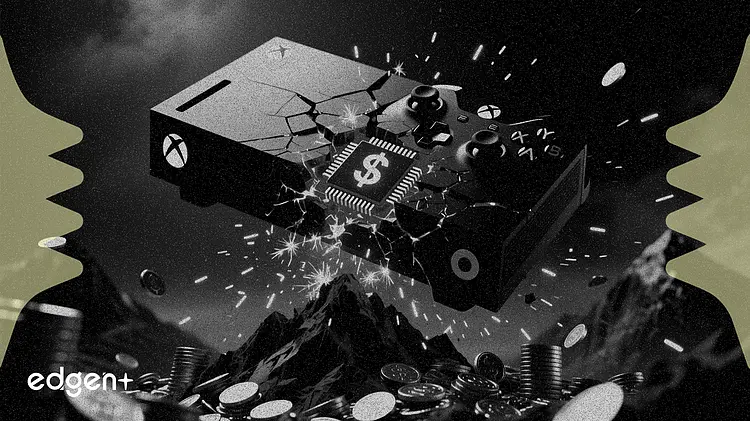
Microsoft's Xbox division is preparing significant layoffs and budget cuts after the close of the fiscal year on June 30, as new Chief Executive Officer Asha Sharma confronts a hardware component crisis that has pushed storage costs five times higher than two years ago.
"Over the past five years, we have spent over $20 billion on ongoing investments in our content, platform, and hardware subsidy, but our annual revenue has declined nearly half a billion during that time," Sharma wrote in a memo to staff that was later published on the Xbox blog. "Going forward, this cannot continue."
The gaming unit will end the fiscal year with an accountability margin of about 3%, down year-over-year, according to the memo co-signed by Xbox executive vice president Matt Booty. Bloomberg reported Wednesday that the layoffs would be "major," citing people familiar with the company's strategy, with significant cuts also expected in marketing and other areas. The reductions would mark the first major restructuring under Sharma, who took over as Xbox CEO in February.
Sharma outlined a severe supply-chain challenge that threatens the company's next-generation console, codenamed Helix, which is targeting a 2027 holiday release. When she joined in February, the price Microsoft paid for console storage components was already more than double what it paid last fall. Those costs have since doubled again, and the company expects another significant increase before the 2027 holiday season, pushing prices to more than five times the level of two years ago. Memory costs have followed a similar trajectory.
"We are currently unable to make as many consoles as players want to buy, and we need a new business model and partnerships for hardware," Sharma said in the memo. In a separate interview with Fortune, she acknowledged that "it will be hard to imagine that mass audiences can afford thousands of dollars to spend on a console generation."
The component crisis is partly driven by the same AI data center buildout that has benefited Microsoft's cloud business. As the company pours capital into Nvidia Corp. GPUs and its own AI infrastructure, demand for high-bandwidth memory and storage has tightened supply across the electronics industry, raising costs for consumer hardware divisions like Xbox.
Microsoft shares fell Thursday on the layoff news, paring some of the gains driven by investor enthusiasm for the company's artificial intelligence strategy. The stock has been supported by expectations that AI services will drive revenue growth across Azure, GitHub Copilot, and Microsoft 365, but the Xbox restructuring highlights the uneven performance of the company's sprawling portfolio.
The layoffs would add to a grim tally at Microsoft, which has cut roughly 40,000 jobs since early 2023 across multiple divisions. The Xbox unit alone has been hit repeatedly: 1,900 cuts in January 2024 after the Activision Blizzard acquisition closed, about 650 in September 2024, and 9,000 company-wide in July 2025 that included Xbox. The new round is expected shortly after the fiscal year ends June 30, with Giant Bomb reporting that about 1,000 employees may be affected.
Sharma has already made several strategic pivots since taking over. She partially reversed last October's sharp hike to Game Pass subscription prices, a move that Xbox chief strategy officer Matthew Ball said cost the company millions of subscribers. She also announced that Xbox would sunset all Copilot AI features on mobile and stop developing them for the console, earning goodwill from gamers who had criticized the AI push.
On the content front, Microsoft is walking back its multi-platform strategy. The company confirmed that Gears of War: E-Day, launching in October, and Clockwork Revolution, due in 2027, will remain console-exclusive to Xbox indefinitely, despite reports that a completed PlayStation 5 version of E-Day was ready to ship. Live-service titles such as Call of Duty will continue to support PlayStation and Nintendo consoles, while single-player games will be evaluated case by case.
The challenges at Xbox mirror broader industry headwinds. Ubisoft Entertainment SA is expected to announce about 380 job cuts at its Belgrade and Winnipeg studios, with the Belgrade office refocusing solely on the Rainbow Six franchise. The broader console market faces a structural question that Sharma articulated directly: if next-generation hardware costs spiral beyond what mass-market consumers can afford, the traditional console business model may need to be reinvented.
Microsoft trades at about 30 times forward earnings, a premium that reflects its AI growth story rather than its gaming business. The Xbox restructuring, while painful in the near term, could be read as a necessary reset — but only if Sharma's new business models for hardware and content can reverse the revenue decline that has persisted despite $20 billion in investment.
This article is for informational purposes only and does not constitute investment advice.