

Li Auto's in-house Mach M100 chip claims to outperform Nvidia's ThorU across every autonomous driving benchmark.
Li Auto's in-house Mach M100 chip claims to outperform Nvidia's ThorU across every autonomous driving benchmark.
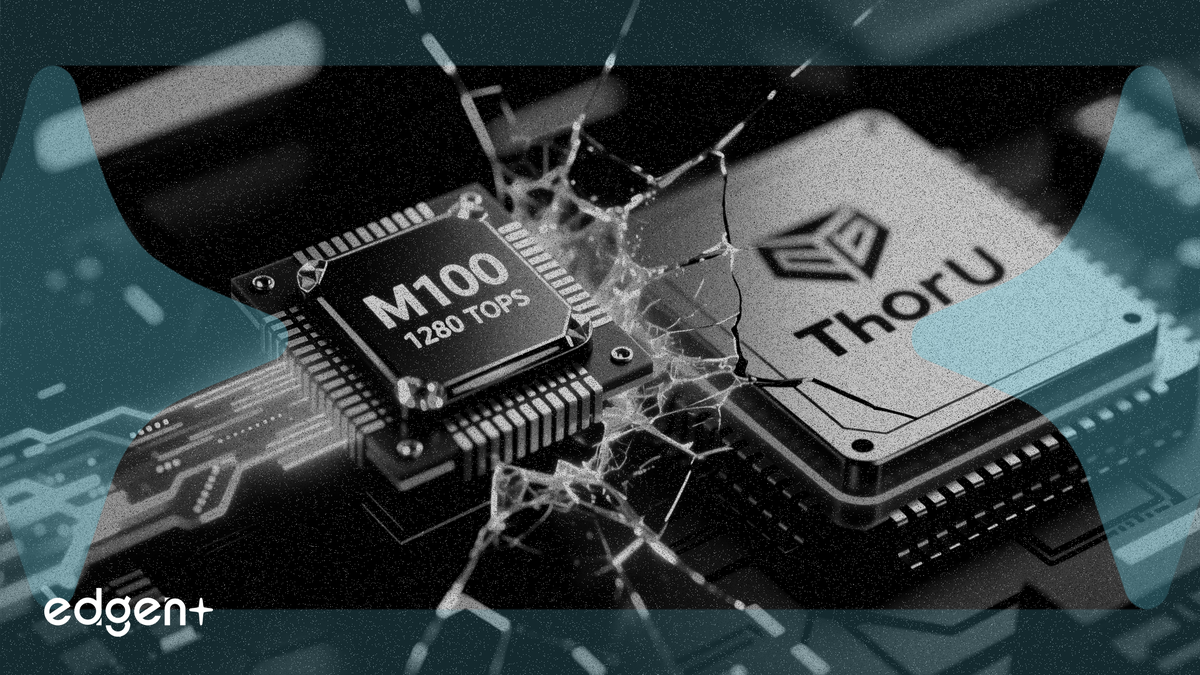
Li Auto's in-house Mach M100 chip claims to outperform Nvidia's ThorU across every autonomous driving benchmark.
Li Auto Inc. unveiled the Mach M100, a 5nm automotive-grade inference chip delivering 1,280 TOPS, directly challenging Nvidia's dominance in the autonomous driving processor market.
"Li Auto cannot merely build chips that are faster than before, but must develop an entirely different type of chip," Group CTO Xie Yan said at the company's Livis Day event on June 15. The goal was to design the architecture around AI computing paradigms rather than traditional computing, he said.
The Mach M100 uses a dynamic dataflow architecture — the first of its kind in an AI chip — which Xie said achieves actual operating efficiency of more than 82%. In benchmark tests against Nvidia's ThorU, the most widely used chip in intelligent driving systems, the Mach M100 outperformed it across CNN-based backbone networks, UniAD and Li Auto's own MindVLA model, according to the company. Li Auto did not disclose the test conditions for the comparison.
The self-developed chip reduces Li Auto's reliance on external suppliers such as Nvidia at a time when Chinese EV makers are racing to differentiate on autonomous driving. Li Auto shares traded at HK$56.50 on Monday, down 0.7%, with short interest at 38% of daily turnover.
The Mach M100 is manufactured on a 5nm process node, though Li Auto did not name the foundry. TSMC and Samsung Foundry are the only two companies currently producing 5nm automotive-grade chips at volume. The choice of foundry carries geopolitical significance for a Chinese company, given US export controls on advanced semiconductor manufacturing equipment.
The move places Li Auto alongside XPeng and NIO, which have also invested in in-house autonomous driving technology, though Li Auto is the first among Chinese EV startups to develop its own inference chip. BYD, the country's largest EV maker, has expanded its semiconductor capabilities through its BYD Semiconductor subsidiary. For Nvidia, which dominates the automotive inference market with its Thor and Orin product lines, Li Auto's in-house development represents a potential loss of a major customer. Li Auto was one of the earliest adopters of Nvidia's Orin platform for its L2+ advanced driver-assistance systems.
If the Mach M100's performance claims hold up under independent verification, Li Auto could reduce per-vehicle chip procurement costs by an estimated 30% to 40%, based on typical margins in the automotive semiconductor supply chain. The company trades at roughly 18 times forward earnings, and the chip program could add 200 to 300 basis points to gross margins once volume production ramps. No timeline for mass production has been disclosed.
This article is for informational purposes only and does not constitute investment advice.
