
Jensen Huang just told investors the memory shortage powering the AI buildout will last years — a direct tailwind for Micron and SanDisk after last week's chip rout.
Jensen Huang just told investors the memory shortage powering the AI buildout will last years — a direct tailwind for Micron and SanDisk after last week's chip rout.
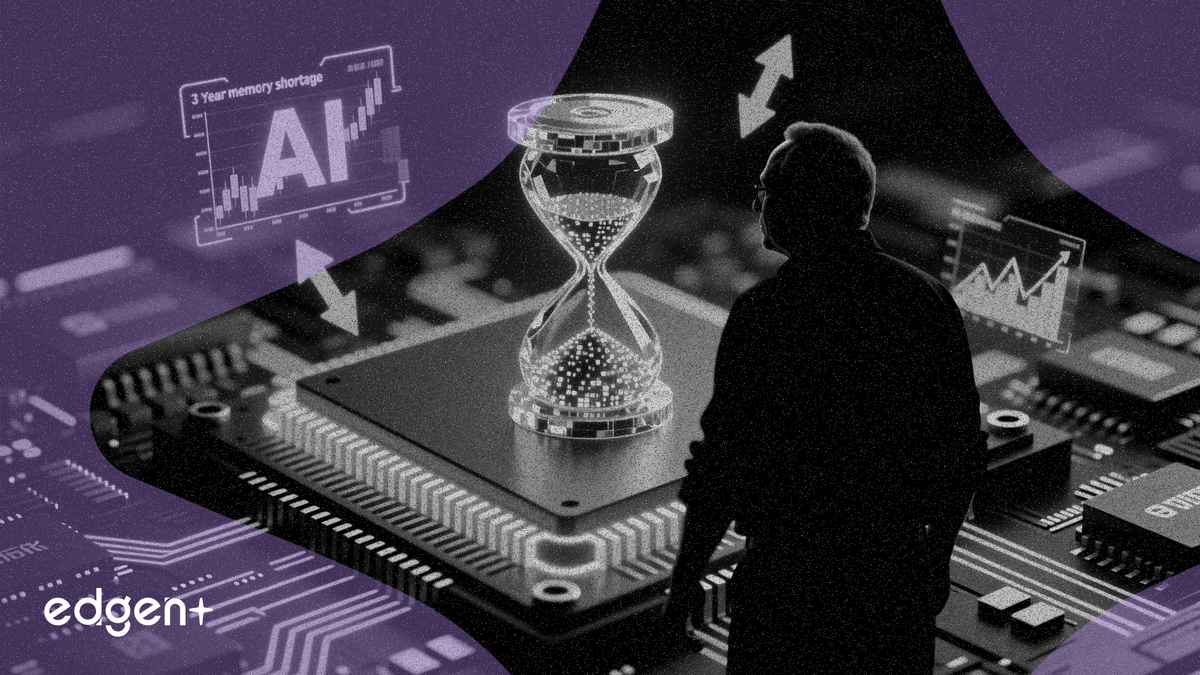
NVIDIA Corp. Chief Executive Officer Jensen Huang, speaking in South Korea on Monday after the worst semiconductor sell-off in months, said AI-related stocks are "very cheap" and warned the memory shortage will persist for several years, a bullish signal for Micron Technology Inc. and SanDisk Corp.
"AI-related stocks are very cheap right now," Huang said, according to remarks reported from his appearance in Seoul. He added that the memory supply crunch — which has driven DRAM and NAND prices sharply higher — shows no signs of easing in the near term.
The comments come after a brutal chip sell-off on Friday that erased billions in market value from semiconductor names. Micron, which has surged more than 900% over the past 52 weeks and recently joined the $1 trillion market-cap club, saw its stock slide alongside peers. SanDisk, up nearly 700% year-to-date, has sold out of production capacity for 2026, with 2027 supply already being booked by hyperscaler customers.
Huang's explicit multi-year timeline on memory tightness provides fundamental cover for elevated valuations across the memory sector. Wall Street estimates SanDisk's earnings per share could reach $177.84 by fiscal 2027; at 20 times earnings, that implies a share price above $3,500 — roughly double current levels. The question is whether supply can catch up before pricing power peaks.
The memory shortage is a structural bottleneck in the AI infrastructure buildout, not a cyclical blip. Data centers require vast quantities of DRAM (dynamic random-access memory) for compute and NAND-based solid-state drives for storage — both of which SanDisk and Micron produce. A single NVIDIA HGX server board can require hundreds of memory chips; the aggregate demand from hyperscalers spending hundreds of billions on AI factories has overwhelmed global fabrication capacity.
Huang's South Korea appearance carried added weight because the country is home to Samsung Electronics Co. and SK Hynix Inc., the world's two largest memory manufacturers. His remarks effectively validated the pricing power that memory makers have enjoyed through the current cycle and signaled that customers should not expect relief anytime soon.
Why the Shortage Has Legs
The supply-demand math explains why Huang sees a multi-year runway. Global DRAM bit supply grew roughly 15% in 2025, according to industry estimates, while AI-driven demand expanded at more than double that rate. Transitioning fabrication lines to advanced nodes — such as the move from 1-alpha to 1-beta DRAM — takes 18 to 24 months and requires billions in capital expenditure. Micron alone has guided for fiscal 2026 capex of $12 billion to $14 billion, much of it directed at its High-Bandwidth Memory (HBM) production lines that serve NVIDIA's GPU accelerators.
SanDisk, which manufactures NAND flash, faces a similar dynamic. The company's sold-out capacity through 2027 reflects hyperscaler pre-commitments that lock in pricing well above historical averages. If the memory shortage persists into 2028 as Huang's comments imply, SanDisk's earnings trajectory could sustain its current growth rate for longer than the market has priced.
For investors, Huang's comments reframe the risk-reward calculation. Micron trades at roughly 12 times forward earnings, a discount to its historical growth rate, while SanDisk's forward multiple sits near 20 times estimated FY2027 earnings — pricing in a soft landing for memory prices that Huang's remarks contradict. If the shortage extends into 2028, both stocks have room to re-rate higher. The risk is that capacity additions from Samsung and SK Hynix eventually close the gap, compressing margins. But for now, the most influential voice in AI has told the market to expect tight supply for years, not quarters.
This article is for informational purposes only and does not constitute investment advice.
