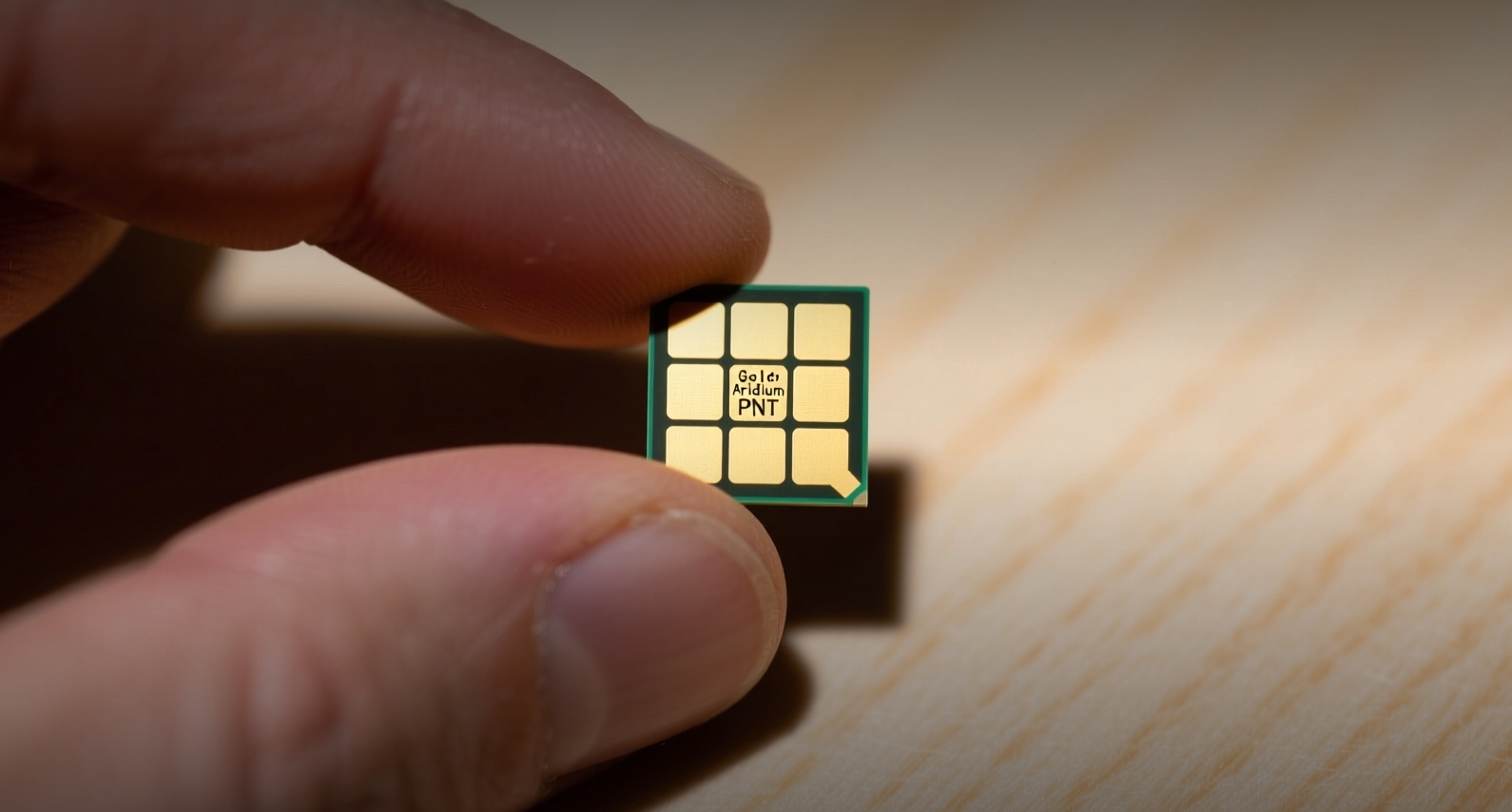
Iridium's new 8-millimeter chip delivers cryptographically secure positioning data as GPS jamming incidents surge worldwide.
Iridium Communications Inc. began commercial shipments of a chip smaller than a fingernail that protects GPS-dependent devices from jamming and spoofing, addressing a threat now costing the US economy more than $1.3 billion a day.
"The market response has reinforced what we're hearing from customers around the world: assured PNT is becoming an essential capability across critical industries," Dr. Michael O'Connor, executive vice president of PNT at Iridium, said.
Measuring 8 by 8 millimeters and weighing less than 0.2 grams, the application-specific integrated circuit delivers timing and location data through one-way signal bursts from Iridium's 66-satellite LEO constellation. The signals are powerful enough to penetrate buildings and contested environments where traditional GNSS fails, using cryptographic validation to continuously verify integrity.
More than 150 organizations across maritime, aviation, telecommunications, and defense have placed orders since the chip's October 2025 unveiling. Iridium, which trades on the Nasdaq under IRDM, operates through more than 500 technology and distribution partners, giving the ASIC a distribution advantage over smaller assured PNT startups that lack an existing satellite network.
The threat is accelerating. In May 2026, UK Defence Secretary John Healey's aircraft experienced in-flight GPS jamming, one of a growing number of incidents targeting commercial aviation and critical infrastructure. A 2019 study sponsored by the US National Institute of Standards and Technology estimated a GPS outage would cost the US economy $1 billion a day — a figure that exceeds $1.3 billion in 2026 dollars. The chip's one-way signal architecture makes it inherently resistant to spoofing because it receives only, unlike two-way systems that can be manipulated.
Two partners are already integrating the chip. Solace Communications is embedding it into its Vector family of assured PNT products, which combine Iridium PNT with multi-band GNSS and inertial sensing to deliver continuous confidence scoring. "Future navigation systems must do more than report a position," Adam Elcock, co-founder of Solace, said. "They must continuously determine whether that position and its timing can be trusted." Skyband Systems plans to integrate the ASIC into its M100 LRU for business and commercial aviation, alerting crews to GNSS jamming while providing aircraft location data.
The chip's commercial availability opens a new revenue stream for Iridium beyond its core satellite voice and data business. Financial markets, telecommunications networks, and power grids all depend on precise time synchronization — a use case the ASIC addresses alongside navigation. Iridium shares will face their next test when the company reports quarterly earnings, with analysts watching for how quickly ASIC orders convert into recognized revenue and whether the chip can gain traction against alternative assured PNT approaches from competitors such as Satelles and Orolia.
This article is for informational purposes only and does not constitute investment advice.