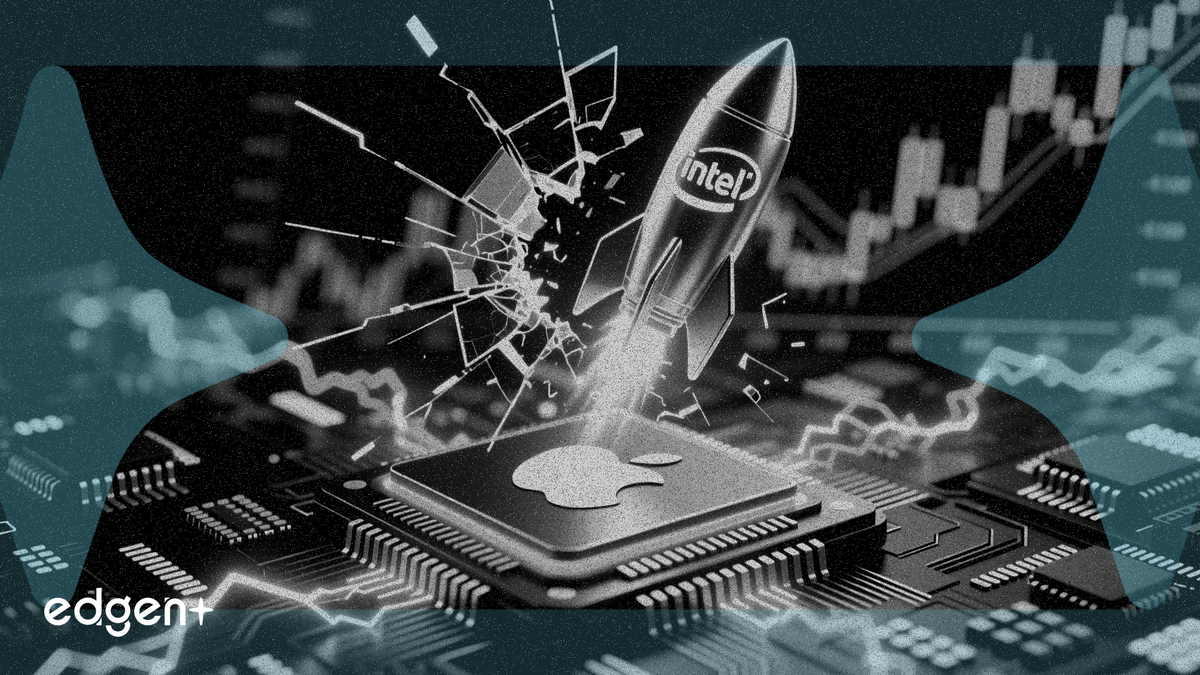
A preliminary deal for Apple to use Intel’s domestic manufacturing, reportedly brokered by the White House, has sent the chipmaker’s stock soaring and fired the starting gun on a potential reordering of the global semiconductor supply chain. The agreement challenges Taiwan’s manufacturing dominance and provides a critical lifeline to Intel’s resurgent foundry business.
“The next wave of AI will bring intelligence closer to the end user, moving from foundational models to inference to agentic,” Intel CEO Lip-Bu Tan said, framing the company’s focus on the high-volume chips that power devices like Apple’s. For Apple, a $4.3 trillion company, the partnership offers a path to diversify its supply chain away from Taiwan, a long-stated geopolitical risk.
The preliminary agreement, reported by The Wall Street Journal, would see chips for Apple’s iPad Pro and entry-level MacBook Airs manufactured on Intel’s 18A process node. The deal follows over a year of negotiations, with reporting from TBPN suggesting direct involvement from Commerce Secretary Howard Lutnick and a personal push from President Trump, who took a 10% equity stake in Intel for the government. The price action tells the story: Intel’s stock (NASDAQ:INTC), which languished near $21 a share, closed at $124.92 on May 8, up 495% over the trailing year.
For Intel, the deal is a landmark validation of its foundry strategy. The company reported first-quarter revenue of $13.58 billion, a 7% year-over-year increase that beat analyst estimates by over 9%. While a $4.07 billion restructuring charge widened GAAP losses, the underlying business showed strength. The Data Center and AI division saw revenue climb 22% to $5.05 billion, and the Intel Foundry segment grew 16% to $5.42 billion, a clear sign of momentum even before the Apple news.
A Turning Point for US Manufacturing
Until the Apple agreement, Intel’s primary external foundry relationship was with the Terafab consortium, a venture linked to Elon Musk’s Tesla and xAI. Landing Apple, which has a staggering $111.18 billion in quarterly revenue and a fresh $100 billion buyback authorization, is a different order of magnitude. It provides a crucial anchor client for Intel’s ambitious and capital-intensive roadmap, which includes the next-generation 14A node.
The government’s role cannot be overstated. By converting a $9 billion grant into an equity stake, the U.S. effectively became an active partner in ensuring Intel’s success as a domestic alternative to overseas foundries. This industrial policy is creating a new template for the semiconductor industry, forcing a re-evaluation of political risk and supply chain concentration.
The New Semiconductor Landscape
The market is increasingly dominated by a handful of names, dubbed the “AI Big Ten,” which now account for 40% of the market’s value. While Intel’s comeback is stunning, it is still chasing giants. Nvidia (NASDAQ:NVDA) remains the undisputed leader, with a $5.23 trillion market cap and quarterly data center revenue of $62.31 billion. Competitors AMD (NASDAQ:AMD) and Broadcom (NASDAQ:AVGO) are also posting massive gains, with AMD’s data center sales up 57% and Broadcom’s AI chip revenue more than doubling to $8.40 billion.
Even with its explosive rally, Wall Street remains divided on Intel. The consensus rating is a “Hold,” with an average price target of $79.76 that the stock has long since surpassed. Bank of America raised its target to $96 but maintained an Underperform rating, citing execution risk. However, bulls see more room to run. Lynx Equity set a Street-high price target of $175, arguing the Apple partnership provides a clear path for Intel’s foundry service to gain traction. With insiders buying shares and the company repurchasing its stake in its Ireland fab, Intel is signaling it has the capital and the political backing to defend its comeback.
This article is for informational purposes only and does not constitute investment advice.