

Intel's $23 billion equity raise funds a manufacturing expansion targeting AI inference demand that could require four to six times more CPUs than training workloads.
Intel's $23 billion equity raise funds a manufacturing expansion targeting AI inference demand that could require four to six times more CPUs than training workloads.
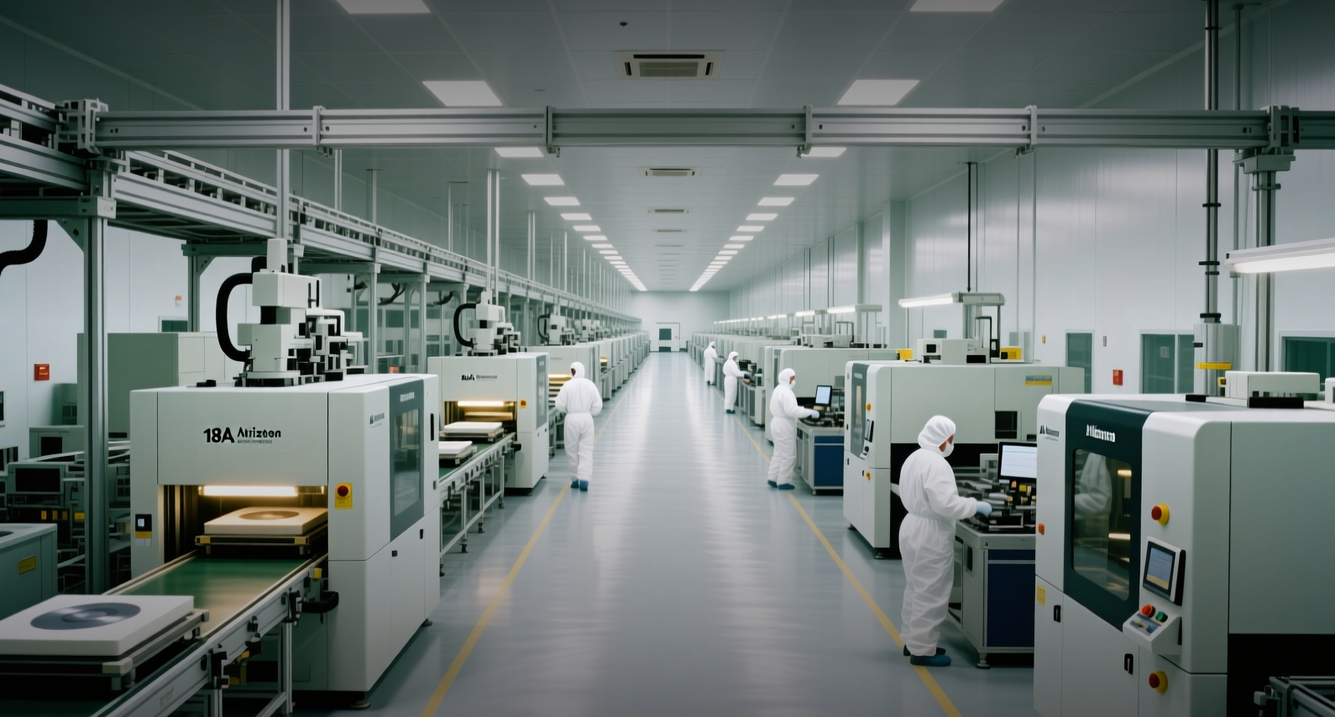
Intel raised approximately $23 billion in equity financing to expand data-center CPU capacity, substrate investments and advanced packaging, betting that the shift from AI training to inference and agentic computing will drive sustained processor demand. Chief Financial Officer David Zinsner said at a Deutsche Bank fireside chat that the company increased its 2026 capital-expenditure outlook by a couple of billion dollars from a prior range of $18 billion to $20 billion.
"The capital raise precedes capital investment," Zinsner said, citing confidence in process execution, advanced-packaging capabilities and demand outlook.
Intel's 18A yields are tracking ahead of internal milestones, while 14A defect density is outperforming target curves at a pace Zinsner compared to the company's 22-nanometer node. The company plans 14A risk production in 2027 and high-volume manufacturing in 2028, with the 0.9 version of its process design kit due in October. Internal product teams are already choosing to design on 14A, and external foundry customer discussions have shifted toward capacity and supply planning.
The capital deployment positions Intel to compete with TSMC and Samsung Foundry for AI-era manufacturing contracts. Zinsner said Intel expects to remain undersupplied this year and likely next year, with data-center server units growing at double-digit rates and average selling prices per core stabilizing after years of declines approaching 20 percent.
Four fabs, one roadmap: 18A to 14A
Intel is ramping production across its global footprint. In Ireland, the company plans to more than double output next year for Intel 3-based Granite Rapids server processors. Fab 52 in Arizona is producing 18A wafers, while Fab 62 is nearing readiness and will require additional equipment investment. Oregon will shift 18A production to Arizona as quickly as possible, freeing capacity to serve as both a pilot line and volume manufacturing location for 14A. In Ohio, Intel is building out shell capacity beginning with its first module.
Zinsner said the transition from AI training toward inference and agentic AI is increasing CPU requirements, with agentic activity potentially requiring four to six times more CPUs than traditional training data centers. He described the data-center CPU business as "a phenomenal business," noting that industry share in coming years may depend less on CPU competitiveness than on suppliers' ability to deliver sufficient volume.
EMIB-T packaging targets 40% gross margin
Intel's EMIB-T advanced-packaging technology, which removes the interposer and supports larger reticle sizes for AI applications, could become a multibillion-dollar annual revenue opportunity per customer. Zinsner said packaging revenue could begin ramping in the second half of 2027, become a run-rate business in 2028 and reach its stride in 2029, with gross margins around 40 percent and operating margins around 30 percent. Packaging could serve as an entry point for foundry customers and create opportunities to cross-sell front-end manufacturing services.
Intel's gross margin is now "comfortably in the 40s" after starting 2026 with internal business plans in the high-30 percent range. The company aims to improve into the mid- and high-40s and ultimately above 50 percent, though growth in foundry, advanced packaging and ASIC products could moderate consolidated margins. Intel Foundry targets break-even by the end of 2027, though stronger customer demand could require more investment and push that timeline into 2028. Foundry operating losses have been running at roughly $2.5 billion per quarter.
On the client side, Zinsner called Panther Lake a "killer product" and said Nova Lake should improve Intel's position in high-end desktop computing after Arrow Lake fell short of customer expectations. Higher memory prices are expected to remain a headwind for client demand into next year before potentially rebounding through 2027. Intel has shifted capacity from Intel 7 client products toward 18A as that node ramps, freeing Intel 7 capacity for data-center processors.
Intel plans to hold an analyst day next year rather than in 2026, Zinsner said, adding that the event will not be tied to announcing foundry customers. The company does not intend to disclose foundry customers unless those customers choose to do so themselves.
Intel shares trade on the Nasdaq under the ticker INTC. The company competes with Nvidia and AMD in data-center processors and with TSMC and Samsung Foundry in contract manufacturing. Intel's edge computing business could eventually reach the size of its client business, driven by industrial AI, robotics and agentic computing.
This article is for informational purposes only and does not constitute investment advice.
