


Broadcom's weaker-than-expected AI chip sales forecast has triggered a broad-based selloff in semiconductor stocks, with Intel and AMD extending declines for a second day.
Broadcom's weaker-than-expected AI chip sales forecast has triggered a broad-based selloff in semiconductor stocks, with Intel and AMD extending declines for a second day.
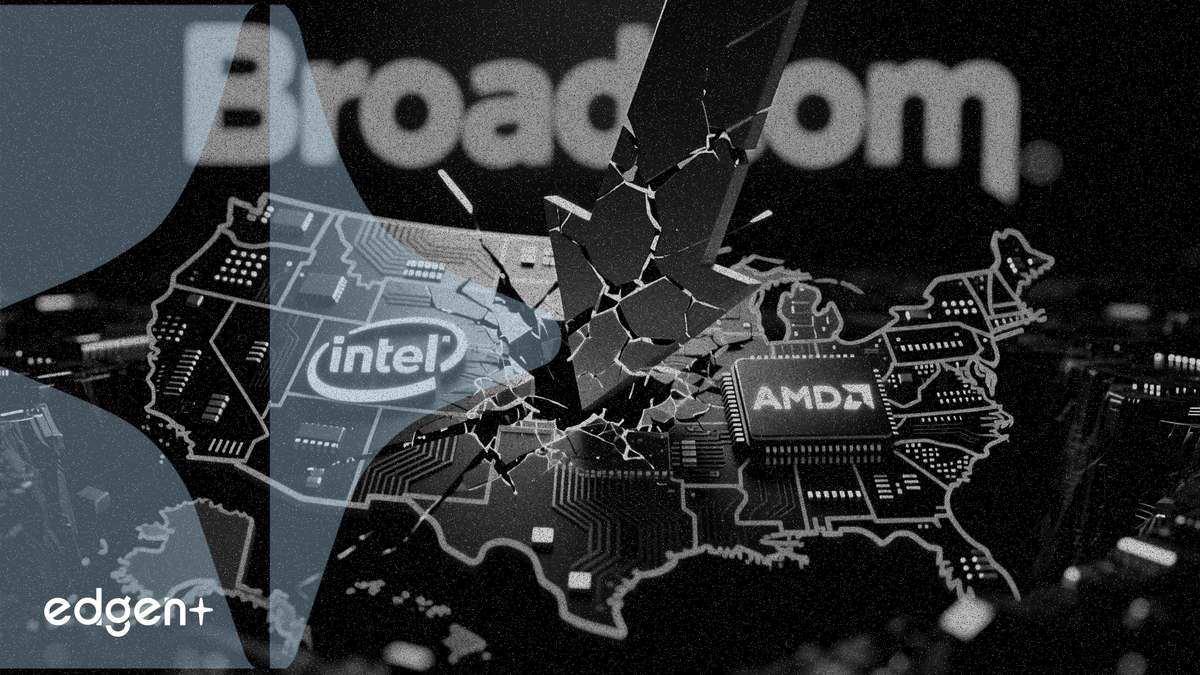
Intel Corp. and Advanced Micro Devices shares fell for a second straight session Friday as a selloff across semiconductor stocks deepened, triggered by Broadcom Inc.'s disappointing artificial intelligence revenue outlook.
"The market was pricing in perfection for AI-related chip names, and Broadcom's guidance — while strong in absolute terms — failed to meet those elevated expectations," said Rachel Kim, semiconductor analyst at Edgen.
Broadcom shares tumbled 12.6% to $418.91 on Thursday after the company forecast $16 billion in AI chip sales for the fiscal third quarter, below the $17.2 billion analysts had expected. The Palo Alto, California-based chipmaker also projected $56 billion in AI semiconductor revenue for fiscal 2026, missing the $57.6 billion consensus, while keeping its fiscal 2027 target unchanged at more than $100 billion. Trading volume on Broadcom reached 79.9 million shares, about 214% above its three-month average of 25.5 million shares.
The selloff shows the extreme valuation premium the market has assigned to AI-exposed semiconductor names. Broadcom, which had more than doubled over the past year before the report, now trades at about 37 times forward earnings — above its three-year average — leaving little room for disappointment. The Philadelphia Semiconductor Index fell alongside the broader sector, with investors reassessing whether lofty AI growth assumptions are sustainable across the supply chain.
Broadcom's AI Guidance Falls Short of Lofty Expectations
Broadcom's fiscal second-quarter results, reported late Wednesday, beat consensus estimates on both earnings and revenue. Adjusted earnings came in at $2.44 a share, topping the $2.40 estimate, while revenue of $22.19 billion exceeded the $22.13 billion forecast. Revenue rose 48% from a year earlier, marking the fourth straight quarter of accelerating sales growth.
The company's AI semiconductor revenue reached $10.8 billion in the quarter, up 143% year over year. Chief Executive Officer Hock Tan described demand for AI data center processors and networking as "simply insatiable" on the company's earnings call. Broadcom forecast fiscal third-quarter revenue of $29.4 billion, above the $28.25 billion analysts had modeled, representing about 84% year-over-year growth.
Yet the market focused on what Broadcom did not say. The company declined to raise its fiscal 2027 AI chip sales target of more than $100 billion, even as analysts modeled $114 billion. Macquarie downgraded Broadcom stock to neutral from outperform, citing a move by Google — one of Broadcom's four named custom chip customers alongside Meta Platforms, Anthropic and OpenAI — to develop AI chips in house. The investment bank said it expects Broadcom's market share to "decline meaningfully" in 2027 as a result.
Competitive Pressure Mounts Across the Sector
The selloff extended beyond Broadcom as investors recalibrated expectations for the entire semiconductor food chain. Intel and AMD, which compete with Broadcom in data center chips and networking, saw their shares decline as the market questioned whether AI infrastructure spending can sustain its current trajectory. Big Tech firms are expected to spend more than $700 billion on AI infrastructure this year, up from about $400 billion in 2025, according to Reuters.
Rival Marvell Technology has also been making inroads with key hyperscale customers. At the end of May, Marvell said its custom chip business would surpass $10 billion in revenue by 2029 and forecast second-quarter revenue above estimates, adding to competitive pressure on Broadcom's custom ASIC (application-specific integrated circuit) business.
Broadcom executives sought to reassure investors about supply constraints, saying on the earnings call that the company is "very comfortable" it has secured chip supply for 2026 and 2027. Tan said Broadcom plans to ship 10 gigawatts worth of compute capacity next year and expects "substantial growth" from fiscal 2027 onward, with visibility extending to fiscal 2028.
At least 14 Wall Street firms raised their price targets on Broadcom after the report, while UBS analyst Timothy Arcuri reiterated his buy rating, saying "new agreements continue to expand custom ASIC engagements." Morgan Stanley's Joseph Moore kept his overweight rating and raised his target to $502 from $485, calling the results "very strong" and the outlook "conservative."
Broadcom shares, even after the 12.6% decline, have gained about 25% year to date. The stock has multiplied almost ninefold since the end of 2022, when the generative AI boom began. The question now facing the semiconductor sector is whether the market's AI growth expectations have simply been reset — or whether they have peaked.
This article is for informational purposes only and does not constitute investment advice.
