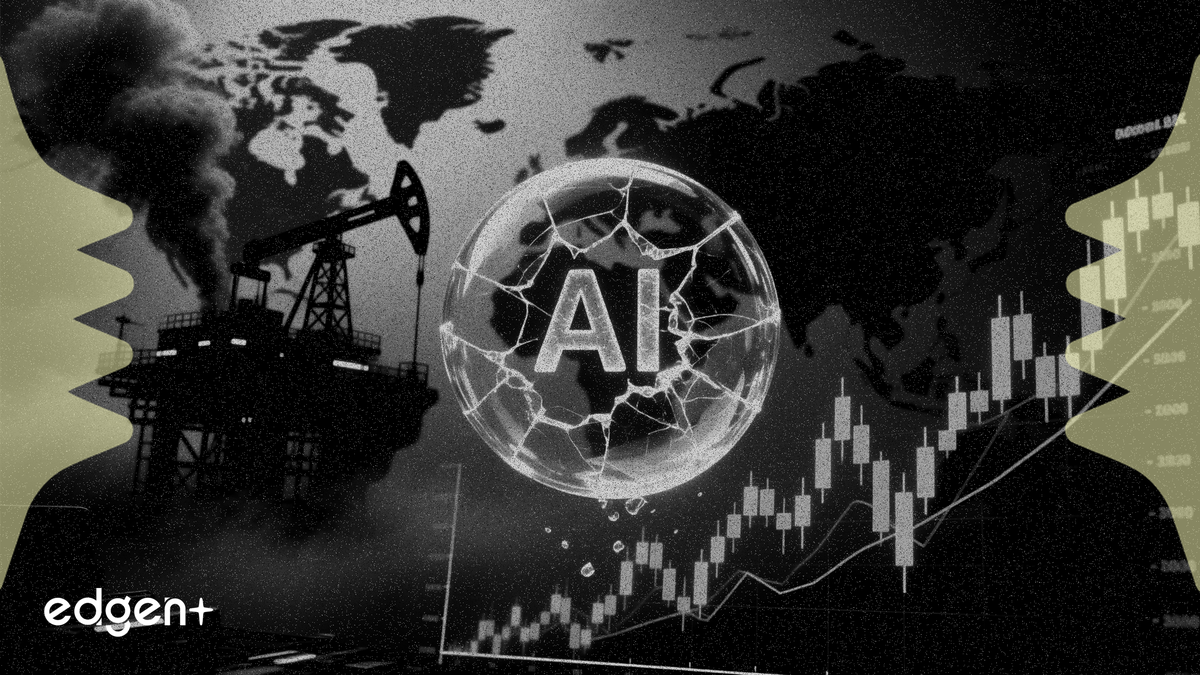
A top portfolio manager is warning the conflict in the Middle East could be the catalyst that bursts the artificial intelligence bubble, even as tech stocks rally on hopes of a temporary ceasefire.
"The conflict in the Middle East could contribute to the AI bubble bursting," Brian Kersmanc, a portfolio manager at GQG Partners, said on Bloomberg, citing how heightened geopolitical risk is affecting his market outlook.
His comments stand in stark contrast to the market’s immediate reaction to a U.S.-Iran agreement for a two-week ceasefire. Asian semiconductor stocks surged Wednesday, with memory chip leader SK Hynix climbing over 15 percent and Taiwan Semiconductor Manufacturing Company rising 4.84 percent. The rally followed weeks of tension over the Strait of Hormuz, a key shipping route for oil and a critical component for chip manufacturing: helium.
The divergence highlights the key question facing tech investors: whether to trade the short-term relief or invest based on the long-term structural risks the conflict has exposed. For now, many see a buying opportunity. Wedbush Securities analyst Dan Ives called the ceasefire a “green light” for risk-on tech assets.
Ceasefire Sparks Relief Rally
The market’s optimism is rooted in the potential reopening of the Strait of Hormuz. Iranian attacks on industrial sites in Qatar, which produces about 30 percent of the world’s helium, and the closure of the shipping route had severely strained supply chains. Helium is indispensable in photolithography, the process used to print chips.
A reopening of the strait eases fears of production delays, sending shares of chipmakers soaring. Beyond SK Hynix and TSMC, China’s SMIC jumped more than 10 percent, while Japanese equipment maker Tokyo Electron climbed 9.6 percent. The news also sent oil prices plunging, relieving potential inflation pressure on margins across the industry.
Energy and Cloud Dependency Expose Deeper Risks
While the market celebrates, the conflict has stress-tested the foundations of the AI boom, revealing significant vulnerabilities. The assumption of cheap, stable energy to power the world’s data centers is eroding.
Data centers could account for 70 terawatt-hours of electricity demand in the EU this year, according to IEA estimates, and global data center energy use is projected to double by 2030 with AI as the primary driver. The Iran conflict, by threatening global energy supply, shows how cloud economics are downstream from volatile energy markets. With European gas prices already up approximately 70 percent since the conflict began, the "cheap cloud" era may be ending as the costs of energy and security are priced into the digital stack.
The conflict has also turned cloud infrastructure into a geopolitical variable. In early March, three AWS data centers in the Gulf were struck by Iranian drones, the first known military attacks on a hyperscale cloud provider. With tens of billions invested in the Gulf region for AI expansion, what was once a technical decision about infrastructure location is now a question of risk management. According to research firm IDC, a conflict lasting up to three months could reduce global IT spending growth by approximately one percentage point in 2026.
While investors like Ives see a "green light," long-term strategists like Kersmanc are flagging that the AI sector's high valuations may not have priced in the new reality of geopolitical instability.
This article is for informational purposes only and does not constitute investment advice.