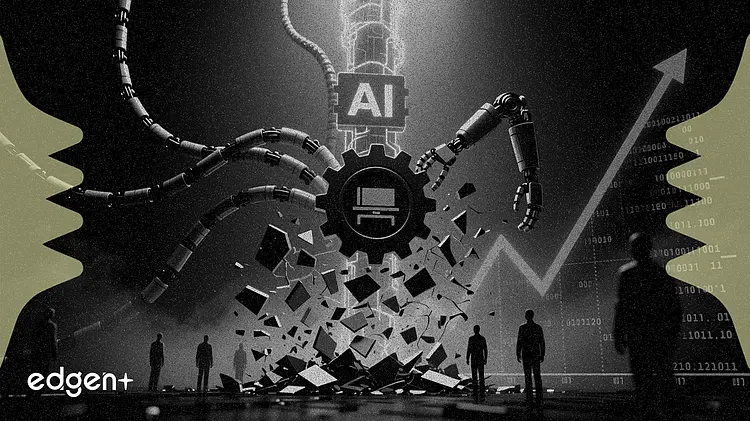
A new Goldman Sachs report suggests the coming wave of AI-driven job displacement could be more severe and prolonged than previous technology shifts, posing a significant challenge to the global economy.
Back
A new Goldman Sachs report suggests the coming wave of AI-driven job displacement could be more severe and prolonged than previous technology shifts, posing a significant challenge to the global economy.

A new report from Goldman Sachs warns that artificial intelligence could automate the equivalent of 25% of current work tasks, potentially leading to significant labor market disruption and economic pain for displaced workers. The analysis, published on April 6, 2026, draws on decades of historical data to contrast the coming AI wave with past technological shifts.
"While technological advancement has always been a double-edged sword for labor, the scale and speed of AI's encroachment into cognitive and white-collar tasks is unprecedented," said David Solomon, CEO at Goldman Sachs, in the report's foreword. "The adjustment period for workers could be significantly longer and more challenging this time around."
The report highlights that previous technology waves, like the introduction of personal computers, primarily automated routine, manual tasks. In contrast, modern generative AI is capable of handling complex, non-routine cognitive work, putting a wider range of professions at risk. The investment bank's research suggests that while new jobs will be created, the skills gap for displaced workers will be substantial, requiring massive investment in reskilling and education.
The findings could reshape long-term investor sentiment, steering capital away from labor-intensive industries and towards companies at the forefront of AI and automation, such as Nvidia and Google. The report also puts pressure on policymakers to address the looming crisis, with potential impacts on future government spending for social safety nets and large-scale retraining programs. The estimated cost of such programs could run into the hundreds of billions of dollars globally over the next decade.
The Goldman Sachs analysis serves as a stark warning against complacency. While the productivity gains from AI are expected to be immense, the report cautions that these benefits may not be evenly distributed. The economic hardship for those whose skills are rendered obsolete could create significant social and political instability.
Unlike the mechanization of agriculture or the automation of factory floors, the AI revolution is coming for a different class of worker. The report identifies paralegals, market research analysts, and even some software developers as roles with high potential for automation. This challenges the long-held belief that higher education is a firewall against technological unemployment.
The report's conclusions are already being debated by economists and technologists. Some, like the researchers at the MIT Future of Life Institute, argue that the Goldman Sachs projections are too conservative. Others, including spokespeople for tech giants like Microsoft, emphasize AI's potential to augment human capabilities rather than replace them entirely.
For investors, the report underscores the importance of evaluating a company's "AI readiness." This includes not only their adoption of AI technologies but also their strategy for managing their workforce through this transition. Companies that invest in human capital and reskilling may prove more resilient in the long run.
This article is for informational purposes only and does not constitute investment advice.