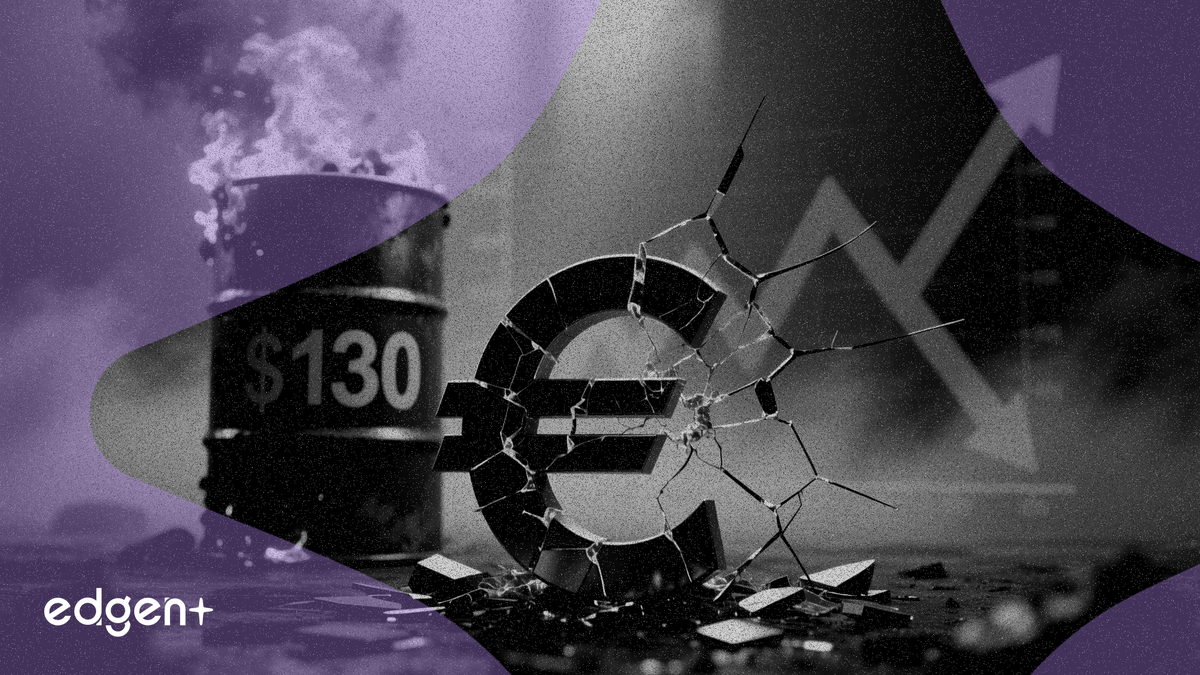
A top European Central Bank official warned that fears of a eurozone recession are “real and justified” as oil prices approach $130 a barrel, injecting significant geopolitical risk into a monetary policy outlook that markets have potentially misread.
"Concerns that the euro zone could slip into recession if the conflict in the Middle East continued are 'real and justified' and talks to end the Iran war will be key for the ECB monetary policy," Bank of Greece Governor Yannis Stournaras said on May 3.
The statement adds a hawkish dimension to the ECB’s upcoming decisions, standing in stark contrast to market pricing that has fully baked in a 50-basis-point rate cut. The divergence comes as Brent crude has surged 10-15% in recent weeks, pushing the Eurozone’s annual energy inflation to 10.9% in April while its economy grew by a mere 0.1% in the first quarter.
The central bank is now trapped between its mandate to control inflation and the growing risk of an economic contraction. With the ECB's key deposit rate at 3.75 percent, officials must decide whether to resume hiking to combat the oil-price shock or pivot toward easing to support the fragile economy, a decision that will be heavily influenced by events far from Frankfurt.
A Difficult Choice: Inflation vs. Recession
The ECB's current predicament is amplified by its past policy errors. In 2008 and 2011, the bank raised rates in response to inflation, only to be forced into sharp reversals months later as the economy buckled. Conversely, in 2022, it was criticized for delaying monetary tightening, allowing inflation to surge into double digits.
According to an analysis by FxPro, this history is forcing the ECB to maintain hawkish rhetoric without necessarily rushing into actual tightening. The goal is to manage inflation expectations without prematurely snuffing out economic activity. However, with annual inflation being revised up to 2.6% in March, the pressure to act is mounting.
Markets Price Cuts as ECB Signals Hikes
The commentary from Stournaras and other European officials indicating potential hikes directly contradicts current market sentiment. Prediction markets, for instance, show a 100% probability assigned to a rate decrease of 50 basis points or more at the April 2026 meeting. This suggests a major disconnect and the potential for a violent repricing if the ECB follows through on its hawkish language.
Bloomberg experts expect President Christine Lagarde to hint at a rate hike in June. If those hints are not perceived as credible by investors, the euro could face significant downward pressure. For now, the central banks in both Europe and the U.S. appear to be in a holding pattern, waiting to see how the geopolitical situation and its impact on energy prices unfold.
This article is for informational purposes only and does not constitute investment advice.