

DeepSeek is betting $300 million that the future of AI can be built without Nvidia, a move that could reshape the global semiconductor landscape.
DeepSeek is betting $300 million that the future of AI can be built without Nvidia, a move that could reshape the global semiconductor landscape.
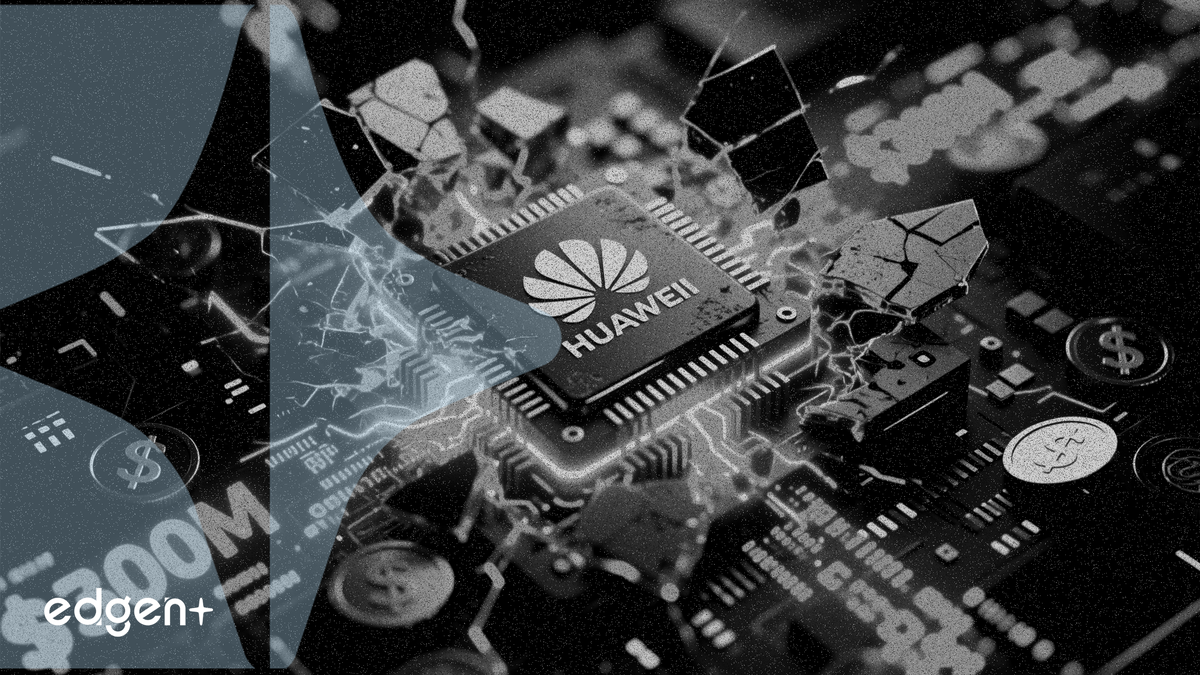
Chinese AI developer DeepSeek is seeking its first external funding round to raise at least $300 million at a valuation of $10 billion, a strategic pivot intended to fund a large-scale migration of its models from Nvidia Corp. hardware to a new system built on Huawei Technologies Co.'s Ascend chips.
"This is a bad result for the United States," Nvidia CEO Jensen Huang said in a recent interview, commenting on the prospect of advanced AI models being optimized to run best on Chinese hardware. His concern underscores the stakes of DeepSeek's move, which represents the first major attempt by a leading AI firm to build a frontier model completely independent of Nvidia's CUDA ecosystem.
The funding is earmarked for the launch and scaling of DeepSeek V4, a trillion-parameter model that has been in development for over 18 months. According to company sources, the model uses a Mixture-of-Experts (MoE) architecture and features a 1 million token context window, a significant expansion from the 128K context of its predecessor. Internal benchmarks show its code generation capabilities exceeding 80% on SWE-bench and 90% on HumanEval, with the ability to handle complex, repository-level bug fixes.
The capital infusion is critical to proving that a top-tier AI model can thrive outside the CUDA software moat that has secured Nvidia's market dominance. For a $300 million investment, DeepSeek is positioning to validate a high-performance alternative, a development that could accelerate China's AI self-sufficiency and encourage a broader industry shift away from reliance on a single hardware provider.
The development of DeepSeek V4 is a significant technical undertaking, made more complex by the strategic decision to decouple from Nvidia. The model, which was originally scheduled for a February release, faced delays as engineers worked to migrate core components from Nvidia's CUDA to Huawei's CANN (Compute Architecture for Neural Networks). This involved extensive code rewrites to ensure performance and stability on the new hardware stack.
V4 is expected to be released in two versions: a full, trillion-parameter model optimized for advanced reasoning and code generation on Huawei Ascend chips, and a smaller 200-billion-parameter version for general use that can run on other domestic chipsets. This dual-version strategy suggests DeepSeek is hedging its hardware dependencies while still prioritizing the development of a nationally-sourced AI infrastructure. The company recently began hiring for server运维 and delivery roles in Inner Mongolia, signaling a move from lab-based development to large-scale deployment.
While known for its capital efficiency, DeepSeek's decision to seek outside funding reflects the immense financial pressures of competing at the frontier of AI research. According to a 2026 Stanford AI Index report, the performance gap between top US and Chinese models has narrowed to just 2.7 percentage points, with each incremental gain demanding exponentially higher costs. For context, OpenAI recently completed a $40 billion funding round at a $300 billion valuation.
DeepSeek's $300 million raise is not just for funding operations but is a strategic wager on hardware independence. By providing early access to domestic chipmakers and deliberately withholding optimization for Nvidia and AMD, the company is forcing a performance showdown. If DeepSeek V4 can demonstrate competitive performance on Huawei's Ascend chips, it will serve as a powerful proof-of-concept that the most advanced AI development is no longer exclusively tied to Nvidia's ecosystem, potentially altering the competitive dynamics of the global semiconductor market.
This article is for informational purposes only and does not constitute investment advice.