
Chinese automakers are pouring billions into humanoid robots, betting that embodied AI becomes the industry's next profit engine after razor-thin EV margins.
Chinese automakers are pouring billions into humanoid robots, betting that embodied AI becomes the industry's next profit engine after razor-thin EV margins.
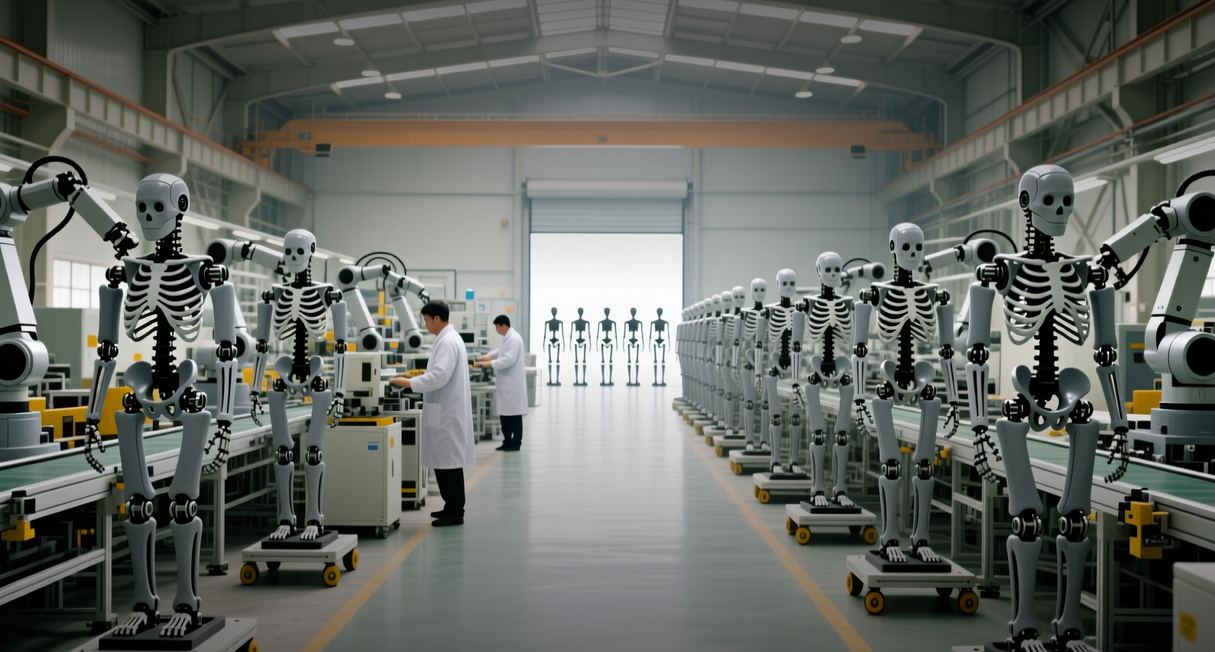
Chinese automakers are pouring billions into humanoid robots, betting that embodied AI becomes the industry's next profit engine after razor-thin EV margins.
Xpeng's robotics unit raised more than $900 million at a $6.3 billion valuation, the largest private round in China's embodied AI industry, as automakers pivot to humanoid robots to escape razor-thin car margins.
"He sees razor-thin profit in cars on the near horizon. Robots look much more promising," Michael Dunne, CEO of San Diego-based advisory firm Dunne Insights, said of Xpeng founder He Xiaopeng.
The round, led by IDG Capital with Gaorong Ventures, Tencent and Alibaba, is one of several moves by Chinese carmakers into robotics. Chery's AiMOGA unit is preparing an IPO, BYD unveiled a humanoid called Xiao Di, and Changan, GAC, Li Auto, SAIC and Seres are developing robots. Xiaopeng and co-president Brian Gu put about $100 million of their own money into the round, the Wall Street Journal reported.
The push extends Tesla's Optimus strategy, where Elon Musk has said robots will one day account for most of the company's value. Chinese automakers bring a manufacturing edge, but the question is whether they can match Tesla on the AI side, Dunne said.
China has more than 150 humanoid-robot companies, according to the National Development and Reform Commission, exceeding the number of its EV brands. National, provincial and local governments spent at least $230 million buying humanoids and related equipment in the first half, up from $62 million a year earlier and $6 million in the same 2024 period, public procurement data show. State Grid plans to spend $1 billion on AI-enabled robots for grid maintenance, and Shenzhen aims to build a $15 billion industry cluster with more than 1,200 robotics companies by next year.
The buildout mirrors the playbook Beijing used for EVs and solar: subsidize a strategic sector, build capacity early, and drive down costs through competition. Unitree, the world's largest seller of robot dogs, saw shares soar more than five-fold in their Shanghai debut on Aug. 19, valuing the company at around $50 billion before pulling back. Deep Robotics disclosed that subsidies accounted for about 42% of its $4.2 million net profit last year.
The machines still struggle with tasks requiring intuition or deviation from programmed routines. "The robots' IQ is too low," Tang Wenbin, co-founder and CEO of AI robotics venture Yuanli Lingji, said at a March industry panel. "A lot of what we see is dancing disguised as working."
The sector has roughly 500,000 hours of high-quality training data but needs 100 million hours for robots to achieve true physical intelligence, said Poe Zhao, an analyst and author of the Hello China Tech newsletter. At a Liuzhou training center, humanoids complete simple tasks at just 20% of a human's speed, one staffer said. Morgan Stanley expects the average price of a humanoid to decline 15% in 2026, while Tesla's Optimus carries a long-term target price of roughly $20,000 against a low-volume hardware bill of materials estimated at $50,000 to $60,000.
For investors, the gap between hype and capability is the key risk. Chinese component prices are falling so quickly that foreign competitors struggle to keep pace, according to BofA Global Research's Ming Lee, and analysts expect consolidation to begin in late 2026 or 2027 as subsidies narrow to the most credible players. "There will 100% be a consolidation sooner or later," said Kevin Xu, founder of Interconnected Capital. "It's just a matter of who and how ugly."
This article is for informational purposes only and does not constitute investment advice.
