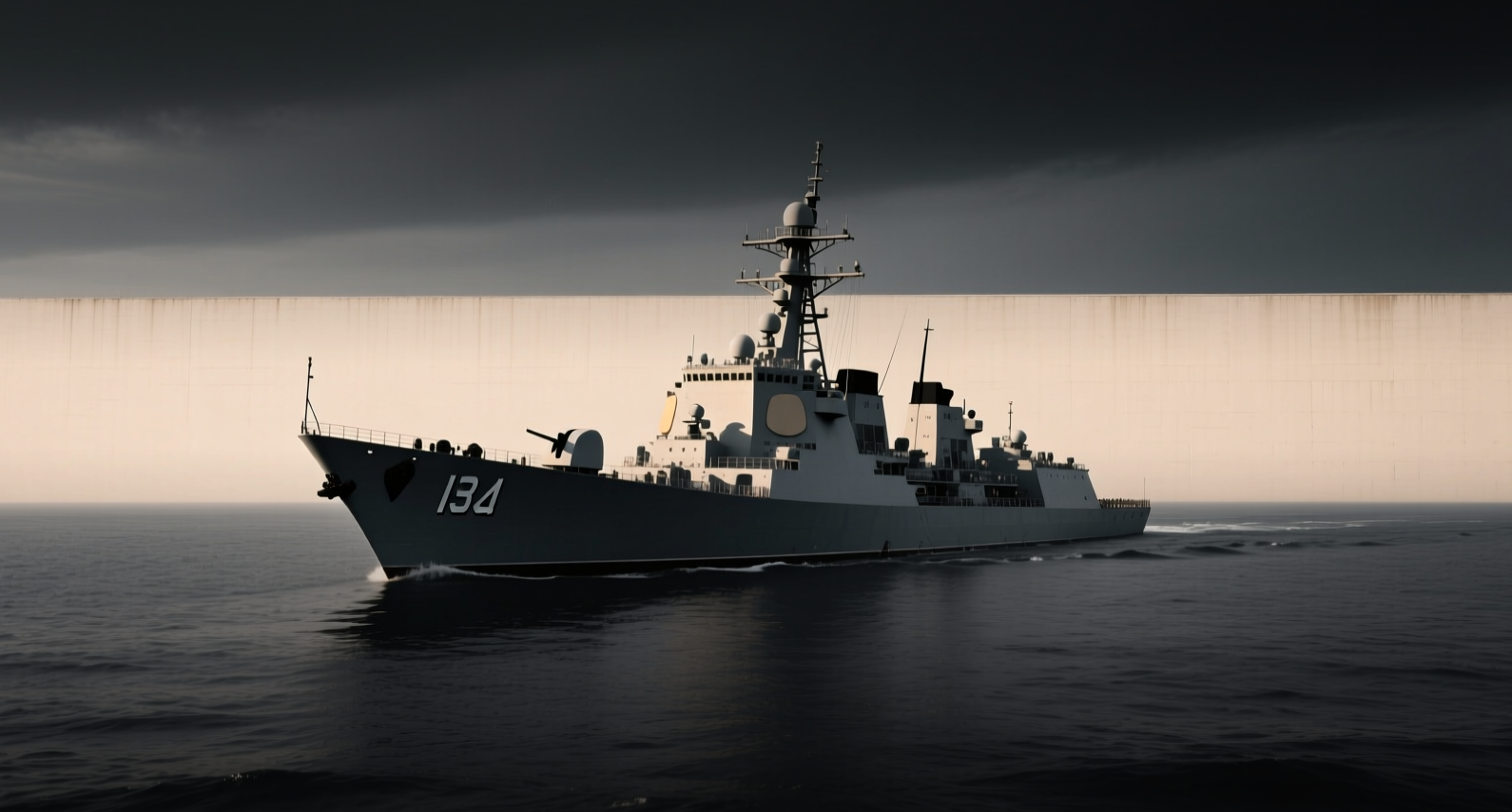
A Chinese guided-missile destroyer fired a machine gun 110 miles from Japan's southernmost atoll, triggering a diplomatic protest that reopened a legal dispute over 154,000 square miles of Pacific waters.
China conducted a live-fire naval drill inside Japan's claimed exclusive economic zone near Okinotorishima on Sunday, prompting Tokyo to lodge a formal protest over what it called a danger to navigation.
"The drill could pose a danger to the navigation of nearby vessels," Minoru Kihara, Japan's chief cabinet secretary, said Tuesday, confirming the protest was delivered through diplomatic channels.
A Chinese guided-missile destroyer fired a machine gun about 110 miles southwest of the atoll after sailing there alongside two other Chinese naval vessels and a Russian frigate, Japan's Defense Ministry said. The drill followed weeklong joint China-Russia naval exercises off the eastern Chinese port of Qingdao. Japan's Joint Staff said it was the first time it had publicly disclosed a live-fire exercise by a foreign navy inside the country's claimed EEZ, though it acknowledged the activity does not violate international law under the United Nations Convention on the Law of the Sea.
The incident revives a longstanding legal dispute over Okinotorishima, which Japan treats as its southernmost island generating a 154,000-square-mile EEZ in the Philippine Sea. China argues the largely submerged feature is a rock, not an island, and therefore cannot generate an EEZ under international law. With China and Russia deepening military coordination, the drill signals a more assertive posture that could raise risk premiums across Asia-Pacific markets.
A Reef or an Island? The Legal Dispute Behind the Drill
Okinotorishima is an uninhabited coral atoll between Taiwan and Guam that sits largely submerged during high tide. Japan claims it as an island under UNCLOS, entitling the country to an exclusive economic zone spanning more than 154,000 square miles. China rejects that classification, arguing the feature fails to meet the legal definition of an island — a naturally formed area of land that can sustain human habitation or economic life.
"Japan's claim of an EEZ around Okinotorishima violates international law," Lin Jian, a Chinese Foreign Ministry spokesman, said Tuesday. "China's activities in the high seas are fully consistent with international law and international practice."
The legal ambiguity creates a flashpoint. UNCLOS does not prohibit military exercises within another country's EEZ, granting coastal states sovereign rights over natural resources rather than full territorial sovereignty. That means Japan's protest carries diplomatic weight but no legal enforcement mechanism — a dynamic that could encourage further Chinese naval activity in the area.
China-Russia Military Cooperation Deepens
The drill was the latest example of growing military coordination between Beijing and Moscow. Japanese Defense Minister Shinjiro Koizumi cited the incident while speaking in Britain on Monday, saying it highlighted "the deepening military cooperation between China and Russia." Japan has also raised concerns over China's recent ballistic missile launch from a submarine and multiple joint bomber flights conducted with Russia around Japanese territory.
Senior Col. Jiang Bin, a spokesman for China's Ministry of National Defense, said the joint exercises with Russia "played an important role in safeguarding the sovereignty and security" of both countries and did not target any third party.
The last time China and Russia conducted joint patrols near Japanese waters, Tokyo scrambled fighter jets to track the activity. The current drill comes a day before a separate confrontation between Chinese and Philippine personnel at the disputed Second Thomas Shoal in the South China Sea, as Beijing applies simultaneous pressure on multiple maritime fronts.
For investors, the incident adds to a risk premium already priced into Japanese defense stocks and safe-haven assets. Japan's defense budget has expanded for several consecutive years, and the GCAP sixth-generation fighter jet program with Britain and Italy — backed by a 4.6 billion pound contract — reflects Tokyo's accelerating military modernization in response to regional threats.
This article is for informational purposes only and does not constitute investment advice.