


BYD has spent four years developing a humanoid robot that aims to bridge the gap between China's hardware strength and the US edge in artificial intelligence.
BYD has spent four years developing a humanoid robot that aims to bridge the gap between China's hardware strength and the US edge in artificial intelligence.
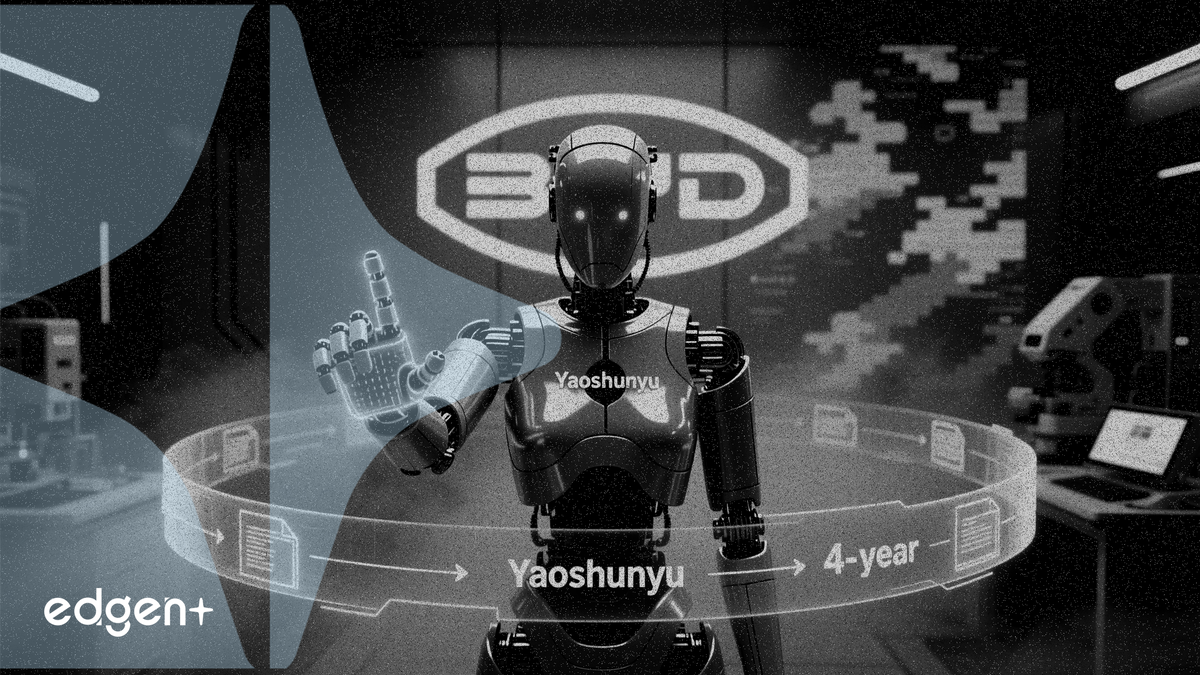
BYD has spent four years developing a humanoid robot that aims to bridge the gap between China's hardware strength and the US edge in artificial intelligence.
BYD Co. has spent four years secretly developing a humanoid robot called Yaoshunyu, aiming to resolve a global robotics imbalance where Chinese machines lack intelligent "brains" and US robots struggle with physical "limbs."
"The core pain point facing China's robotics sector is the lack of a brain — insufficiently intelligent decision-making and perception systems," Stella Li, executive vice president of BYD, said on the company's official investor platform program.
The project was formally launched in 2022 after years of confidential research and development, Li said. US robots, by contrast, possess advanced algorithms but face challenges in large-scale production and commercialization, she added. BYD's goal is to develop robots with both capabilities — well-developed brains and limbs capable of executing tasks in complex environments.
The disclosure positions BYD, already the world's largest electric-vehicle maker by sales, as a contender in the humanoid robotics market projected to reach $38 billion by 2035, according to Goldman Sachs Research. BYD shares traded 1.1 percent lower in Hong Kong on the news, with short selling accounting for 35 percent of turnover.
BYD's Robotics Ambition
BYD joins a growing list of companies racing to commercialize humanoid robots for industrial and domestic use. Tesla Inc. has been developing its Optimus robot since 2021, while Xiaomi Corp. unveiled its CyberOne humanoid in 2022. Boston Dynamics, now owned by Hyundai Motor Group, has demonstrated advanced locomotion with its Atlas robot but has yet to achieve mass production.
Li's diagnosis of the industry's brain-versus-limbs imbalance highlights a structural divide. Chinese companies excel at manufacturing hardware at scale — BYD produced 3 million EVs last year — but often rely on foreign suppliers for advanced AI chips and perception software. Nvidia Corp.'s Jetson platform powers many robotics development systems globally.
BYD's expertise in battery technology, electric motors, and cost-efficient mass production gives it an edge in the "limbs" department. The company's vertically integrated supply chain, which spans from battery cells to vehicle assembly, could translate directly to robotics manufacturing at scale — a capability no US robotics company currently matches.
Investment Angle
For investors, BYD's robotics push opens a new growth vector beyond the slowing EV market. The company trades at about 18 times forward earnings, a discount to Tesla's 55 times, partly because BYD is still viewed primarily as an automaker. A successful humanoid robot program could command a valuation premium similar to how Tesla's Optimus project factors into its multiple. However, BYD did not disclose a timeline for commercial deployment or production targets, making near-term revenue contribution unlikely.
This article is for informational purposes only and does not constitute investment advice.
