

A leadership change at the world's most valuable company sees a hardware expert take the helm as the AI race intensifies.
A leadership change at the world's most valuable company sees a hardware expert take the helm as the AI race intensifies.
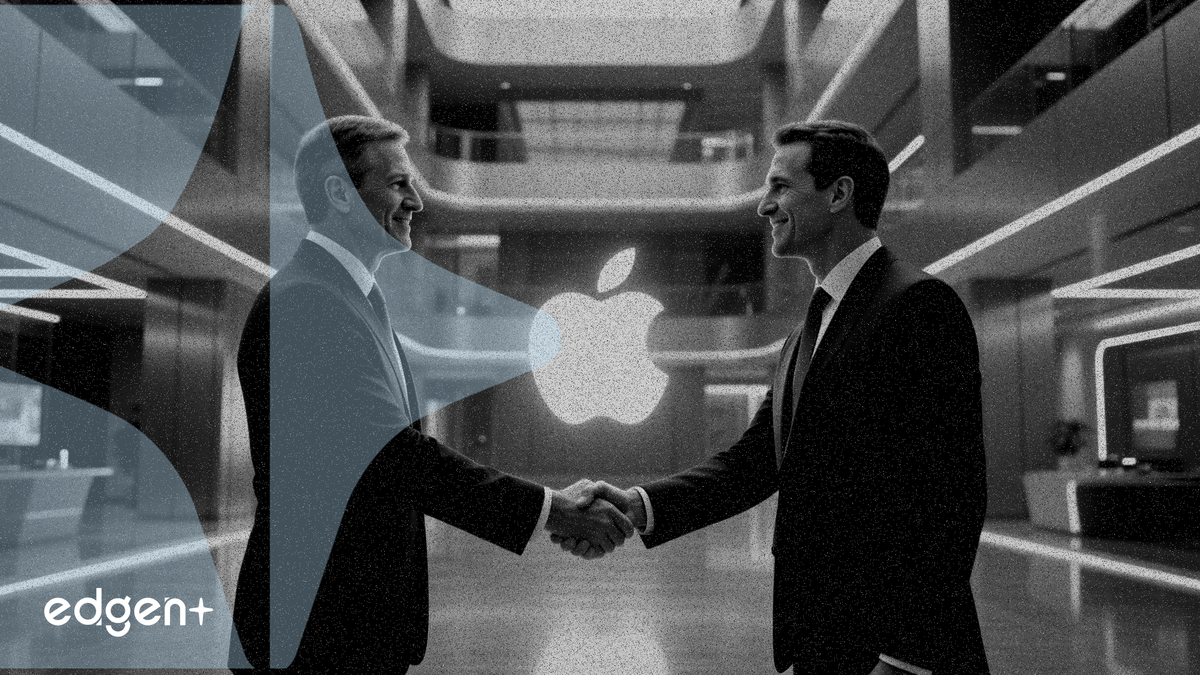
A leadership change at the world's most valuable company sees a hardware expert take the helm as the AI race intensifies.
Apple announced Monday that Chief Executive Officer Tim Cook will step down from the role he has held for 15 years, handing leadership of the $4 trillion company to hardware engineering chief John Ternus. The transition will take place on September 1, 2026, after which Cook will become executive chairman of the board. Under Cook's leadership, Apple's market capitalization grew by more than 1,000% from approximately $350 billion in 2011.
"It has been the greatest privilege of my life to be the CEO of Apple and to have been trusted to lead such an extraordinary company," Cook said in a statement. "John Ternus has the mind of an engineer, the soul of an innovator, and the heart to lead with integrity and with honor. He is without question the right person to lead Apple into the future."
The succession follows a long-term planning process by the board. Ternus, a 25-year veteran of the company, has been senior vice president of Hardware Engineering since 2021, overseeing the development of products including the iPhone, iPad, and Apple Watch. Cook's tenure saw Apple's annual revenue grow from $108 billion in fiscal 2011 to a projected $416 billion in fiscal 2025, driven by the global success of the iPhone and the introduction of new categories like the Apple Watch and AirPods.
The leadership change comes at a critical juncture for Apple and the broader technology industry. While Apple's valuation soared under Cook's operational expertise, the company is widely seen as lagging competitors in the artificial intelligence revolution. The appointment of Ternus, a product-focused hardware engineer, raises questions about the company's future strategy as it navigates a software- and AI-centric landscape, a challenge underscored by its recent partnership with Google to power AI features.
When Tim Cook took over from the visionary co-founder Steve Jobs in 2011, he inherited a company already on a steep upward trajectory. His calm, methodical leadership style, a stark contrast to Jobs' charismatic and often volatile approach, proved to be exactly what Apple needed to scale its operations globally. Under his stewardship, Apple's active installed base of devices surpassed 2.5 billion, and its services division grew into a business generating over $100 billion annually, equivalent to a Fortune 40 company.
Beyond the financial metrics, Cook made his mark on corporate culture and social advocacy. In 2014, he became the first chief executive of a Fortune 500 company to publicly come out as gay, a moment hailed as a significant milestone for LGBTQ+ representation in business. He has consistently advocated for privacy as a "fundamental human right" and pushed for greater accessibility in Apple's products.
John Ternus will be the third CEO in Apple's history, and his background signals a continued focus on product engineering excellence. He joined Apple's product design team in 2001 and has been instrumental in many of its most successful hardware launches. His leadership was key during the Mac's critical transition to Apple-designed silicon, a move that has revitalized the product line and delivered significant performance and efficiency gains.
"Having spent almost my entire career at Apple, I have been lucky to have worked under Steve Jobs and to have had Tim Cook as my mentor," Ternus said. "I am humbled to step into this role, and I promise to lead with the values and vision that have come to define this special place for half a century."
The choice of a hardware-focused leader in an AI-dominated era is the central variable for investors. While Ternus has an impeccable track record in delivering successful products, his biggest test will be articulating and executing a coherent AI strategy that can compete with offerings from Google, Microsoft, and others. The future performance of Apple's stock, which trades at a valuation north of $4 trillion, likely hinges on whether its new leadership can prove that the company that perfected the smartphone can also capture the next wave of innovation.
This article is for informational purposes only and does not constitute investment advice.