Advanced Micro Devices is preparing to ship its MI450 accelerator platform at the end of the third quarter and scale Helios rack-scale systems through 2027, as executives describe AI demand spreading beyond graphics processors into server CPUs, AI PCs and adaptive computing. Chief Financial Officer Jean Hu, speaking at the Citi Global TMT Conference, said production shipments of MI450 products begin late in the current quarter with revenue starting then, followed by a "very significant step up" in the fourth quarter and further increases into early 2027.
"The demand and the volume for 2027 has certainly gone above our original initial expectation," Hu said, adding that AMD is expanding supply to meet customer requirements. She called AI "the most consequential technology transformation" and said the market has shifted as inference demand now outpaces training demand, with agentic AI creating demand for both GPUs and CPUs.
AMD raised its estimate of its addressable market to $2 trillion by 2030 at its Advancing AI event and expects its data center business to double next year, driven by GPU and server CPU demand. The company identified Meta, OpenAI and Anthropic as three anchor customers for multigigawatt-scale deployments and multigenerational engagements. Hu said demand for the current MI350 platform has been strong among model builders, newer AI companies and enterprise customers, with neocloud providers expected to serve customers beyond the largest strategic accounts.
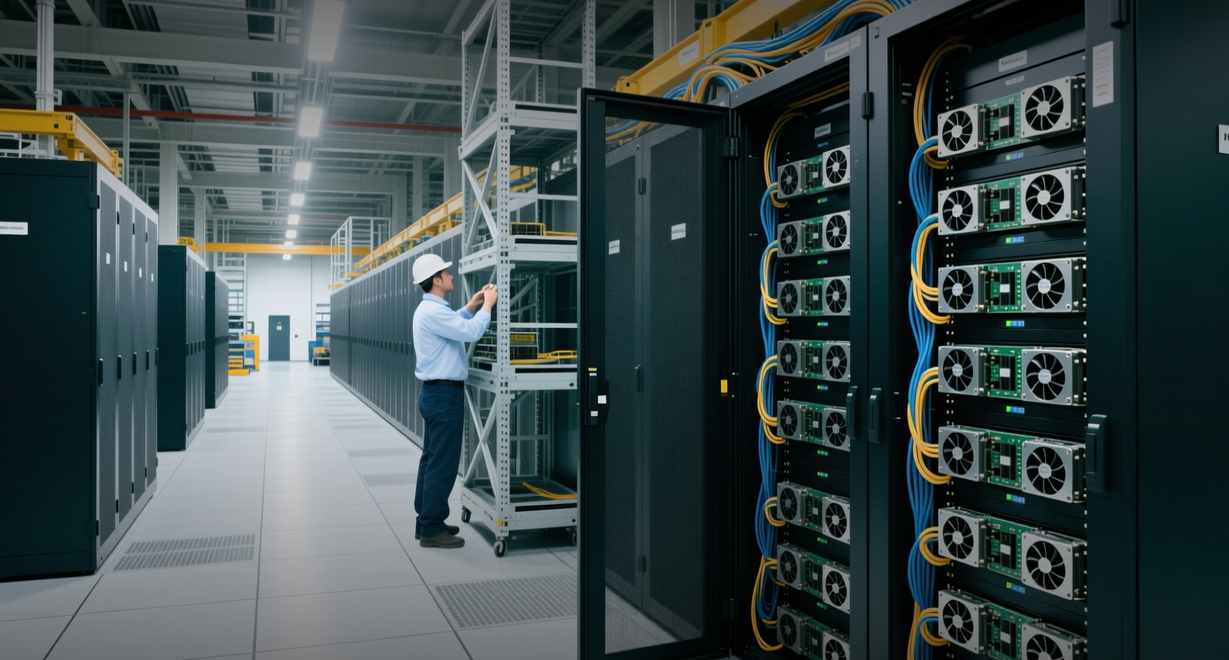
The MI450 ramp is the linchpin of AMD's push to challenge Nvidia's dominance in AI infrastructure. Helios rack-scale systems pair 72 MI455X accelerators with 18 sixth-generation EPYC "Venice" CPUs, connected by AMD Pensando networking and the open ROCm software stack. AMD says Helios delivers up to 30 percent more tokens per dollar than the leading competitive solution, while the MI455X offers 34 times higher token throughput than its MI355X predecessor. The MI430X, aimed at high-performance computing and sovereign AI, delivers up to 288 TFLOPS of hardware-based FP64 performance.
Rack-scale complexity and the supply chain
Deploying Helios at rack scale adds complexity beyond the availability of GPUs, CPUs and high-bandwidth memory, Hu said. AMD is working with original design manufacturers, supply-chain partners and customers on component availability, manufacturing processes, mechanical systems and software. Supply remains tight across wafers, advanced process nodes, high-bandwidth memory, advanced packaging, substrates and other components, she said.
AMD has increased capital expenditures primarily to build capacity for CPU production, including purchasing equipment and using consignment arrangements. Hu said Taiwan Semiconductor Manufacturing Co. remains AMD's primary wafer supplier for the foreseeable future, with geographic diversification through TSMC's Arizona fab. The Venice server platform is ramping production on TSMC's 2nm process, the first high-performance computing product to enter production on that node.
Matt Ramsay, AMD's corporate vice president of financial strategy and investor relations, said the company's technical engagement with large model-building customers is shaping future Instinct MI500 and MI600 products as well as subsequent rack designs. He said inference has become the majority driver of AI computing demand, with a shift from chatbot applications toward agentic inference creating opportunities for inference silicon and the CPUs that run AI agents.
Server CPUs and the inference opportunity
AMD expects server CPU revenue to expand more than 80 percent year over year in the second half and by more than 70 percent next year, Hu said, with the business remaining supply-constrained. The company raised its 2030 total addressable market forecast for server CPUs to more than $220 billion, from $60 billion projected at its November 2025 financial analyst day, driven largely by agentic AI workloads that require CPUs for data retrieval, workflow execution and orchestration. Ramsay said AMD aims to reach 50 percent of the server CPU dollar market over time.
The inference push extends beyond GPUs. AMD has partnered with Cerebras to deploy Helios systems in Cerebras' cloud alongside its wafer-scale engine racks, and its acquisition of Taalas adds engineering talent and technology for ultra-low-latency inference silicon using chiplets. Ramsay said AMD believes it offers a tokens-per-dollar advantage for large-scale inference in its current generation and plans to expand training capabilities with the MI450 series and future generations.
AMD shares have climbed roughly 116 percent year to date, giving the company a market capitalization near $826 billion, as investors price in the AI infrastructure buildout. The stock trades well above the average analyst price target of $596 set in early August, reflecting how much of the MI450 and Helios opportunity the market has already captured. While AI accelerators remain below AMD's corporate-average gross margin, Hu said their ramp should drive substantial revenue and gross-profit-dollar growth, with stronger server CPU and embedded-business performance helping offset dilution. AMD guided for a 56 percent gross margin in the third quarter and expects quarterly results to vary as MI450 ramps.
This article is for informational purposes only and does not constitute investment advice.