


AMD's Helios rack-scale platform, backed by a 2-gigawatt commitment from Anthropic, is the strongest challenge yet to Nvidia's AI compute dominance.
AMD's Helios rack-scale platform, backed by a 2-gigawatt commitment from Anthropic, is the strongest challenge yet to Nvidia's AI compute dominance.
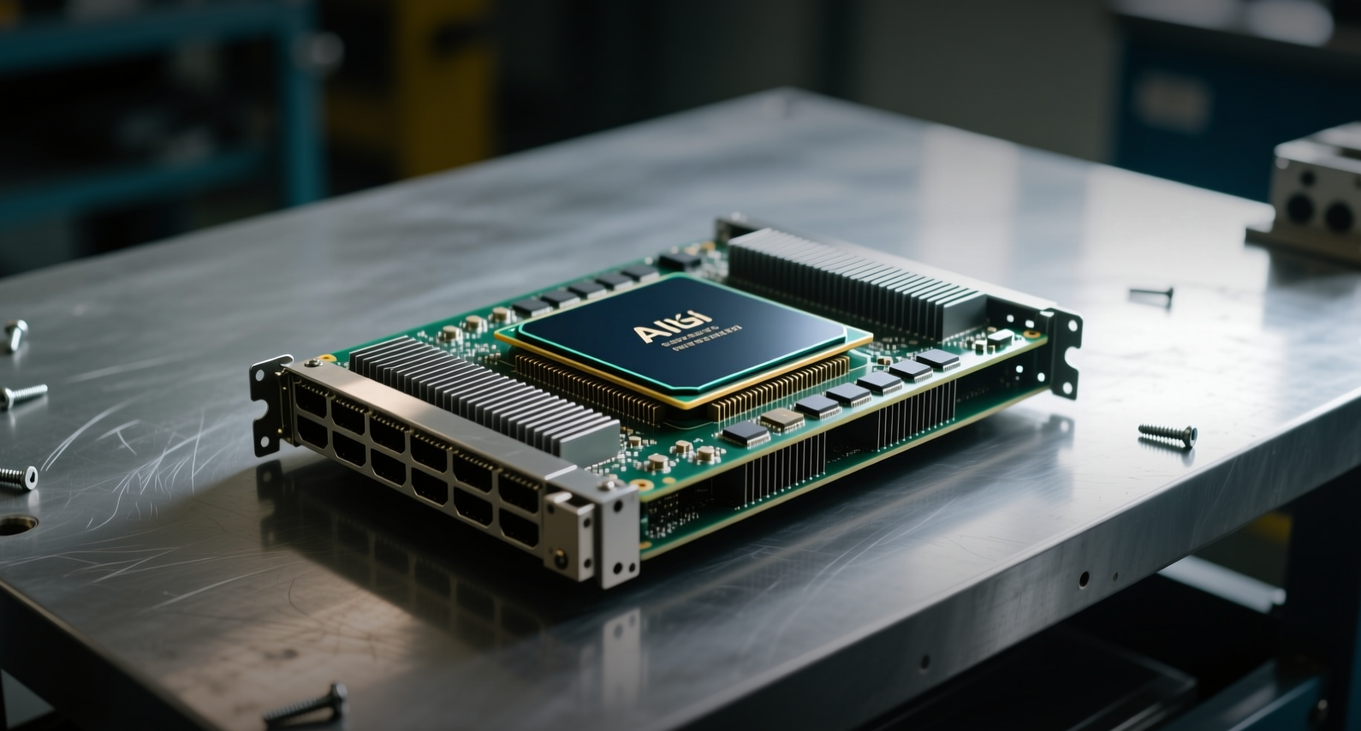
AMD's Helios rack platform, backed by a 2-gigawatt commitment from Anthropic, threatens Nvidia's grip on AI compute as both chipmakers post record quarters that reveal a widening gap in scale.
"Customer pull is very strong and tracking ahead of our initial forecasts," Lisa Su, chief executive of AMD, said of Helios on the earnings call. Jensen Huang, Nvidia's chief executive, told investors the company sees $1 trillion in Blackwell and Rubin revenue from 2025 through calendar 2027.
AMD posted record revenue of $11.54 billion, with Data Center up 107 percent year over year to $6.72 billion — now 58 percent of total revenue. EPYC server chips grew more than 70 percent, and Instinct accelerators more than doubled. Nvidia's data center revenue reached $75 billion, up 92 percent, with networking nearly tripling. AMD's non-GAAP gross margin was 56 percent versus Nvidia's 75 percent.
AMD trades at 68 times forward earnings after a 180 percent run, pricing in a flawless MI450 ramp. Nvidia, at 24 times non-GAAP earnings with 65 percent operating margins, offers a cheaper entry into the same AI buildout. Nvidia reports fiscal second-quarter results on Aug. 26, with Wall Street expecting $92 billion in sales and $2.08 in earnings per share.
Helios vs. Vera Rubin: Two Different Zip Codes
Helios layers 72 MI455X accelerators with EPYC Venice CPUs and Pensando networking, making AMD a credible second source for gigawatt-scale AI compute. AMD claims Helios could deliver up to 30 percent more inference tokens per dollar compared to Nvidia's Vera Rubin NVL72 on a selected workload. Anthropic committed to up to two gigawatts of MI450 series GPUs in Helios, with the first gigawatt starting in 2027. OpenAI expects to bring Helios online in late 2026, and Meta plans large-scale AMD deployments.
Nvidia operates at a different altitude. Huang said the company is "growing share in inference very, very quickly," and Blackwell is shipping into every major hyperscaler. The company refreshed its buyback program by $80 billion and raised its dividend to 25 cents per share.
The Software Moat and the Custom-Chip Threat
AMD's Rackham software now runs more than 3 million models out of the box, with open-source contributions up more than tenfold over the past year. That is real progress against CUDA, though not parity. Bloomberg Intelligence forecasts Nvidia will retain at least 70 percent of AI training despite the competition.
The bigger threat may come from Nvidia's own customers. Google's TPU 8i reportedly offers 80 percent better performance per dollar than its predecessor, while Amazon's Trainium3 could deliver up to 4.4 times Trainium2's performance. Broadcom is enabling hyperscalers to build purpose-designed accelerators, and OpenAI recently showed off its Broadcom-developed inference chip.
Startups add another dynamic. Etched, an AI-chip startup valued at $21 billion after a $700 million raise, took just 44 days to get its chips running inference workloads. Michael Burry called Etched "serious competition for NVDA," noting that 15 percent of its workforce came from Nvidia.
For AMD, the question is whether Helios can convert design wins into sustained revenue growth at scale. The 68 times forward multiple leaves little room for execution missteps. For Nvidia, the Aug. 26 earnings report will test whether the $1 trillion pipeline translates into guidance that justifies the current valuation. Even modest share losses on aggressive pricing would matter for a stock trading at 24 times non-GAAP earnings.
This article is for informational purposes only and does not constitute investment advice.
