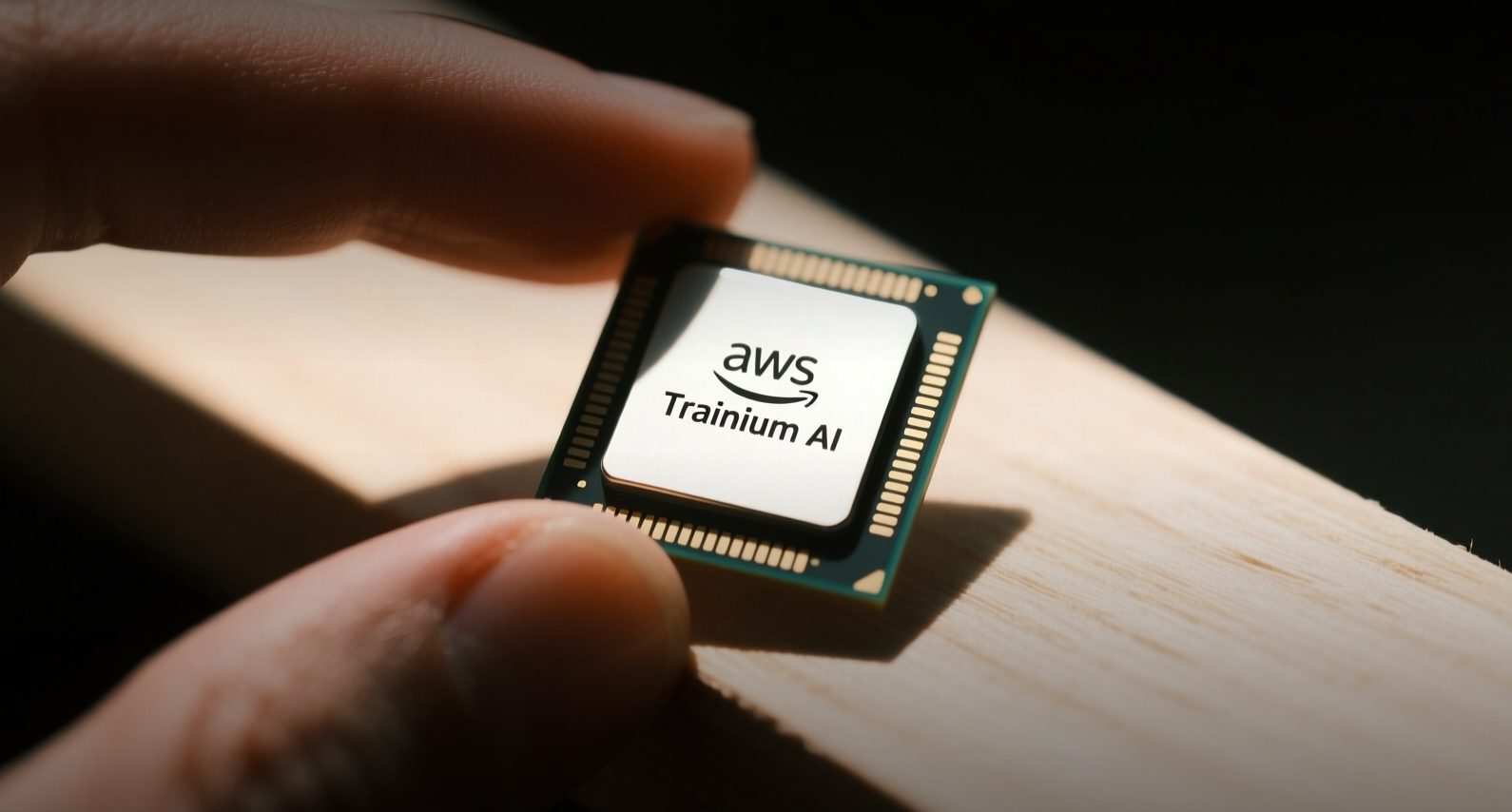
Amazon is betting on AI systems that simulate physics, not text — and using the deal to challenge Nvidia's chip dominance.
Amazon joined a $310 million funding round for Odyssey, a startup building AI "world models" that simulate physics and 3D environments, as the tech giant pushes its Trainium chips beyond language-based AI workloads.
"This round provides the compute, infrastructure, and partners to push the frontier of general world models, and to achieve a GPT-3 moment for the field," Oliver Cameron, co-founder and chief executive of Odyssey, said.
The Series B, led by Natural Capital at a $1.45 billion valuation, included AMD Ventures, Google's GV, EQT and the CIA-linked fund In-Q-Tel. Nvidia's venture arm backed Odyssey's Series A four months ago but sat out this round. As part of the deal, Amazon Web Services becomes Odyssey's preferred cloud provider, supplying its Trainium chips — a direct competitor to Nvidia's dominant GPUs.
The investment signals that the most compute-intensive frontier of AI — simulating the physical world for robotics, defense and gaming — is becoming a battleground for chip suppliers. Amazon has committed as much as $83 billion to AI companies including Anthropic and OpenAI, and Chief Executive Andy Jassy has said the company holds $225 billion in outstanding Trainium contracts.
Why Amazon's chips, not Nvidia's
Odyssey's decision to adopt Trainium reflects a broader shift as AI buyers hunt for alternatives to Nvidia, which controls an estimated 80 percent of the AI chip market. The startup achieved 80 percent model flop utilization on Trainium3 — roughly double the industry average of 40 to 50 percent — meaning it extracts nearly twice the useful compute per dollar, according to Amazon.
Ron Diamant, vice president and distinguished engineer overseeing Trainium at Amazon, said Odyssey's team optimized their world model on the chip with minimal support from Amazon. "They just went ahead and did it," he said.
The partnership is not exclusive. Odyssey's models also run on Nvidia's H200 and B200 chips, with usage costs of $2 to $4 per hour per person, according to Cameron. But the presence of AMD Ventures and In-Q-Tel alongside Amazon in the round reads as a vote of no confidence in Nvidia's pricing and supply terms.
A crowded race to simulate reality
Odyssey was founded in late 2023 by Cameron, a former Cruise and Voyage executive, and Jeff Hawke, a founding engineer at self-driving firm Wayve. Its roughly 55 staff, spread across Palo Alto, London and Zurich, include alumni of DeepMind, Tesla, Waymo and Apple.
The company's world models are trained on physics and cause-and-effect rather than text, allowing them to simulate persistent 3D environments. A robotics company could run thousands of training scenarios inside Odyssey's simulation instead of on a real factory floor. Recent projects include Odyssey-2 Max for physics simulation and Agora-1, which lets multiple agents act in one shared world.
The field is drawing enormous capital. Runway reached a $5.3 billion valuation after a $315 million round in February. Fei-Fei Li's World Labs raised $230 million. Yann LeCun's new lab is reportedly raising at a 3 billion euro valuation before shipping a product. The presence of In-Q-Tel, and Odyssey's own mention of defense as a target use, underscores that whoever can convincingly simulate the physical world will have customers beyond gaming and robotics.
For investors, the question is whether world models can deliver a commercial breakthrough comparable to GPT-3's 2020 debut, which triggered the current AI boom. Odyssey's $1.45 billion valuation — with roughly $27 million raised before this round and 55 employees — reflects a bet on technology that has yet to prove it generates revenue at scale. Amazon, meanwhile, gains a high-profile reference customer for Trainium at a moment when every chip buyer is evaluating alternatives to Nvidia.
This article is for informational purposes only and does not constitute investment advice.