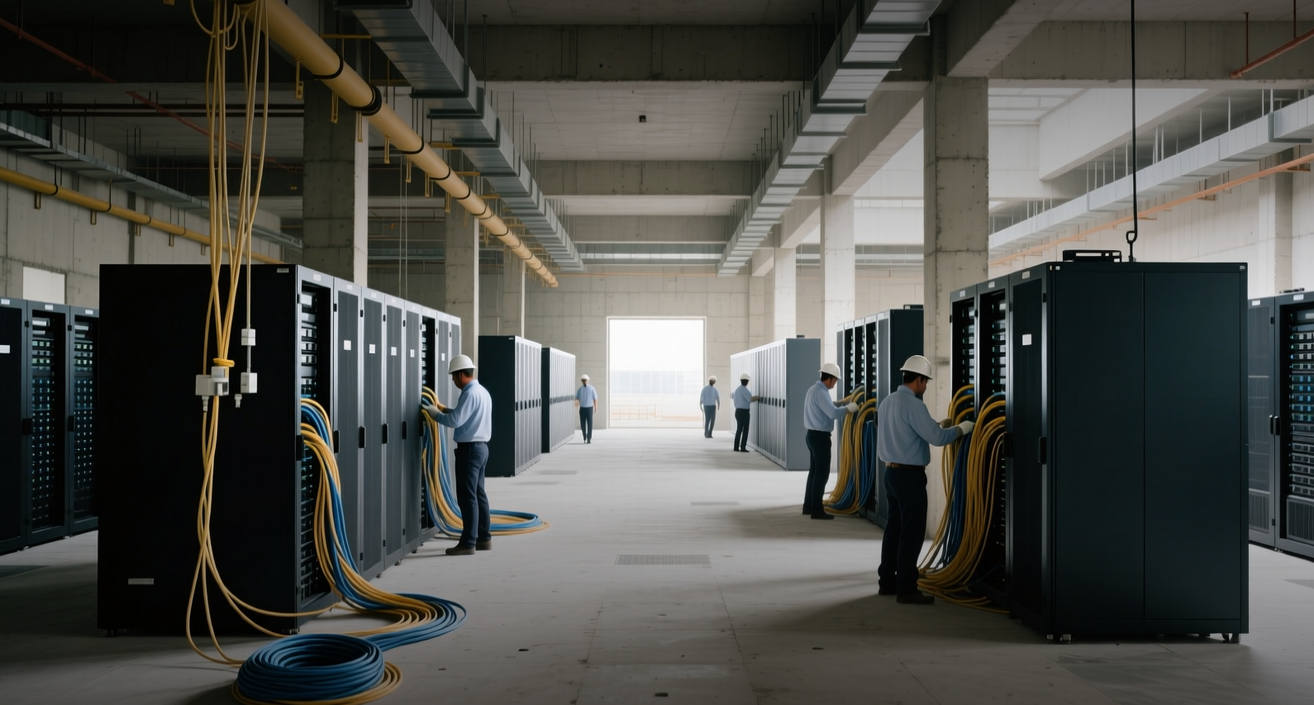
Global spending on AI infrastructure is set to reach $1.2 trillion next year, according to UBS, as hyperscalers and enterprises pour capital into data centers and computing capacity — a buildout that Google Cloud and Accenture are now trying to monetize by stationing AI engineers directly inside client operations.
The two companies launched a joint unit that will embed AI specialists on-site at enterprise customers, pairing Google Cloud's Vertex AI platform and Gemini models with Accenture's systems-integration workforce. The move targets the widening gap between infrastructure investment and actual deployment, where many large organizations have bought compute capacity but lack the engineering talent to turn it into working applications.
"Cloud providers are no longer competing on raw capacity alone — the differentiator is whether customers can actually ship AI products," said Adrian Zuercher, head of asset allocation for Asia at the UBS Global Wealth Management chief investment office. "The market is shifting from investment scale to commercialization outcomes."
UBS's revised estimate of $1.2 trillion in global AI capital expenditure for next year reflects sustained demand from major technology companies expanding data centers and computing infrastructure. The bank noted that cloud service providers' second-quarter revenue grew an average of 48 percent year over year, with growth potentially accelerating to 58 percent this quarter. Corporate earnings momentum has also broadened beyond technology into industrial, financial, and consumer segments, according to UBS.
The capex cycle is rippling through the hardware supply chain. Taiwan, which produces the bulk of the world's GPU modules and AI servers, saw exports surge 44.7 percent year over year in the first seven months of this year, with shipments to the United States climbing more than 60 percent. UBS raised its 2026 growth forecast for Taiwan's economy to 11 percent, well above market consensus, and projects 4.3 percent growth next year.
A structural shift is underway in where that spending lands. For the first time since the AI boom began, the combined contribution of ten markets outside the United States — including Singapore, India, Vietnam, Australia, and Japan — to Taiwan's export growth has caught up with and slightly exceeded that of the U.S., according to customs data cited by UBS. International cloud providers have launched regions in Hyderabad, India, and Jakarta, Indonesia, while Australia has drawn plans for A$25 billion in AI infrastructure investment.
For Google Cloud and Accenture, the on-site deployment unit is a bet that the next phase of the AI cycle rewards whoever can convert infrastructure into revenue. Google Cloud has trailed Amazon Web Services and Microsoft Azure in market share, and embedding engineers at clients is a direct attempt to lock in enterprise workloads before rivals deepen their own services relationships. Accenture, which has spent heavily on AI acquisitions, brings the delivery bench that Google lacks.
The stakes for investors are concentrated in who captures the services layer on top of the capex boom. Alphabet trades at a discount to its mega-cap peers despite Google Cloud's accelerating growth, while Accenture's valuation hinges on whether AI services can offset slowing traditional consulting demand. UBS recommends diversified equity exposure across the AI value chain rather than single-name concentration, paired with two-to-five-year high-quality bonds to lock in current yields.
The bank's base case holds the Federal Reserve steady on rates this year as U.S. inflation cools, a backdrop that keeps capital flowing toward long-duration AI projects. Whether the trillion-dollar buildout sustains itself now depends less on how much hyperscalers spend and more on whether enterprises can turn that infrastructure into measurable returns.
This article is for informational purposes only and does not constitute investment advice.