
**A 200-pound bipedal robot that can share factory floor space with human workers without a fence is the engineering bet behind the first US-listed pure-play humanoid robotics company.
**A 200-pound bipedal robot that can share factory floor space with human workers without a fence is the engineering bet behind the first US-listed pure-play humanoid robotics company.
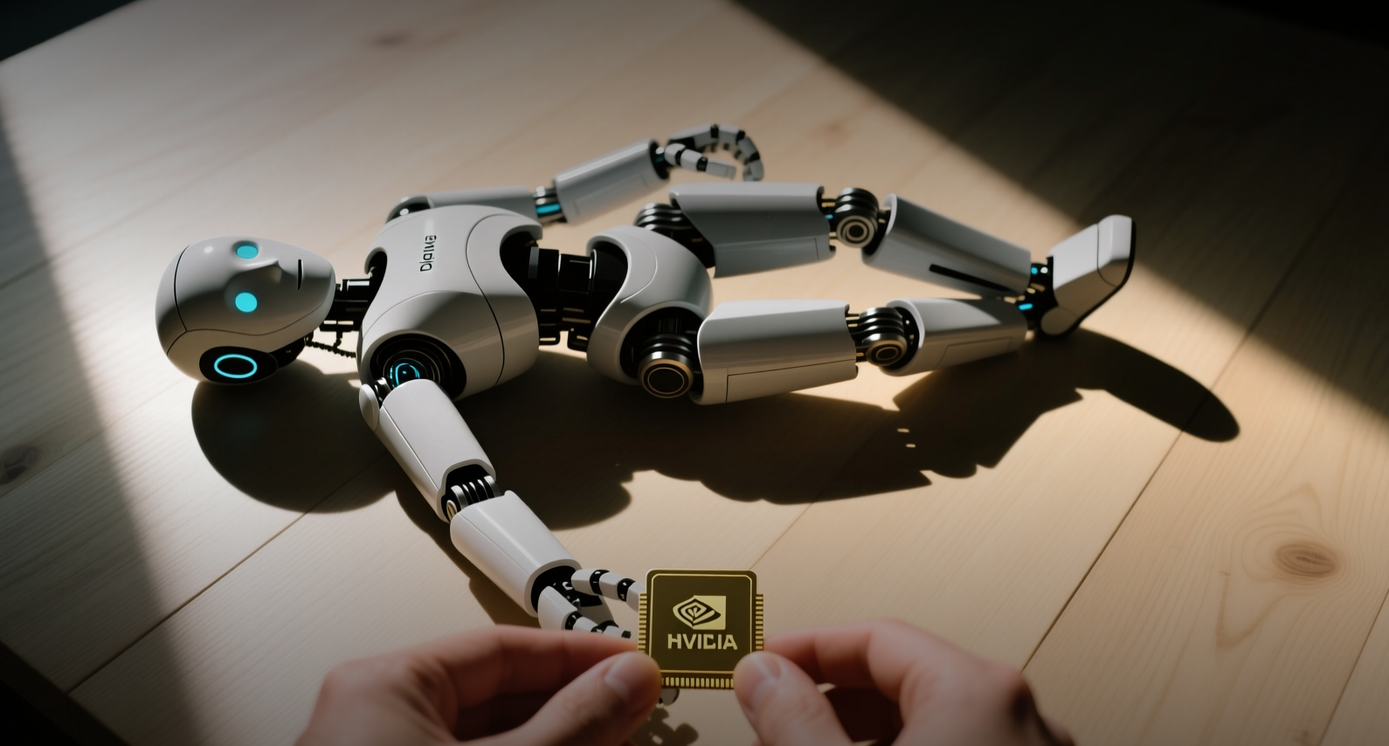
A 200-pound bipedal robot that can share factory floor space with human workers without a fence is the engineering bet behind the first US-listed pure-play humanoid robotics company.
Agility Robotics, the Oregon-based maker of the Digit humanoid, plans to go public through a merger with Churchill Capital Corp XI that values the combined company at $2.5 billion and will raise more than $620 million in gross proceeds. The deal, announced June 24, will list on Nasdaq under the ticker AGLT once shareholder and regulatory approvals clear, expected before year-end.
"The safety brain and the functional brain need to talk to each other often and with much higher context," Amit Goel, senior director of robotics and edge-AI ecosystem at Nvidia, said. "We built that operating-system layer and the software stack so that you can run these two things together."
Nvidia's Halos for Robotics, announced June 22 at the Automate 2026 trade show in Chicago, is the architecture that makes the Digit v5 commercially viable beyond the fenced workcells that constrained prior generations. Built on more than 18,600 engineering years of autonomous vehicle safety development, Halos spans four layers: Nvidia IGX Thor compute hardware delivering up to 2,070 FP4 teraflops, Holoscan sensor connectivity, Halos OS safety software with an external-camera perception layer, and a third-party certification pathway against ISO/IEC TR 5469. Agility is Nvidia's inaugural partner for the system.
The commercial stakes are large. Morgan Stanley researchers project one billion humanoids will be deployed globally by 2050, with a total addressable market of $7.5 trillion. Agility's Digit has already logged more than 65,000 hours of operational use across nine customer sites including Schaeffler, GXO Logistics, Mercado Libre, and Toyota Motor Manufacturing Canada, which signed a Robots-as-a-Service agreement in February 2026 for seven units at its Woodstock, Ontario plant.
The $300 million order book and what it actually means
The headline figure that has driven investor interest — $300 million in committed multi-year orders for Digit v5 — requires careful reading. According to the SEC filing, the figure is not recognized revenue, depends on Agility meeting contractual milestones, and derives primarily from a single three-year contract for 1,000 robots with an undisclosed customer. Agility's trailing annual revenue stands at approximately $37.2 million, and the company consumed roughly $100 million in cash during 2025, placing the pre-money valuation at a price-to-revenue multiple above 33 times.
The $200 million PIPE component of the transaction, priced at $10 per share and led by Foxconn, includes participation from existing investors Nvidia, Amazon, and SoftBank Vision Fund 2, all of whom rolled their equity into the public entity rather than taking cash. The 180-day lock-up from close signals alignment among early backers. Post-merger, the combined company will have approximately 325.7 million total shares outstanding, with warrants at an $11.50 strike price representing additional future dilution.
CCXI shares, the SPAC vehicle currently trading on Nasdaq, have risen roughly 91% since early April 2026, reflecting what analysts describe as a scarcity premium. Figure AI carries a private valuation of about $39 billion but remains inaccessible to retail investors. Boston Dynamics is absorbed inside Hyundai's balance sheet. Tesla's Optimus project is a fraction of Tesla's overall business. AGLT, when it lists, will be the only US ticker whose entire business is humanoid robots.
Why safety certification is the gatekeeper to mass deployment
The engineering transition from workcell-enclosed operation to what Agility and Nvidia call cooperative safety is the commercial linchpin of the listing. Prior Digit generations required physical barriers separating robots from workers, limiting deployment to facilities redesigned around the robots. Digit v5, using Nvidia Halos, is designed to operate in any facility built for human workers.
The technical approach relies on sim-to-real transfer, in which Digit's whole-body control system — an LSTM-based neural network with fewer than one million parameters — is trained in Nvidia's Isaac Sim physics simulator for the equivalent of decades of real-world experience in three to four days of compute time. The trained policy transfers zero-shot to physical hardware, eliminating months of on-site calibration.
Safety concerns are not theoretical. Viral videos have shown a humanoid robot dancing uncontrollably at a restaurant and another kicking a child during a performance in China. Michele Silva, a functional safety expert at Reynolds & Moore, told the Wall Street Journal that a 200-pound bipedal robot losing power "can fall over and crush you." An expert panel at the International Organization for Standardization is working on safety guidelines for humanoid robots, with a new international standard expected by mid-2028.
Agility's manufacturing footprint to meet demand is RoboFab, a 70,000-square-foot factory in Salem, Oregon designed to produce up to 10,000 units annually once fully ramped. The company sources approximately 75% of Digit's components within the United States. The pipeline of more than 30 potential customers evaluating large-scale deployment through Agility's Customer Acceleration Program represents the next layer of contracted orders beyond the initial backlog.
Competitive landscape and what comes next
Agility is not alone in seeking public-market capital for humanoid robotics. China's Unitree Robotics, the global volume leader with more than 5,500 units shipped in 2025, filed for a listing on Shanghai's STAR Market in March 2026 seeking to raise approximately $608 million. China's Agibot is pursuing a Hong Kong IPO at a reported valuation of $5.1 billion to $6.4 billion. EngineAI has confidentially filed for a Hong Kong listing as well.
What Agility offers that Chinese competitors cannot is unrestricted access for US investors without currency controls, regulatory approval barriers, or the national security concerns that have led US government agencies to flag Chinese-origin robotics hardware for procurement restrictions. For institutional and retail capital specifically seeking domestic humanoid exposure, AGLT is structurally the only candidate.
The merger remains subject to Churchill XI shareholder approval, SEC review of the Form S-4 registration statement, and standard regulatory clearances. The S-4 will include Agility's full audited financial disclosures, converting the company from a SPAC announcement with summary metrics into a public entity with quarterly reporting obligations. Digit v5's commercial launch is also scheduled for 2026, pending the Nvidia Halos certification process.
For investors, the math is straightforward but unproven. At a 33x price-to-revenue multiple on $37.2 million in trailing revenue, the market is pricing in commercial execution that has not yet been delivered. The $300 million order backlog must convert to revenue on schedule, cooperative safety certification must pass third-party inspection, and RoboFab must scale production fast enough to fulfill the 1,000-robot contract. If those conditions hold, AGLT offers the first direct equity exposure to a sector Morgan Stanley sees reaching $7.5 trillion by 2050. If they do not, the scarcity premium that has driven CCXI shares 91% higher since April could unwind as quickly as it built.
This article is for informational purposes only and does not constitute investment advice.
