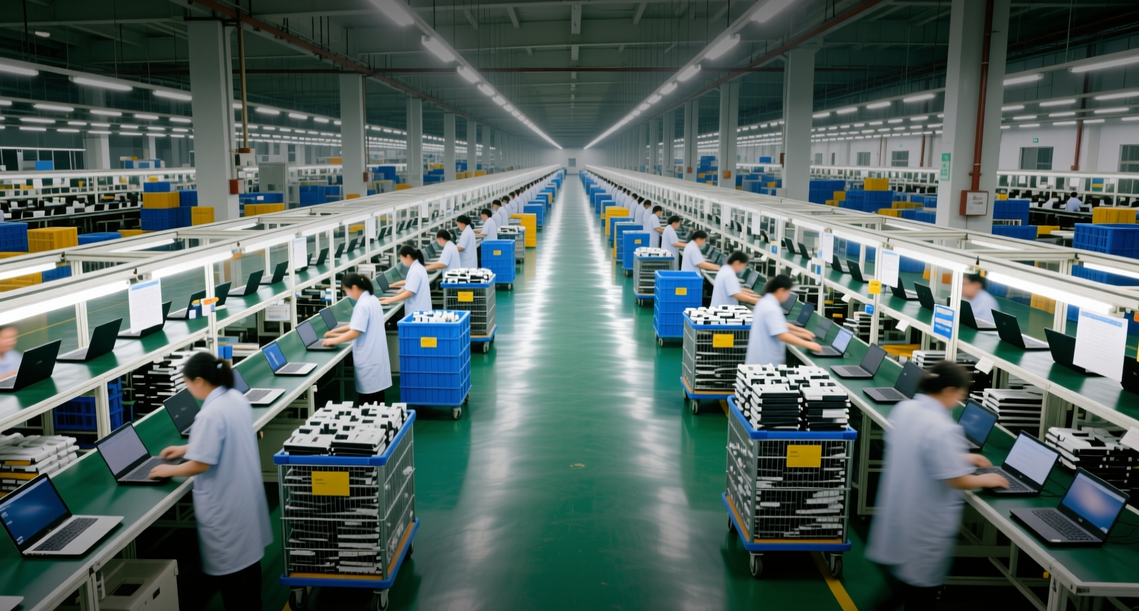
Three of the world's largest laptop brands are reversing years of Southeast Asia manufacturing investment because the math no longer works.
HP, ASUS, and Acer are moving laptop production back to China from Thailand and Vietnam, where a $9 per-unit cost disadvantage erases the entire gross margin on entry-level models, supply chain sources told Digitimes.
"The cost gap remains too wide and the impact of substitute tariffs has proved limited," supply chain sources told the Taiwan-based trade publication, explaining why the relocation logic has collapsed.
Brand manufacturers average gross margins of 3 percent to 10 percent per laptop. On a $300 entry-level model at 3 percent margin, gross profit is exactly $9 — meaning Southeast Asian production consumes the entire margin. With shipment volumes in the millions, the differential becomes a multi-million-dollar annual drag. The supply chain in Southeast Asia "clearly has not yet taken shape," according to the sources, with insufficient component localization and persistently high logistics and labor costs compared with China's mature industrial clusters.
The reversal hits Taiwan's ODM ecosystem directly. Quanta and Inventec's Thailand plants, plus Pegatron and Wistron's Vietnam facilities, face production migration pressure as clients rebalance. The shift signals a broader reassessment of tariff-driven supply chain diversification, with implications for China's manufacturing sector and Southeast Asian industrial policy.
Tariff logic collapses after Supreme Court ruling
The original migration to Southeast Asia was driven by Trump-era tariffs. But the US Supreme Court ruled Trump's reciprocal tariffs unconstitutional, and while the administration threatened replacement measures, supply chain sources said the follow-up impact falls far short of the original regime. With the tariff threat downgraded, brands recalculated the China-versus-Southeast Asia cost equation and found the gap impossible to justify.
The tariff calculus was the original reason brands moved production in the first place. When the legal foundation for those tariffs was removed, the cost-benefit analysis flipped. China's laptop manufacturing ecosystem — spanning component suppliers, assembly lines, and logistics networks — remains the most cost-efficient in the world, and the $9 per-unit gap reflects that structural advantage.
Who stays, who returns
Lenovo, Dell, and Apple are notable exceptions. Lenovo's cautious approach to capacity diversification means less to reverse. Dell's heavy exposure to US government procurement keeps it anchored to its current footprint. Apple operates on a different calculus — premium pricing provides margin cushion, supply chain automation reduces relocation costs, and its original MacBook exit from Shanghai was driven by COVID-era single-site risk, not cost. That logic remains unchanged, and its Vietnam plans proceed.
For investors, the shift benefits China-based manufacturing supply chains and could improve ODM margins as production consolidates in lower-cost clusters. Taiwan's ODM firms face a mixed picture: lower production costs in China could support margins, but idle Southeast Asian capacity represents stranded capital. The durability of this reversal depends on whether future US tariff policy returns to the aggressive posture that triggered the original exodus.
This article is for informational purposes only and does not constitute investment advice.