
Canada's retaliatory tariffs on $20 billion of U.S. imports took effect Tuesday, sending Dow futures down 308 points as the trade escalation compounds oil-driven inflation pressure ahead of next week's Federal Reserve decision.
Canada's retaliatory tariffs on $20 billion of U.S. imports took effect Tuesday, sending Dow futures down 308 points as the trade escalation compounds oil-driven inflation pressure ahead of next week's Federal Reserve decision.
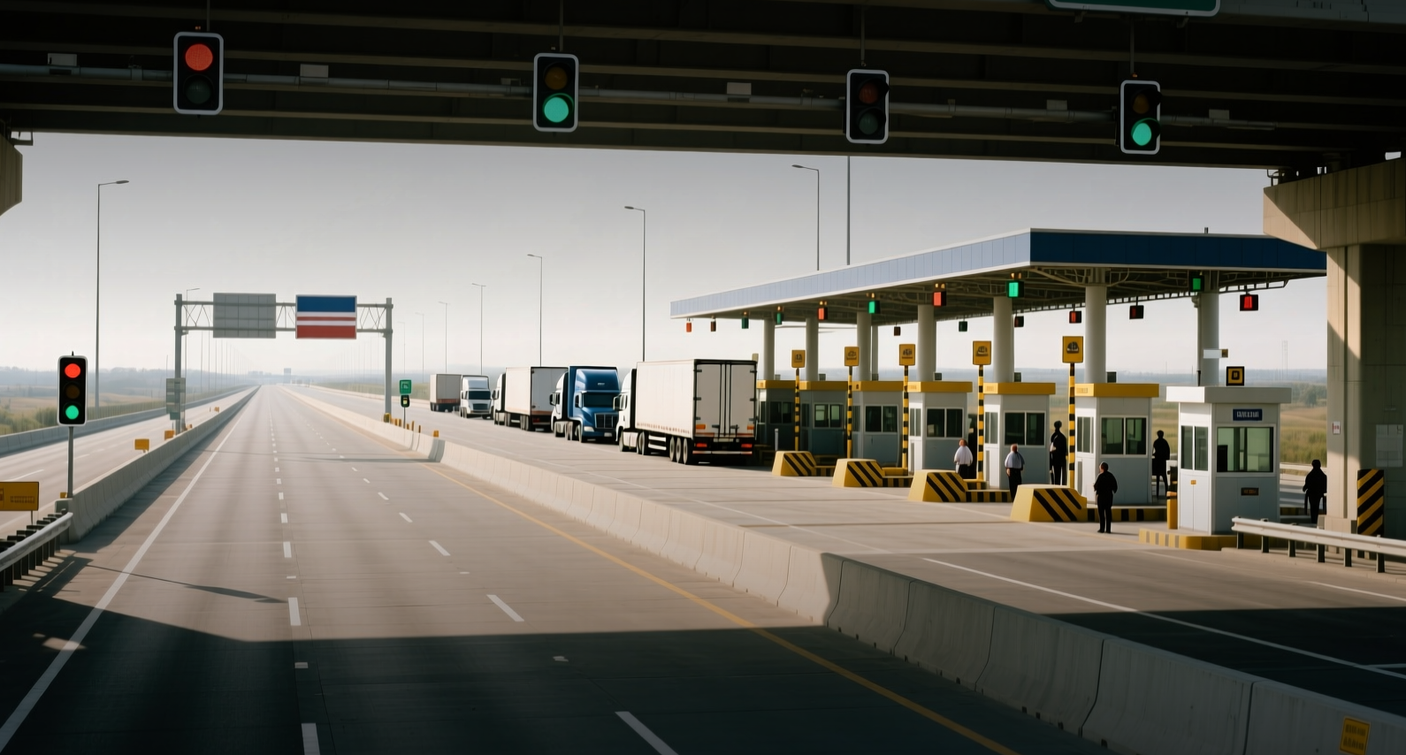
Dow Jones Industrial Average futures slid 308 points at the open of a holiday-shortened week Tuesday as Canada's retaliatory duties on U.S. goods took effect, layering a second trade front onto an energy-driven inflation scare ahead of the Federal Reserve's policy meeting. The levies, spanning 15 percent to 50 percent across three tiers on roughly $20 billion of imports, mirror Washington's own duties on Canadian machinery, textiles, and consumer products.
"Canada will match Washington's new tariffs dollar for dollar in order to protect Canadian workers, farmers, families, and businesses," Prime Minister Mark Carney told reporters in late August, before the measures took effect at 12:01 a.m. Eastern time Tuesday.
The cross-asset fallout was immediate. S&P 500 futures slipped 0.2 percent while the tech-heavy Nasdaq 100 futures bucked the trend, rising 0.1 percent, as investors rotated toward technology names. The tariff news landed on a week already braced for volatility: Brent crude climbed 1.1 percent to $97.31 a barrel and West Texas Intermediate rose 1.3 percent to $92.66, both six-week highs, after weekend exchanges between the U.S. and Iran. The 10-year Treasury yield touched 4.812 percent intraday last week, its highest since November 2023, while the rate-sensitive 2-year yield reached 4.425 percent, a level not seen since January 2025.
The stakes for equities are concentrated in the coming days. The Fed meets next week, with CME Group's FedWatch tool pricing a 60 percent probability of a quarter-point hike, a bet that could shift sharply when the Producer Price Index lands Thursday and the Consumer Price Index Friday. Strong nonfarm payrolls last Friday had already hardened rate-hike expectations, and every additional tick in crude adjusts market inflation forecasts upward. "A series of central bank meetings in the coming weeks will test whether the market's resilience can be sustained," said Ed Yardeni, president of Yardeni Research. "Global bond yields are also rising. The question is whether this reflects better-than-expected economic growth, higher-than-expected inflation, or an imminent fiscal debt crisis."
The tariff escalation carries its own escalation risk. President Donald Trump singled out Canadian aircraft maker Bombardier on his Truth Social platform Monday, writing "No more Bombardier sales in the United States!" unless the company shifts production to the U.S. — a threat he has made before without administrative follow-through, yet one that signals the dispute is unlikely to cool. The steel and aluminum duties were raised to 50 percent from 25 percent in response to earlier U.S. tariffs, and the affected list spans dairy, home appliances, electronics, and agricultural machinery.
The last comparable escalation came when the U.S. first imposed duties on Canadian steel and aluminum, a round that compressed bilateral trade flows and rippled through export-oriented sectors on both sides of the border. This time the transmission is broader because it coincides with an energy shock. George Saravelos, global head of FX research at Deutsche Bank, noted that overseas investors now prefer U.S. equities over U.S. Treasuries — a "historic shift" not seen since the global financial crisis — which, if sustained, raises the cost of U.S. government borrowing and pushes long-end yields higher.
Asian markets offered an early gauge of the mood. South Korea's KOSPI opened up 0.72 percent at 7,045.79 before foreign and institutional selling narrowed gains, while Japan's Nikkei 225 pulled back more than 500 points as the yen strengthened to ¥153.53 per dollar, its strongest in about seven months, fueling Bank of Japan rate-hike expectations. Taiwan's TAIEX fell 155.31 points, or 0.33 percent, and Australia's S&P/ASX 200 dropped 0.63 percent.
If oil stays elevated, it pushes inflation expectations up, which strengthens the case for a Fed hike, which lifts Treasury yields and compresses equity valuations — a self-reinforcing loop that leaves little room for error. Whether markets find equilibrium before the Fed's decision next week will determine the depth and duration of this round of volatility, with the tariff trajectory and Thursday's and Friday's inflation prints the two variables most likely to break the cycle.
This article is for informational purposes only and does not constitute investment advice.
