

Apple's new desktop lineup pushes local AI processing with the first 2nm chip and a quad-die M5 Ultra.
Apple's new desktop lineup pushes local AI processing with the first 2nm chip and a quad-die M5 Ultra.
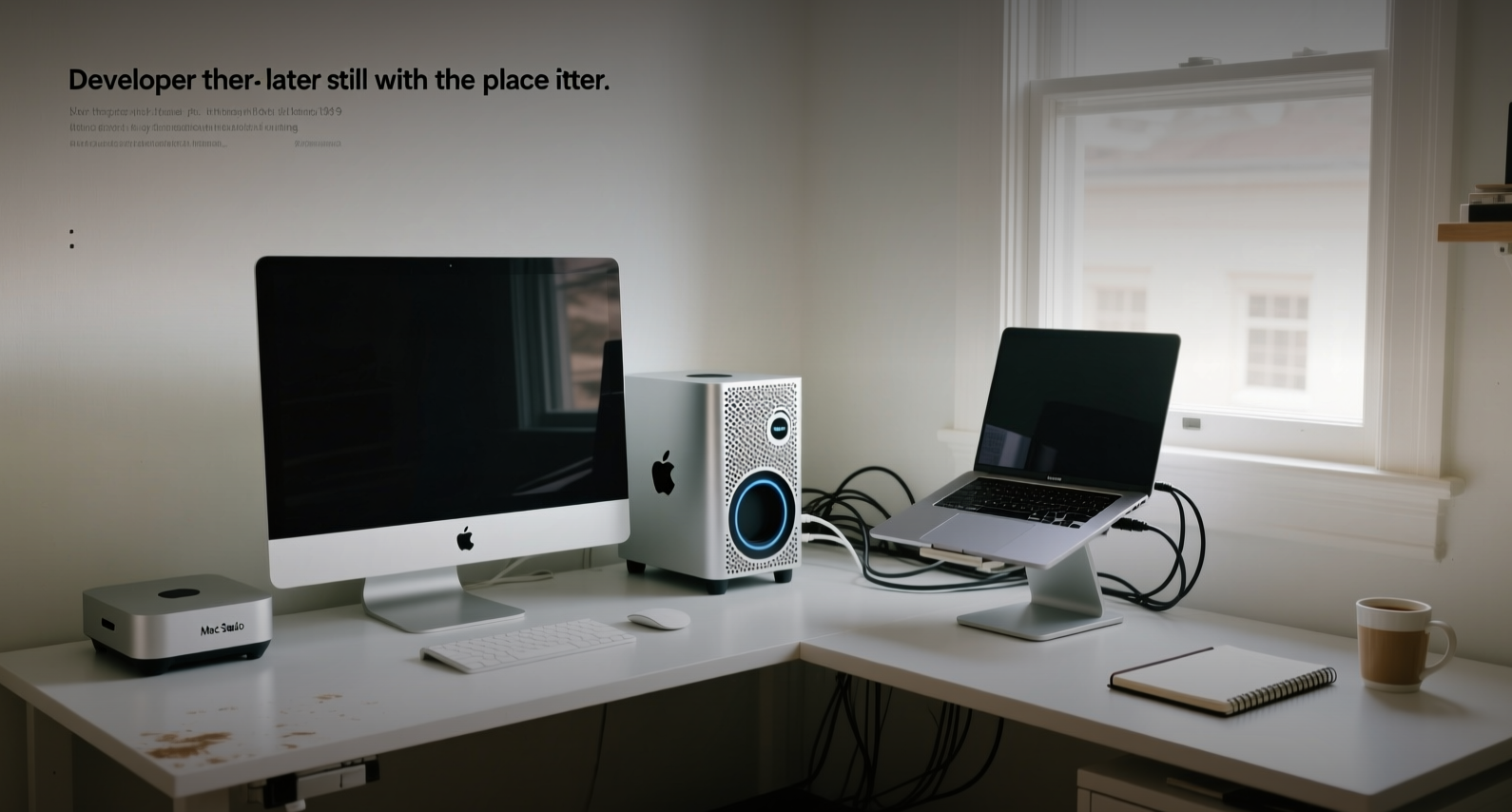
Apple's new Mac mini and Mac Studio put local AI processing at the center of its desktop strategy, with the M6 chip on a 2nm process and the M5 Ultra delivering up to 512GB of unified memory.
Apple's Mac business grew almost 30% last quarter, and the company credits much of that to developers buying desktops to run AI models locally rather than in someone else's cloud, according to a briefing with tbreak ahead of Tuesday's announcement.
The M6 Mac mini starts at $899 with a 12-core CPU, 12-core GPU and dual 16-core Neural Engines, while the M5 Pro version starts at $1,699 with up to 64GB of memory. The Mac Studio moves to M5 Max from $2,499 and the new quad-die M5 Ultra from $5,499, with memory bandwidth up to 1.2TB/s.
The launch positions Apple against Nvidia and Qualcomm in the AI computing race, with the company's $33.7 billion Mac business in 2025 serving as a foothold. Pre-orders opened Tuesday, with shipments starting Sept. 22.
The M6 is Apple's first chip built on a 2nm process, packing a 12-core CPU with two super cores, four performance cores and six efficiency cores. Apple claims multi-threaded performance up to 1.2x the M5 and 2.4x the M1, with the GPU delivering nearly 30% more peak compute for AI than M5 and more than 8x the M1. Unified memory bandwidth rises to 170GB/s, up 10% from M5.
The Mac mini's base configuration pairs the M6 with 16GB of unified memory and a 256GB SSD. Apple frames it as the always-on desk-side box for running agents next to a MacBook, name-checking agentic coding in Xcode and frameworks such as OpenClaw and Codex. The M5 Pro option adds up to an 18-core CPU, 20-core GPU and Thunderbolt 5, with memory configurable to 64GB at 307GB/s.
The Mac Studio's headline is the M5 Ultra, Apple's first quad-die chip. It joins two M5 Max dies through a new UltraFusion interconnect carrying 4.4TB/s between dies, presenting software with a single processor and a single pool of unified memory. The full M5 Ultra has a 36-core CPU and 80-core GPU with Neural Accelerators in every core, delivering up to 4.3x the peak AI compute of the M3 Ultra Mac Studio it replaces.
Apple also introduced clustering support over Thunderbolt 5 and RDMA, letting four Mac Studios pool memory into one shared space. The company positions a four-node cluster as capable of loading frontier-class open-weight models with over a trillion parameters, running off a standard wall outlet with no per-token costs.
Both machines ship with macOS 27, codenamed Golden Gate, which brings the new Siri and a wider set of Apple Intelligence features. On the developer side, Core AI is a new framework for building, running and deploying AI models on Apple silicon, spreading work across CPU, GPU and Neural Engine.
The M6 Mac mini starts at $899 in the US, up from $799 for the M4 model, reflecting the AI-driven memory and storage shortage that has forced Apple to raise prices across its Mac and iPad lines. The M5 Pro mini starts at $1,699, up from $1,599 for the M4 Pro. The Mac Studio M5 Max holds at $2,499, while the M5 Ultra starts at $5,499, up from $5,299 for the M4 Ultra.
The early launch — before Apple's September iPhone event — comes as Nvidia prepares its RTX Spark AI chip and Microsoft pushes its own AI hardware agenda. Apple's explanation for the timing is straightforward: demand. People are waiting for these machines, and the company would rather get them on sale than hold them for a later event.
For investors, the question is whether Apple can sustain the momentum. The Mac business grew nearly 30% last quarter, and the new hardware extends the run. But the memory supply constraints flagged on Apple's last earnings call remain unresolved, and the company offered no assurances beyond saying it will build as many as it can.
This article is for informational purposes only and does not constitute investment advice.
